



Extremismo misto, pouco claro e instável: quando uma categoria não é uma tipologia

 ORCID logo

Recebido: agosto 24, 2026. Aceito: novembro 24, 2026. Publicado: novembro 26, 2026. https://doi.org/10.56296/aip00075 · © 2026 Os autores

Detalhes dos autores

: NZ Police

*Endereçe a correspondência para Che Tibby, [email protected], 180 Molesworth Street, Te Aro, Wellington, 6011

Revisão por pares transparente

Este comentário foi submetido a cinco rodadas de revisão editorial, em conformidade com as políticas da revista para este formato de publicação.

Citação

Tibby, C. (2026). Mixed, unclear, unstable extremism: When a category is not a typology. advances.in/psychology, 1, e339724. https://doi.org/10.56296/aip00075

Tibby, Che. "Mixed, unclear, unstable extremism: When a category is not a typology." advances.in/psychology, vol. 1, no. 1, 2026, e339724. https://doi.org/10.56296/aip00075.

Tibby, Che. 2026. "Mixed, unclear, unstable extremism: When a category is not a typology." advances.in/psychology 1 (1): e339724. https://doi.org/10.56296/aip00075.

Tibby C. Mixed, unclear, unstable extremism: When a category is not a typology. advances.in/psychology. 2026;1(1):e339724. doi:10.56296/aip00075.

Tibby, C. (2026) 'Mixed, unclear, unstable extremism: When a category is not a typology', advances.in/psychology, 1(1), e339724. Available at: https://doi.org/10.56296/aip00075.

Esta é uma tradução gerada por IA do título, do resumo e das principais conclusões; o corpo do artigo permanece em inglês.

Resumo

Contribuindo para o debate recente nesta revista, este artigo descreve o fenómeno do extremismo Misto, Pouco Claro e Instável (Mixed, Unclear, Unstable) na perspetiva de uma agência de aplicação da lei. Apresentando um estudo realizado em 2025, argumento que o fenómeno MUU não representa um tipo de extremismo único ou emergente, constituindo antes uma categoria dinâmica utilizada principalmente na mitigação de ameaças. Não se verificou um motivo partilhado nem um padrão comportamental uniforme no grupo, e mais de 50% saíram da classificação no prazo de doze meses à medida que surgiam novos dados. O rótulo MUU funciona sobretudo como um instrumento administrativo para lidar com pessoas cujas ações exigem a atenção policial, mas que carecem da natureza unificada de uma ameaça extremista violenta ou terrorista. A única constante foi a sua interação com ecossistemas extremistas transnacionais online. Consequentemente, a questão crítica deixa de ser se necessitamos de melhores classificações de terrorismo e passa a ser determinar se as autoridades de contraterrorismo são o mecanismo adequado para lidar com estes indivíduos, bem como examinar de que forma os ambientes digitais estão a influenciar as tendências criminais emergentes.
Editor Curated

Principais conclusões

  • O autor examinou uma coorte de indivíduos classificados pela Polícia da Nova Zelândia como extremistas 'Mistos, Pouco Claros e Instáveis' (MUU), um grupo que tem representado de forma consistente cerca de 20% dos casos de segurança nacional desde a introdução da categoria em 2023. Os processos foram codificados manualmente segundo cinco lentes de risco não ideológicas: solidão, ideação suicida, saúde mental precária, violência familiar e extremismo online.
  • A coorte MUU não constituiu um tipo de extremista reconhecível ou distinto. Para além da ausência de uma causa identificável, os investigadores não encontraram qualquer padrão comportamental comum consistente ou estatisticamente significativo que ligasse os indivíduos, e a categoria não abrangia extremistas multicausa do tipo 'salad bar'; era antes composta por pessoas com motivações singulares e ideação mal definida.
  • A categorização foi fortemente moldada pelos procedimentos policiais e não por uma tipologia: 54% da coorte de 2025 eram Pistas Ativas (Active Leads) e 46% Pessoas de Interesse (Persons of Interest), mas no prazo de um ano cerca de 57% tinham saído do estatuto ativo e apenas 8% passaram de Pista a Pessoa de Interesse. O autor argumenta que a avaliação de ameaças deve ser orientada pelo comportamento e não pela ideação, e que o envolvimento com ecossistemas extremistas transnacionais online foi o elemento comum mais claro entre os casos.
O texto completo continua em inglês

Introduction

Following recent debate in this journal initiated by Horgan and Shayler (2026) in relation to the topic of Mixed, Unclear, Unstable extremism (MUU), a study of MUU individuals in Aotearoa/New Zealand is offered as an example of how the issue is managed by a contemporary law enforcement agency. From the perspective of a practitioner working in a small country, the expositions of the ‘salad bar’ phenomena provided in this journal are a significant and welcome addition to New Zealand’s efforts to understand the ongoing evolution of counter-cultural Siege-style leaderless resistance (Sunshine, 2024) and associated threats such as militant accelerationism or participatory memetic extreme violence (Ondrak & Vitelli, 2025).

Categorisation of Violent Extremism in New Zealand

To assist in understanding the extremist threatscape, New Zealand uses a system of categorisation for violent and recognisably violence-fascinated individuals or groups (CTAG, 2022). Allocation to a category typically reflects a professional judgement that a potentially violent individual is expressing support for, or adherence to ideological, political, or religious extremism.a In such an instance they might be categorised as an ‘identity-motivated violent extremist’, or ‘faith-motivated violent extremist’ as appropriate.

Psychology of Violent ExtremismPart of a Special IssuePsychology of Violent ExtremismThis article belongs to a curated special issue. Discover more research on this topic from the full collection.Explore the special issue →

In agreement with Cassam (2026, pp.4-5), in New Zealand statute the crime of terrorism must be evidentially linked to a ‘cause’, which means that for New Zealand Police the definition of terrorism is not theoretical, and has a specific and statutory meaning. Importantly, serious violence such as school shootings or family annihilation that can reasonably be linked to an individual’s participation in online violent extremist ecosystem, but which lacks a clearly defined cause, cannot be charged as terrorism even where it might have a significant effect on the public’s feelings of safety.

Initiated in recognition of specific reporting to NZ Police, and the growing number of reports of concern about ‘non-ideological’ extreme violence in both greyzone and academic literature, in a 2025 study we unpacked and examined a small cohort of individuals classified as MUU by New Zealand Police staff, and under active investigation in July 2025 (Tibby, 2026). The cohort comprised individuals who were considered either:

  • ‘leads’, primarily made up of individuals reported to Police via non-emergency channels, and who were not yet established as persons of interest, or,
  • ‘persons of interest’, individuals under investigation as a potential threat to national security.

At the time of extraction, this cohort made up over 20% of the total number of individuals under either assessment or investigation by specialist counter-terrorism staff. Approximately 20% of the national security cohort has been categorised as MUU since the implementation of the category in 2023.

Seeking Patterns in the Muu Category

In order to determine if there were specific patterns in the 2025 cohort, it was examined using 5 non-‘cause’ lenses known to adversely affect individuals and create susceptibility to extremism including: loneliness and social isolation; suicidal ideation; poor mental health; exposure to family harm as either bystander, victim or offender; and exposure to or participation in online extremism. The investigative records held on each individual were manually reviewed and coded against these variables by an experienced analyst (Tibby, 2026, pp. 2-3).

The study revealed that in New Zealand the MUU category does not capture a recognisable type of extremist, and aligns with Horgan and Shayler’s (2026, p. 2) statement that MUU is an administrative category that intentionally captures three separate types of individuals: individuals with an evident mixture of causes, no clear cause (the largest subcategory in the New Zealand example), or unstable attachment to any one cause (i.e. who might sometimes rapidly shift from one position to another, or express variable causes and other issues).b

The 2025 study also clearly demonstrated that in the New Zealand context the MUU category was not capturing multi-cause-selecting ‘salad bar’ individuals; the category was populated by a wide range of individuals with unique motivations and poorly defined ideation. On careful examination of the case files the most specific pattern was the absence of association with a cause, and no consistent or common patterns of behaviour that brought each individual to the attention of Police. Put plainly, the New Zealand MUU cohort provided no contribution to understanding typologies in violent extremism. Instead, the cohort closely conformed to the findings of Gill (2026), Horgan (2024), and others (Colvin & Campion, 2026; Gøtzsche-Astrup, 2018; Marchment et al., 2025; Mohamed Ali et al., 2017), where the only commonality among different extremists is often the absence of generalisable patterns or pathways in radicalisation.

Processes Strongly Affect Categorisation in New Zealand

The study also provides a very specific retort to Perliger (2026, p.2), who correctly notes the preference for behavioural assessment among practitioners. For New Zealand, the absence of cause-oriented ideation among national security threats does not require greater understanding of administrative typology, or the need for greater or better training of analysts. Supporting McCauley’s (2026) assertion that cognition is not a crime, ideation is not a crime in New Zealand statute. The observation of a possible violent cause is however a triage trigger (i.e. ensuring that the individual or group in question is investigated by an appropriately specialised member of staff). Behavioural assessment is therefore critical, because reasoned identification and prevention of possible violence and harm is a key plank of our mission statement, and carries greater importance than regulation of opinion, however extreme the opinion may be.

While the proportion of cases categorised as MUU in New Zealand has remained constant since 2023, this consistency masks that at least some allocation to the category is informed by processes within Police. When an analyst or investigator is presented with an individual who does not readily conform to any of the ‘traditional’ causes, they are provisionally placed in the ‘Unclear’ category, and can cycle out into another category as further information is uncovered. It is uncertain whether this also occurs in places that use a similar set of categories, but this New Zealand practice demonstrates that Horgan and Shayler are once again correct – MUU does not represent a discrete typology. It is instead an operational portmanteau used to encompass a range of individuals with potentially concerning behaviours and possible attachment to a cause.

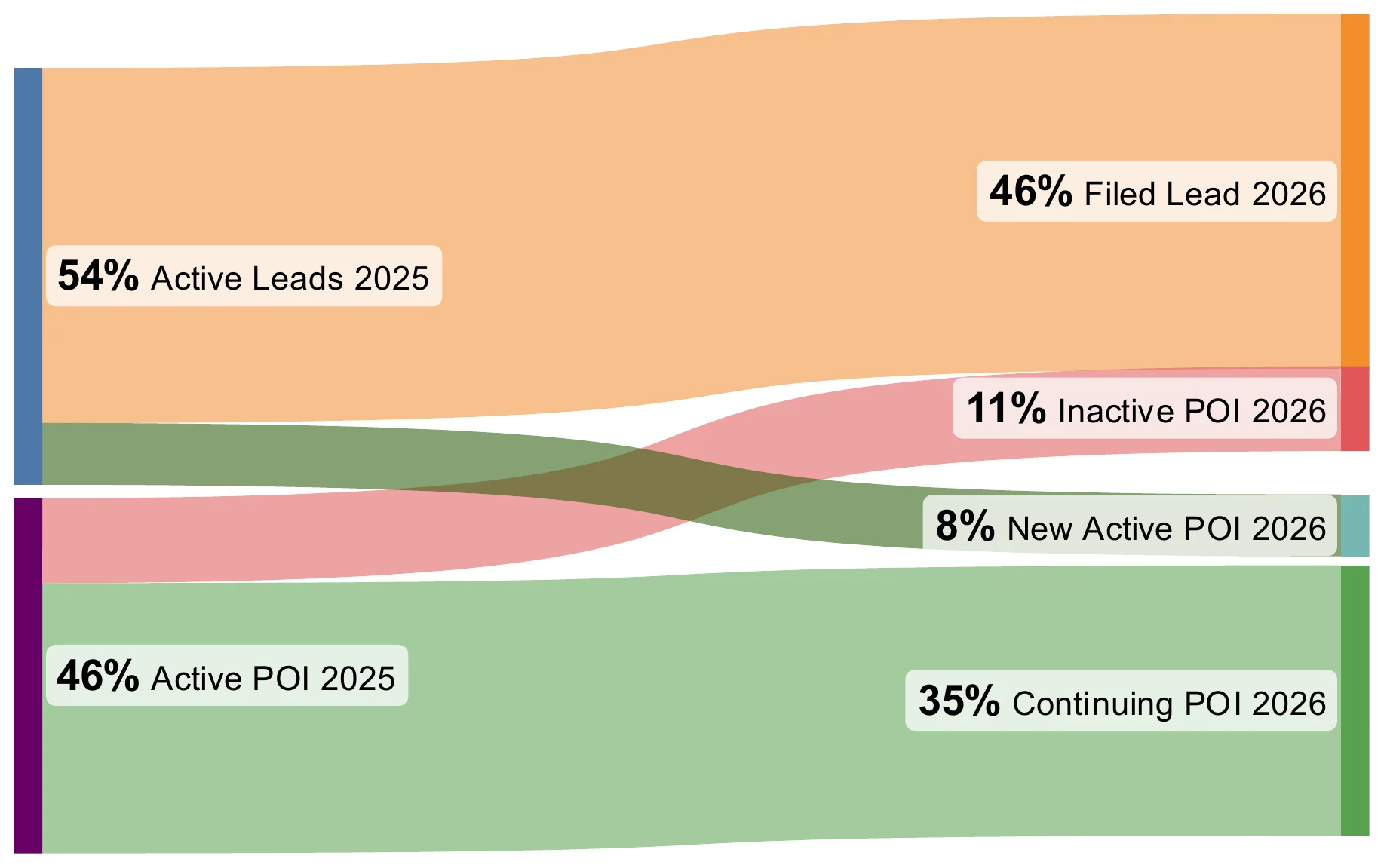
This practice on the part of New Zealand Police staff means that Perliger’s (2026, p. 2) assertion that declining ideological literacy is contributing to insufficient recognition of typology is at best only partially correct. As seen in Figure 1, 54% of the 2025 MUU cohort were Active Leads under assessment, and 46% were Active Persons of Interest (POI) under investigation. Between June 2025 and May 2026 turnover was high, with only 8% of the cohort converting from Lead to POI, and approximately 57% of the cohort cycling out from ‘active’ status: 46% became ‘Filed Leads’ as clarificatory information came to hand, and 11% were POI who were investigated and ‘downgraded’ to inactive. Filed Leads typically represented instances where the individual either did not meet the threshold for investigation or presented no threat of violence and were ‘parked’, and inactive POI were typically cases where investigation was intentionally ceased.

Figure 1
Movement of study subjects between 2025 and 2026. Values are percentages of the full cohort.

A Sankey diagram showing how individuals classified as Mixed, Unclear, Unstable (MUU) extremism cases changed status between 2025 and 2026. Of the 54% who were Active Leads in 2025, 46% became Filed Leads and 8% became New Active POI. Of the 46% who were Active POI (persons of interest) in 2025, 35% remained Continuing POI and 11% became Inactive POI. This illustrates the instability of the classification.

Note. POI = Person of interest. Leads that were made inactive shortly after the 2026 comparison date (4% of the cohort) are counted as Filed Leads.

Lessons Provided by the Nz Muu Cohort

Examination of the New Zealand MUU cohort by a senior and experienced analyst clearly demonstrated that the Police attention paid to the individuals in the cohort was justifiable (i.e. their behaviour was sufficiently concerning to warrant initial concern, and also sufficient to justify preventative or other actions by Police). But it also showed that any assumption that they collectively presented a discrete and clearly bounded typology would be misguided. This supports Horgan and Shayler’s (2026, p.14) argument that ideology is merely a single motivation for action, supports our previous observation that reaction to, and prevention of, criminal extremism (statutory criminality associated with or driven by extremism) has greater value in threat assessment than reaction to evidence of ideology (Tibby, 2026), and supports assertions that holistic and multi-agency responses to this type of threat are the most appropriate reaction (Argentino & Lindsay, 2026; Clemmow et al., 2026).

From the perspective of a practitioner, what needs to be asked in the debate about the growth of ‘non-ideological extreme violence’ is not whether better typologies of terrorism are required, but whether activation of ‘national security’ or counter-terror powers represent the appropriate method of threat management when a ‘non-ideological’ individual is identified by authorities. In practical terms, if a person has committed no crime, then attention to them placed by New Zealand Police needs to be justifiable – there needs to be a reasonable demonstration that their behaviour, and not their ideation, might result in offending. Granted, ideation has been a confirmatory proxy for ‘pathway to violent extremism’ assessment models for many years. But that practice is also becoming questionable as some extremism has evolved away from adherence to ‘conventional’ causes such as Salafi Jihadism or Neo-Nazism (Cooter, 2026), and is beginning to represent less and less justification for reasonable suspicion.

This leaves open a key question. There is a through line that ran in the majority of the cases studied – the interaction of individuals with a transnational online extremist ecosystem. New Zealand is effectively an ‘import ecosystem’ for extremist materials; we tend to be recipients of extremist messaging and disinformation aimed at larger countries or populations, but which is unfortunately both passively and actively consumed by domestic extremists. For some of these consumers they prefer to ‘theme’ their consumption of material, and upon examination by an analyst or investigator this diet of extremism clearly indicates preference for a particular cause. This in turn results in allocation to a specific category such as ‘white identity-motivated violent extremism’ (CTAG, 2022). For others, their diet is eclectic or mosaic, and if examined with the intention of identifying a clear and themed pattern might result in the conclusion that the individual is ideologically incoherent (Tibby, 2026). The findings clearly aligned with Baele’s (2026, pp. 2-3) assertion that idiosyncratic ideation or ‘hybridity’ can be reasonably and logically associated with the engagement of the MUU-categorised individuals with the chaos and self-directed learning evident in internet dependency.

As stated, ‘ideology’ or cause has acted as a proxy for suspicion that a person or organised group is involved or implicated in violent extremism for several decades. If involvement in online extremist ecosystems has at least partially replaced that vector for radicalisation, then it is logical for law enforcement to move attention to staunching such ingress. I therefore agree with McCauley (2026) that the critical question is not whether ideology has changed or morphed into new types of terrorism. The core question is how online extremist ecosystems are driving patterns in offending, or creating new classes of criminal behaviour – of which, sadistic online exploitation is unquestionably the most pressing (Thorn, 2026).

Horgan and Shayler’s (2026) initiating paper in this series serves as a welcome warning to both scholarly and practitioner colleagues about the dangers of over-applying any novel and assumed typology to an evolving and diverse extremist landscape, particularly in a social and cultural interregnum instigated by the advent of ubiquitous smartphones and attention-greedy algorithms (boyd, 2026). There are undoubtedly misanthropic individuals and groups operating in contemporary, transnational extremist ecosystems, and we have significant evidence of individuals aggregating self-justificatory, bricolage causes for violence and crime. As experts, we should recognise that blithe uses of generalisable, descriptive mantles like ‘Nihilistic Violent Extremism’ or MUU are likely increasing in currency because they are shorthand for ‘extremism that worries us but doesn’t fit our current conceptual frameworks’. This should be viewed as an opportunity to broaden both knowledge and practices, while concurrently fitting observed threats first and foremost to existing legislative frameworks.

Conflicts of Interest

The author declare no competing interests

Funding

This research received no external funding.

Author Contributions

Che Tibby conducted and examination of MUU-categorised individuals in a New Zealand cohort, and drafted the entirety of this paper.

Endnotes

a. In NZ Legislation a violent act is terrorism where it is intended to advance a political, ideological, or religious cause, and is also intended to force or coerce a government or organisation (section 5, Terrorism Suppression Act 2002).

b. NZ Police does not publicise the number of individuals under investigation as national security ‘leads’ or ‘persons of interest’.

Readers of this article also read
Commentary

The end of ideological violence

by Clark McCauley Cited by 3
Research Article

Deadly persuasion: A multilevel analysis of leader influence tactics and lethality in violent extremist organizations

by Mackenzie Harms, Alex Bruens, Justin Jones, & Gina Ligon
Perspective

Why the ‘salad bar of ideologies’ does not help us understand contemporary violent extremism

by John Horgan & Morgan Shayler Cited by 9
Commentary

The erosion of conceptual clarity in the study of political violence

by Arie Perliger Cited by 6
Commentary

Extremism without ideology

by Quassim Cassam Cited by 5
Commentary

Why the ‘salad bar’ might actually help extremism research – A reply to Horgan and Shayler

by Stephane Baele Cited by 5
Commentary

Shifts and continuity in contemporary violent extremism: Moving toward a dynamic and developmental understanding?

by Cécile Rousseau & Samuel Veissière Cited by 3
Research Article

A Behavior-Change model of jihadi media: The Information-Motivation-Behavioral skills framework and TTP video propaganda

by Sachal Jacob, Weeda Mehran, Jiaxin Tong, & Anthony Lemieux
Editor Curated

Frequently Asked Questions

  • What is 'Mixed, Unclear, Unstable' (MUU) extremism in the New Zealand context?

    MUU is an administrative category used by New Zealand Police since 2023 for potentially violent individuals who do not fit traditional labels such as ‘faith-motivated’ or ‘identity-motivated’ violent extremist. As Tibby (2026) explains, the label intentionally captures three distinct groups:

    1. people with an evident mixture of causes;
    2. people with no clear cause at all (the largest subgroup in New Zealand);
    3. people with an unstable attachment to any single cause, who may shift rapidly between positions.

    According to Tibby (2026), MUU is best understood as an ‘operational portmanteau’ rather than a true typology of extremist. It is a holding bucket for concerning behaviour that worries investigators but does not match existing conceptual frameworks, and individuals are often moved out of it as more information arrives.

  • How was the New Zealand MUU cohort studied?

    The analysis reported by Tibby (2026) focused on individuals classified as MUU and under active assessment or investigation by specialist counter-terrorism staff in July 2025. These were either ‘leads’ (reported through non-emergency channels but not yet persons of interest) or ‘persons of interest’ (under investigation as potential national security threats). At extraction, the cohort represented over 20% of everyone being assessed or investigated. An experienced analyst manually reviewed and coded each investigative file against five non-ideological lenses known to increase susceptibility to extremism: loneliness and social isolation, suicidal ideation, poor mental health, exposure to family harm, and exposure to or participation in online extremism. Tibby (2026) then tracked how each case moved through police processes between June 2025 and May 2026.

  • Did the study find a distinct type of 'salad bar' extremist?

    No. The work by Tibby (2026) found that the MUU category was not capturing multi-cause-selecting ‘salad bar’ individuals. Instead, the cohort consisted of a wide range of people with unique motivations and poorly defined ideation. The most specific pattern was simply the absence of any association with a cause; no consistent or statistically significant common pattern of behaviour explained why these individuals came to police attention. In this sense, Tibby (2026) concludes that the New Zealand cohort contributed nothing to building typologies of violent extremism. This aligns with Horgan and Shayler’s argument that MUU is not a discrete typology, and with wider research suggesting the only commonality among extremists is often the lack of generalisable radicalisation pathways.

  • How did the MUU cases move through the police system over time?

    Turnover was high. According to Tibby (2026), 54% of the 2025 cohort were Active Leads under assessment and 46% were Active Persons of Interest under investigation. Over the following year:

    1. only 8% converted from Lead to Person of Interest;
    2. around 57% cycled out of active status altogether;
    3. 46% became ‘Filed Leads’ once clarifying information showed they did not meet the investigation threshold or posed no violence threat;
    4. 11% were Persons of Interest who were investigated and downgraded to inactive.

    Tibby (2026) notes that individuals who do not fit traditional causes are provisionally placed in the ‘Unclear’ category and often cycle out as information emerges, meaning the stable 20% MUU share partly reflects internal police processes rather than a stable population of a particular extremist type.

  • What does the author recommend for managing 'non-ideological' extremism?

    Tibby (2026) argues that the key question is not whether better typologies of terrorism are needed, but whether national security or counter-terror powers are the right tool when a ‘non-ideological’ individual is identified. In New Zealand, ideation is not a crime, and terrorism must be legally linked to a political, ideological, or religious cause under the Terrorism Suppression Act 2002. Police attention therefore has to be justified by behaviour that could lead to offending, not by beliefs. Because engagement with a transnational online extremist ecosystem ran through most cases, Tibby (2026) suggests law enforcement should focus on how these ecosystems drive new patterns of offending, such as sadistic online exploitation, and favour holistic, multi-agency responses fitted first to existing legislation.

References

Argentino, M.-A., & Lindsay, A. (2026). Remotely coerced violence: 764, the Com Network, and the hybridization of threats. CTC Sentinel, 19(6). https://ctc.westpoint.edu/remotely-coerced-violence-764-the-com-network-and-the-hybridization-of-threats/

Baele, S. J. (2026). Why the “salad bar” might actually help extremism research: A reply to Horgan and Shayler. advances.in/psychology, 1(1), Article e359159. https://doi.org/10.56296/aip00060

boyd, d. (2026). Social media is now parasocial media. Social Media + Society, 12(2), Article 20563051261437487. https://doi.org/10.1177/20563051261437487

Cassam, Q. (2026). Extremism without ideology. advances.in/psychology, 1(1), Article e945134. https://doi.org/10.56296/aip00062

Clemmow, C., Schumann, S., Rubini, S., Martinsone, A., & Rottweiler, B. (2026). Pathways into violence-focused online communities: Examining configurations and temporal patterns of motivational drivers and risk factors. CrimRxiv. https://doi.org/10.21428/cb6ab371.7f864f6b

Colvin, E., & Campion, K. (2026). “Vulnerable and easily influenced”: Examining the vulnerabilities and susceptibilities associated with the engagement of young Australians in extremism. Safer Communities, 25(1), 13–31. https://doi.org/10.1108/SC-09-2024-0060

Combined Threat Assessment Group. (2022). The violent extremism ideological framework explained. National Security Journal, 4, 1–11. https://doi.org/10.36878/nsj20220703.03

Cooter, A. (2026). Beyond the pathway: Applying a cult coercion lens to nihilistic violent extremism. Institute for Countering Digital Extremism. https://www.nextgenmen.ca/s/Beyond-the-Pathway.pdf

Gill, P. (2026, June 16–18). [Keynote address]. Terrorism and Social Media Conference 2026, Swansea University, Swansea, United Kingdom.

Gøtzsche-Astrup, O. (2018). The time for causal designs: Review and evaluation of empirical support for mechanisms of political radicalisation. Aggression and Violent Behavior, 39, 90–99. https://doi.org/10.1016/j.avb.2018.02.003

Horgan, J. (2024). Terrorist minds: The psychology of violent extremism from Al-Qaeda to the far right. Columbia University Press.

Horgan, J., & Shayler, M. (2026). Why the “salad bar of ideologies” does not help us understand contemporary violent extremism. advances.in/psychology, 1(1), Article e607682. https://doi.org/10.56296/aip00057

Marchment, Z., Clemmow, C., & Gill, P. (2025). Adverse childhood experiences and susceptibility to violent extremism. Terrorism and Political Violence. Advance online publication. https://doi.org/10.1080/09546553.2025.2557594

McCauley, C. (2026). The end of ideological violence. advances.in/psychology, 1(1), Article e145270. https://doi.org/10.56296/aip00066

Mohamed Ali, R. B., Moss, S. A., Barrelle, K., & Lentini, P. (2017). Does the pursuit of meaning explain the initiation, escalation, and disengagement of violent extremists? Aggression and Violent Behavior, 34, 185–192. https://doi.org/10.1016/j.avb.2017.01.013

Ondrak, J., & Vitelli, L. (2025). Participatory memetic violence: Legend, ostension, and ideologically diffuse violence. Global Network on Extremism and Technology. https://gnet-research.org/2025/12/18/participatory-memetic-violence-legend-ostension-and-ideologically-diffuse-violence/

Perliger, A. (2026). The erosion of conceptual clarity in the study of political violence. advances.in/psychology, 1(1), Article e824472. https://doi.org/10.56296/aip00059

Sunshine, S. (2024). Neo-Nazi terrorism and countercultural fascism: The origins and afterlife of James Mason’s Siege. Routledge.

Thorn. (2026). Advancing response to sadistic online exploitation in networked youth environments: Insights & recommendations from the field. https://info.thorn.org/hubfs/Research/Thorn_SOEResponse_Report_2026.pdf

Tibby, C. (2026). Incoherent violent extremism in a New Zealand cohort. Journal of Policing, Intelligence and Counter Terrorism, 21(3), 357–365. https://doi.org/10.1080/18335330.2026.2637446

Previous Post
A painted illustration showing a lone young man seen from behind, hunched over a glowing smartphone while sitting on a rooftop ledge at night. A blurred, rain-streaked Southeast Asian city skyline of dark towers and warm orange lights fills the background, framed by bare tangled branches. The isolation and screen glow evoke online radicalization, True Crime Community immersion, and the loneliness that can fuel nihilistic violent extremism among youth.

Beyond the salad bar: Nihilistic violent extremism and the quest for significance in Southeast Asia