




Abstract
Jihadi media is typically studied for its narratives and themes; this study frames jihadi media as a behavioral intervention. The Information-Motivation-Behavioral Skills (IMB) model was developed in health psychology to explain behavior change. We apply the IMB framework to a corpus of 44 videos produced by the Tehreek-e-Taliban Pakistan (TTP) between 2009 and 2020 to theorize how Islamist media may lead to behavioral change. Using qualitative content analysis we disambiguate how the TTP inform audiences about the group’s political vision, motivate participation through appeals to religious duty and community identity, and build perceived capacity to act through repeated exposure to jihadi operations. We extend the IMB framework by reconceptualizing the behavioral skills component as vicarious online efficacy transmission, the process by which media consumption strengthens audience beliefs in their capacity to participate in jihad. Intercoder reliability, assessed on 30 independently double-coded videos, was substantial for Motivation and Behavioral Skills (κ =.70 and.78) and moderate for Information (κ =.57). Findings reveal a coherent mobilization strategy that uses anti-democratic framing, Muslim victimhood narratives, and normalization of violence integrated across IMB components, challenging characterizations of the TTP as unsophisticated propagandists. More broadly, the analysis demonstrates that a behavior-change framework can move the study of jihadi media beyond descriptive themes to the mechanism through which propaganda seeks to produce action.
Editor Curated
Key Takeaways
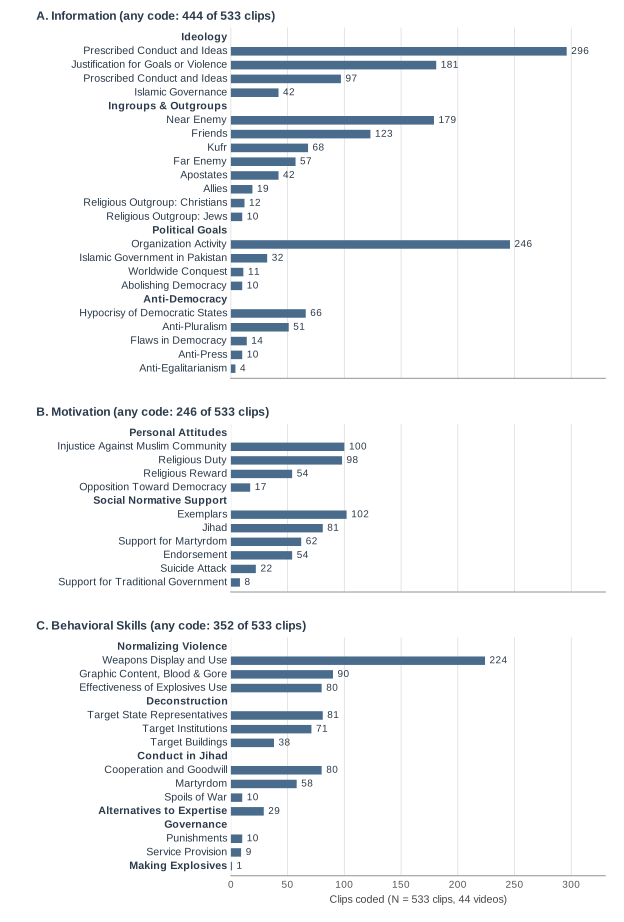
- Pakistani Taliban (TTP) propaganda videos usually work on three levels at once. They tell viewers who the group is and who its enemies are, push viewers emotionally to act, and model what action looks like. Codes from all three Information-Motivation-Behavioral Skills (IMB) dimensions appeared together in 37 of 44 videos (84.1%) and in 177 of 533 coded clips (33.2%).
- Hostility to democracy runs through TTP messaging. Anti-democratic content appeared in 123 of 533 clips (23.1%) across 31 of 44 videos. The group relies more on portraying democracies as hypocritical, for example by showing abuses by Pakistani security forces, than on theological arguments: 'Hypocrisy of Democratic States' appeared in 66 clips, compared with only 14 for 'Flaws in Democracy.'
- TTP videos build viewers’ sense that they can take part not by teaching skills but by showing violence repeatedly. Only one clip in the whole corpus shows how to make explosives, and no video calls for lone-actor attacks. Instead, weapons handling and use appeared in 224 of 533 clips, graphic violence in 90, and attacks on named officials, institutions and buildings in 129, breaking the Pakistani state down into reachable targets. Resolve and divine favour are presented as substitutes for training (29 clips), and the videos recruit for the organisation rather than inspire independent violence.
Keywords: