




Abstract
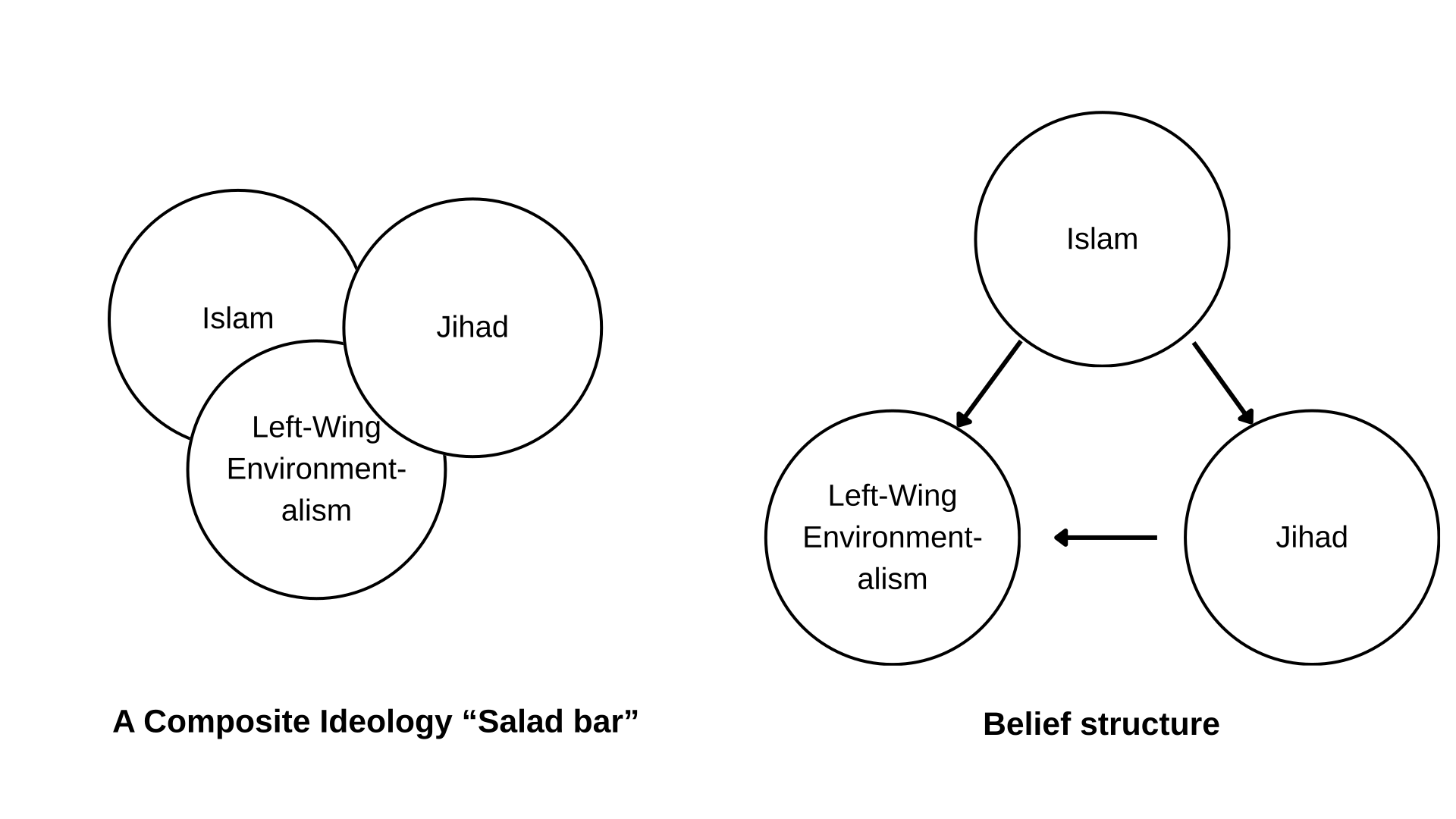
Responding to Horgan and Shayler (2026), we agree that the “salad bar” metaphor lacks theoretical value, but we argue for a refinement scheme where ideology—even salad-bar ones—are conceptualized as a structure instead of as a mere mix of beliefs. We call for scholars in this area to move toward the deeper structural dimensions of ideologies. Using the case of Indonesian Islamic Jihadists, we identify stable sacred components and peripheral operational components within their ideological structure and show how this distinction may be useful in explaining the underlying psychological mechanism of ideological shift that the classification of ideology as mix of beliefs alone cannot provide.
Editor Curated
Key Takeaways
- Milla and colleagues argue that extremist ideology is not a random 'salad bar' mix of beliefs but a structured network organized around a central, 'sacred-symbolic' core. In their Indonesian jihadist sample, religion (Islam) consistently occupied that central node, holding the belief system together even as peripheral ideas shifted.
- In a study of 42 radicalized individuals, fusion with religion did not differ in a statistically significant way between incarcerated (deradicalized) and non-incarcerated participants, whereas willingness to fight for religion was lower among the incarcerated. This suggests that deradicalization loosens peripheral commitments while the sacred core remains intact.
- Using a conceptual similarity measure, the researchers found that a perceived connection between Islamic identity and Sharia positively predicted willingness to fight for religion, while a perceived connection between Islamic identity and democracy was negatively linked to it. This pattern supports the idea that structural connections—not just ideological content—drive both radicalization and moderation.
Keywords: