




Abstract
Exposure to radical content is a major concern in violent extremism research, yet most people who encounter it never support violence. This study examined which form of exposure—deliberate engagement with radical people and settings versus incidental exposure—is linked to support for political violence, and the role of obsessive passion for an ideology. Four cross-sectional U.S. samples (Democrats, Republicans, environmental supporters, and Muslims; total N = 924) found that deliberate engagement, not incidental exposure, was consistently associated with violence support. Obsessive passion was reliably linked to both deliberate engagement and violence support, while harmonious passion was not. A three-wave longitudinal study of right-wing Americans ( N = 593) located this coupling in time: within persons, obsessive passion and deliberate engagement reciprocally predicted one another across six-week intervals, whereas passion and violence support showed no within-person dynamics in either direction—their strong association was carried entirely by stable, trait-level differences. These variables appear to form a tightly coupled radicalization syndrome rather than a simple linear pathway from passion to engagement to violence. The findings challenge theories and interventions that assume an ordered motivation-to-violence process.
Editor Curated
Key Takeaways
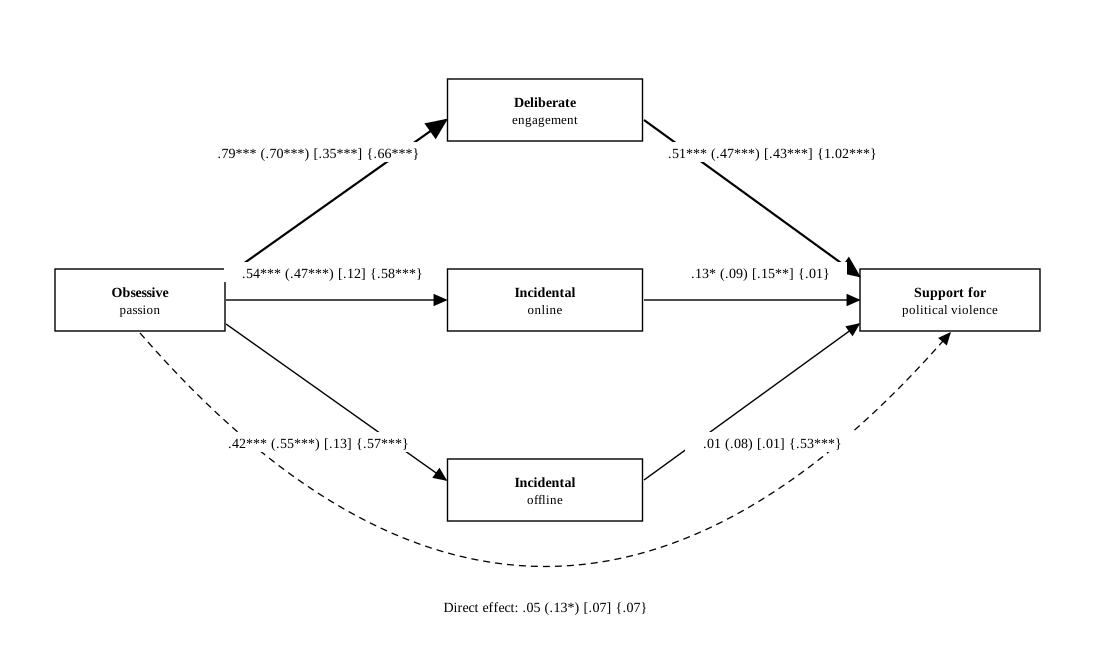
- Across four ideologically diverse U.S. samples (Democrats, Republicans, environmental supporters, and Muslims), deliberate engagement—actively seeking out radical people, settings, and content—was the only pathway that consistently linked obsessive passion to support for political violence (significant indirect association in every group, i.e., Democrats: B = .41, 95% CI [.20, .65]; Republicans: B = .33 [.15, .61]; environmentalists: B = .15 [.04, .33]; Muslims: B = .68 [.31, 1.08]). By contrast, incidental or accidental exposure did not statistically significantly mediate this relationship in most groups, suggesting that how someone engages matters more than mere exposure.
- The study emphasizes that it is the obsessive quality of ideological passion, not the sheer intensity of commitment, that is tied to radicalization. Harmonious passion, which reflects an equally strong but balanced commitment, was not statistically significantly associated with support for violence in most samples, whereas obsessive passion showed strong correlations with support for violence (among Democrats: r = .53; Republicans: r = .47; environmentalists: r = .29; Muslims: r = .57; all ps < .001).
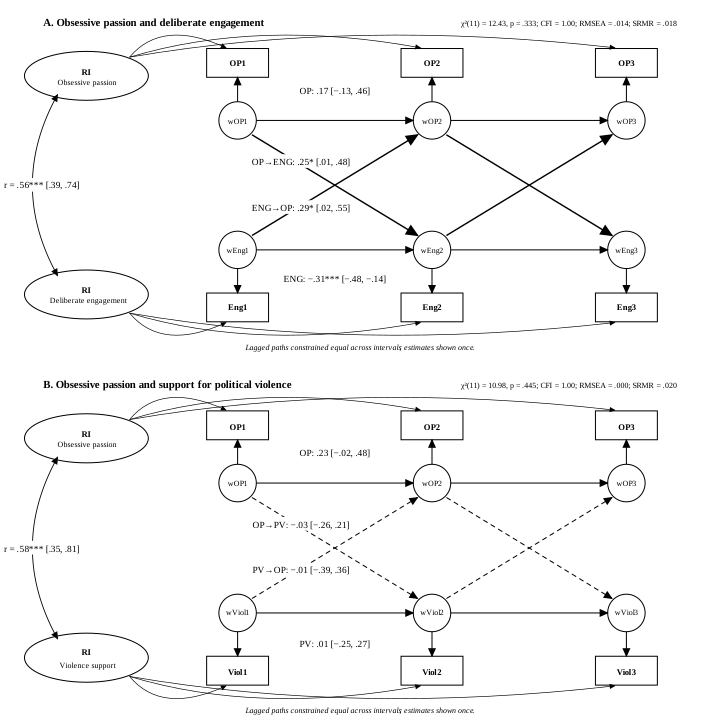
- The three-wave longitudinal study of far-right Americans (N = 593) revealed that obsessive passion and deliberate engagement reinforced one another over time within individuals (obsessive passion → engagement B = .25, p = .042; engagement → obsessive passion B = .29, p = .036). However, obsessive passion and support for violence showed no statistically significant within-person dynamics (ps > .828) despite strong trait-level coupling (random-intercept r = .58), pointing to a self-reinforcing 'syndrome' rather than a simple causal chain.
Keywords: