



Weaponising the past: An extended SIMCA model for how social identity and collective memory shape variation in collective action responses to democratic backsliding

ORCID logo, & ORCID logo

Received: July 25, 2025. Accepted: April 2, 2026. Published: April 9, 2026. https://doi.org/10.56296/aip00055

Creative Commons
Published under the Creative Commons BY 4.0 license.
BY
Published under the Creative Commons BY 4.0 license.

Abstract

Democratic backsliding is accelerating globally, yet societal responses to this trend vary drastically, ranging from mass resistance to widespread indifference or active support. To explain this divergence, this paper investigates how social identity and collective memory shape responses to democratic backsliding, focusing on collective action and proposing an extension of the SIMCA-model. It draws on three case studies from Russia, Israel and the United States. All of these cases are situated within a proposed extension of SIMCA to democratic backsliding. In Russia, identity and collective memory may legitimise Putin’s rule and prevent large-scale collective action. In Israel, secular Jews, Arabs, and religious Jews’ identities and collective memories produce different perceptions of democracy. This may explain why these groups engage in varying degrees and types of collective action. In the United States, affective polarisation, Trump’s use of nostalgia, and a declined salience of historic totalitarian threats may weaken democratic commitment. Undemocratic collective action on January 6th may represent these processes. The paper then discusses how social media and Large Language Models may increasingly manipulate identity and collective memory to legitimise authoritarianism and hinder collective action. Finally, future psychological interventions that could counter manipulations of identity and collective memory are discussed. By integrating psychological theory with global political developments, this paper offers a potential explanatory framework for why some groups resist democratic backsliding, while others remain indifferent or support it.
Editor Curated

Key Takeaways

  • The paper extends the Social Identity Model of Collective Action (SIMCA) to democratic backsliding by adding collective memory and an explicit group relative deprivation pathway. Stronger democratic group identification increases perceived injustice and perceived group efficacy, which in turn predict collective action. Collective memories that portray democracy as historically central (and past resistance as successful) feed into these pathways; memories that valorize authoritarian stability do the opposite.
  • In Russia, identity reframing and collective memory dampen resistance to backsliding. Putin’s rhetoric redefines favorable comparison standards (sovereignty, traditionalism), the 1990s are remembered as chaotic, and the Soviet era is selectively glorified—together lowering appraisals of injustice and group efficacy. Recent experimental data show that priming Russians to recall the 1990s reduces endorsement of democratic values, aligning with the model’s predictions about memory shaping identity and action tendencies.
  • Israel illustrates divergent identity–memory constellations producing opposite mobilizations. In 2023, about 7.5% of Israelis protested judicial reforms, with 70% of secular Jewish Israelis fearing loss of their lifestyle—consistent with strong democratic identity, injustice appraisals, and high perceived efficacy. By contrast, many Arab citizens showed apathy (weak Israeli identification, normalized deprivation), while many religious Jewish Israelis supported reforms (religious identity > democratic identity), and Kahanist currents mobilized against liberal principles via particularistic Holocaust memories and monarchic nostalgia.
Author Details

Neil Lavie-Driver: Department of Psychology, University of Cambridge, Link to Profile

Sander van der Linden: Department of Psychology, University of Cambridge, Link to Profile

*Please address correspondence to Neil Lavie-Driver, nil23@cam.ac.uk, Department of Psychology, University of Cambridge, Cambridge, CB2 3EB, United Kingdom

Citation

Lavie-Driver, N. & van der Linden, S. (2026). Weaponising the past: An extended SIMCA model for how social identity and collective memory shape variation in collective action responses to democratic backsliding. advances.in/psychology, 1, e719332. https://doi.org/10.56296/aip00055

Transparent Peer Review

The current article passed three rounds of double-blind peer review. The anonymous review report can be found here.

Introduction

Democratic backsliding – the “state-led debilitation or elimination of the political institutions sustaining an existing democracy” (Bermeo, 2016, p. 1) – has become one of the defining trends of the 21st century (Druckman, 2024). Decades after the fall of the Soviet Union prompted declarations of the final victory of liberalism (Fukuyama, 1992), such optimism now appears naive. By 2023, around 71% of the world lived under autocratic rule, up from 48% ten years prior (Nord et al., 2024). While this trend is global, societies vary in their degrees of collective action – actions taken by groups with the goal of improving their conditions (van Zomeren, 2013) – in response to perceived democratic backsliding. For instance, despite eroding democracy, Vladimir Putin remains largely popular in Russia (Frye et al., 2017; Statista, 2025). By contrast, Benjamin Netanyahu’s attempts to weaken Israel’s judiciary in 2023 sparked mass collective action and a drop in support for his government (Lubell, 2023; Medina, 2023). What explains such differences? While structural factors, such as media freedoms, are important, this paper will explore the specific role of the interaction between social identity (Tajfel & Turner, 2000) and collective memory (Halbwachs, 1950/1992). The assumption that democracy is worth defending through collective action is not universal. Instead, we will argue, it is shaped by whether a group’s identity, informed by its collective memories, promotes perceptions of democratic backsliding as an injustice incurring group relative deprivation. The varying importance of democracy to a group’s identity and history, as well as their historical ability to collectively achieve desired outcomes, may impact their willingness to engage in collective action. These ideas are in line with the social-identity model of collective action (SIMCA; van Zomeren et al., 2008). Drawing these points together, this paper advances a theoretical adaptation of SIMCA to democratic backsliding. The final section of the paper outlines directions for empirically testing this model.

We use the SIMCA model (van Zomeren et al., 2008) as a core theoretical framework for this paper because it offers one of the clearest and most extensively researched (e.g., van Zomeren et al., 2018) psychological frameworks for explaining the psychological processes which contribute to collective action. At its core, SIMCA proposes that people are most likely to politically mobilise when they (a) strongly identify with a relevant group, (b) believe this group is being treated unfairly (injustice), and (c) expect that collective action can realistically achieve change (group efficacy). These proposals may plausibly extend to collective action responses to democratic backsliding. Given that democracy is fundamentally socially constructed (e.g., Cheneval & Nicolaidis, 2017), it appears reasonable to expect that collective action in relation to democracy may similarly be driven by such social identity-based psychological constructs. In this paper, social identity is understood not merely as group membership, but as the part of the self-concept derived from belonging to an ingroup and from comparing that ingroup to outgroups in ways that sustain positive distinctiveness (Tajfel & Turner, 2000). This comparative dimension is central to the analyses that follow. For example, the paper will discuss cases in which undemocratic actors redefine the criteria of intergroup comparison to legitimise authoritarianism.

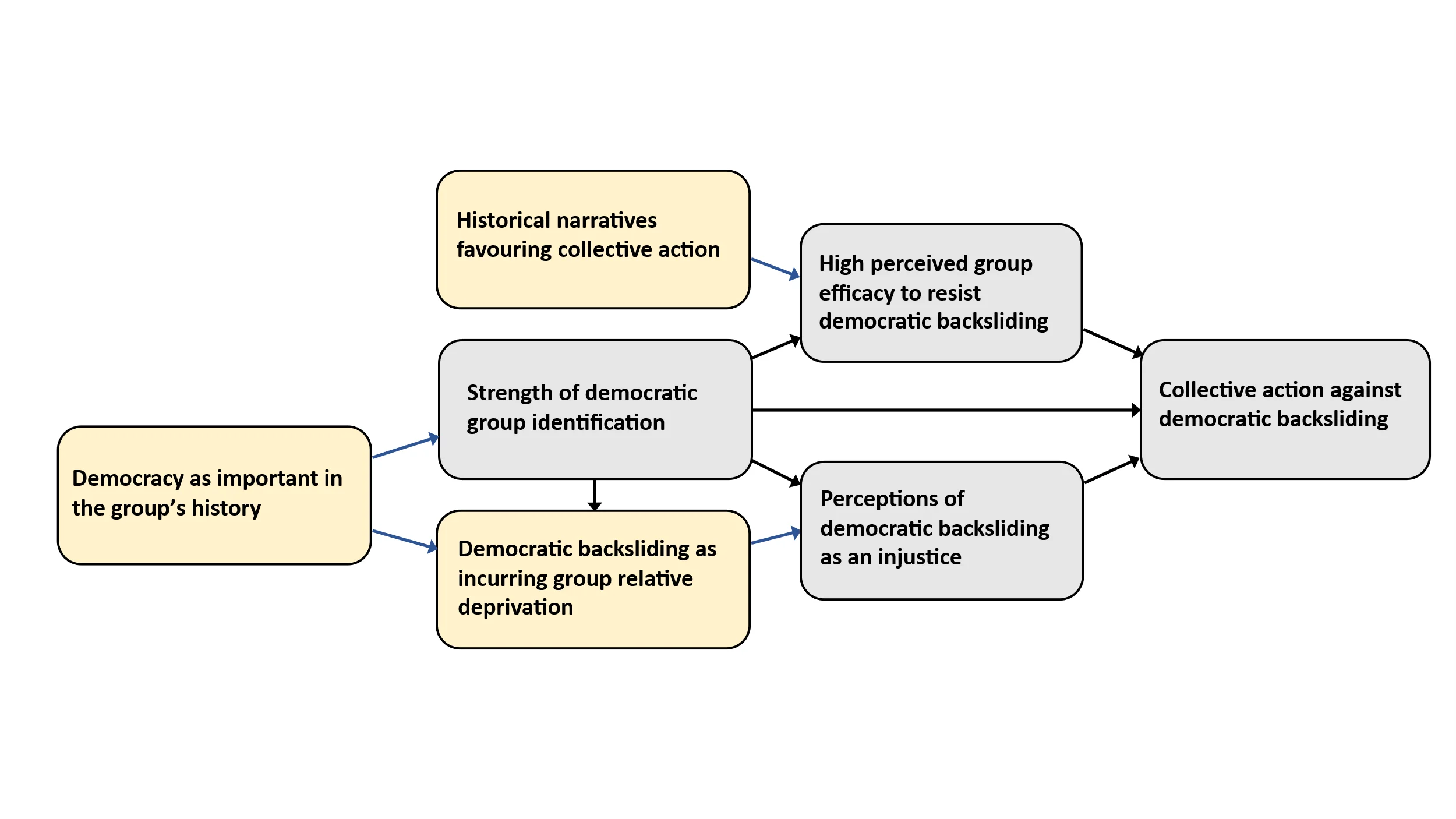
The core SIMCA components retained here – and later highlighted in grey in Figures 1–6 – are strength of group identification, perceived injustice, perceived group efficacy, and collective action. We extend the SIMCA model in two key ways: by applying it to democratic backsliding, where collective action may defend or undermine democracy, and by including collective memory – widely held memories of community members that bear on their collective identity (Hirst & Manier, 2008). Specifically, we argue that collective memory may shape whether democracy becomes central to a group’s identity, whether democratic backsliding is perceived as unjust, and whether a group can resist (group efficacy). We also more explicitly depict the role of group relative deprivation in predicting injustice appraisals, applied to the context of democratic backsliding. Our extended model is first illustrated in Figure 1.

As evidence for the model, the paper presents three case studies from Russia, Israel and the United States. The material for each was drawn from a review of relevant academic literature, historical analyses, and journalistic sources. This approach reflects a secondary case study design (Awasthi & Gopakumar, 2023). A case study is generally defined as “an examination of a real-world phenomenon within its naturally occurring context, without directly manipulating either the phenomenon or the context” (Kaarbo & Beasley, 1999, p. 372). Although this method limits causal inference, it can allow for theory exploration, hypothesis development, and analytical generalisation (Kaarbo & Beasley, 1999; Yin, 2013). Further, case studies are well-suited for exploring complex sociopolitical phenomena that often cannot be ethically or practically studied in experiments or surveys, especially in authoritarian contexts.

Figure 1

Proposed extension of SIMCA to the role of social identity and collective memory in collective action against democratic backsliding.

Beyond this practical advantage, we believe the case study approach offers unique methodological benefits. The ability to develop new theoretical premises through case studies gives them an advantage when complex ideas are initially difficult to establish using standard quantitative, qualitative, or computational methods (Starman, 2013). The potential role of collective memory and social identity underpinning collective action in response to democratic backsliding is sufficiently complex as to warrant a “detailed consideration of contextual factors” (Starman, 2013, p. 37) before more standardised methods. A systematic literature review would also be limited, given the relative absence of literature directly addressing the interaction between these constructs and democratic backsliding. A case study approach better allows for the integration of more dispersed existing insights into a coherent explanatory framework. This approach is therefore used here to explore how the mechanisms proposed in the model may operate in different sociopolitical contexts. Evidence of varying empirical strength – including analysis of political rhetoric, survey data, and experiments – is interpreted through the lens of the pathways specified in our extended SIMCA model. While we draw on some empirical data, many of our claims are subjective interpretations of sociopolitical events, grounded in psychological principles. We believe this approach can inspire future empirical work.

Given the relative lack of this approach in political psychology, much of the literature discussed here is taken from non-psychological sources and integrated with psychological theory, since each case study explores historical developments in each society. This integration supports growing calls to combine psychological explanations of cultural variation with insights from history and other disciplines (Knights, 2012; Muthukrishna et al., 2021).

Because randomisation is not feasible in case study research (Seawright & Gerring, 2008), our diverse case studies adopt a theory-driven approach to critically examine cases. These cases were selected because of their diversity in representing the variable of interest (i.e., democratic backsliding). We focus on these three societies because each uniquely illustrates how identity and collective memory may interact to shape responses to democratic backsliding. Moreover, each has experienced varying degrees of democratic backsliding and historic levels of democracy (World Population Review, n.d.). This difference allows for an exploration of the similarities and differences in the role of identity and collective memory across political contexts. These examples could then inform psychological approaches to democratic backsliding in contexts beyond those explored here.

Russia was selected as a case where democracy has been associated by Putin with Western outgroups. Modern Russian identity, by contrast, is portrayed as being built upon the foundations of a strong, authoritarian state, which is relatively superior to democracy. Further, a negative collective memory of the economic crises of the 1990s, which directly followed failed attempts to democratise post-Soviet Russia, has allowed for Putin to associate democracy with chaos. Limited historical examples of successful collective action (e.g., the failure of historic revolts to end autocratic rule in Russia) and a sanitised, selective memory of the Soviet era (e.g., prioritising victory in WW2 over examples of repression) may have also helped limit collective action against Putin.

Israel is selected as a contrasting example. Democracy is a more contested issue in Israel than Russia, shaped by different identities and interpretations of collective memories. For example, secular and religious Jewish Israelis disagree on whether Israel being democratic is more important than the country’s Jewish character, leading to competing identity drivers. Arab citizens of Israel, meanwhile, may feel indifferent to a democracy that they deem to primarily represent a Jewish outgroup; Israel is a self-defined Jewish state, and most Arabs do not identify primarily as Israeli. For each of these groups, different collective memories, including of Israel’s political history or the Holocaust, contribute to such differing perceptions of Israeli democracy. These differences may help explain varying group reactions, including collective action, to events such as the Netanyahu government’s proposed weaking of the Israeli judiciary’s independence.

Finally, the United States was selected as a case where increasing affective polarisation (i.e., increased hostility across political divides) has increased tolerance for undemocratic behaviour by one’s political ingroup. For example, affective polarisation helped fuel undemocratic collective action, through attempting to overturn a democratic election appraised as unjust, when supporters of Trump stormed the Capitol building on January 6th, 2021. This growing affective polarisation is coupled with Trump’s allusions to the United States’ historical greatness and recent decline. We argue that the decline in perceived outgroup threats internationally, while the collective memory of 21st century totalitarianisms fade, has also helped foster these processes through reducing superordinate national identification amidst the threat of conflict.

We will also examine how social media and Large Language Models (LLMs) may intensify the identity and collective memory processes that could contribute to democratic backsliding and limit pro-democracy collective action. Our case studies all occur before these technologies have reached their full potential and may be considered preludes for the future if relevant psychological insights are not utilised for effective interventions.

Lastly, then, this paper will consider potential psychological interventions for counteracting these trends and propose future research directions, including experiments priming particular identities and collective memories. Understanding and targeting such psychological dynamics may be crucial for safeguarding democracy.

Conceptual Framework: Social Identity and Collective Memory

According to Social Identity Theory (Tajfel & Turner, 2000), individuals derive a significant part of their self-concept from group membership. Individuals are motivated to engage in social comparison (Hogg, 2000), which involves comparing their ingroup (the group they identify with) with outgroup (groups with which they do not identify). As part of this social comparison tendency, groups are also motivated to view their group as positively distinct – that is, in possession of uniquely positive traits compared to other groups (Mummendey, 1995; Tajfel & Turner, 2004).

Politics, then, is never merely a battle over policies, but also a struggle between identities (e.g., Greene, 1999; Huddy, 2001; Parker & Lavine, 2025). Different identities motivate different types of engagement and collective action – defined as “any action that individuals undertake as psychological group members… with the subjective goal to improve their group’s conditions” (van Zomeren, 2013, p. 1). The role of identity is outlined in the social identity model of collective action (SIMCA; van Zomeren et al., 2008). As discussed in the Introduction, SIMCA proposes that collective action is driven by group identification, perceived injustice, and group efficacy. To unpack these components in greater theoretical detail, perceptions of injustice tend to be rooted in group relative deprivation – the impression that the ingroup is undeservingly worse off than other groups (Pettigrew et al., 2008; van Zomeren et al., 2008; Walker & Pettigrew, 1984).

It is worth noting, however, that being worse off than others or experiencing inequality does not always produce feelings of unfairness. System justification theory (Jost et al., 2004) suggests that individuals may be motivated to see existing systems as fair, even when they are disadvantaged (Osborne & Sibley, 2013). A key factor, then, is deservedness: relative deprivation is appraised when groups believe they deserve better outcomes (Feather, 2015; Smith et al., 2012). These perceptions can concern material factors, such as income inequality, as well as more subjective appraisals of, for instance, political power (Smith et al., 2012).

Another key determinant is the strength of group identification – meaning the degree to which individuals identify with and feel attached to a group. As van Zomeren et al. (2018) state, “group identification lies at the heart of the SIMCA…as it predicts collective action directly and indirectly” (p. 4). Supporting this premise, injustice perceptions, group efficacy and the frequency of collective action are predicted by group identification (Thomas et al., 2020). Moreover, strength of group identification may prompt appraisals of group relative deprivation (Tropp & Wright, 1999).

If collective action is shaped by these factors, it may follow that distinct groups respond to democratic backsliding differently. For example, one group might perceive democratic backsliding as incurring group relative deprivation. On the one hand, this relative deprivation might be perceived internally (for example, relative to internal outgroups) or externally (for instance, social comparison with Western democracies). By contrast, in some cases, authoritarianism may be framed as positively distinct from liberalism and met with little resistance. Given this variety of potential responses, research on how different groups react to democratic backsliding is highly relevant. However, a global framework for understanding democratic backsliding is lacking in social psychology (Druckman, 2024). Our cross-cultural case studies will aim to help address this gap.

While SIMCA specifies psychological mechanisms underlying collective action, it does not fully address why certain groups perceive injustice and group efficacy differently. Here, collective memory becomes critical too. A collective memory is the socially constructed narrative of a group’s past, providing a framework for interpreting current events (Halbwachs, 1950/ 1992; Hirst & Manier, 2008). Because collective memories are socially constructed, the same memories can be interpreted differently by different groups (Nicholson, 2017; Wertsch & Roediger, 2008). Their socially constructed nature also makes them strongly interlinked with identity – for instance, informing interactions with historically hostile outgroups (Babinska & Licata, 2025).

Collective memory both shapes and is shaped by identity. It helps form identities by helping to define group norms (e.g., Wang, 2018). Conversely, identity influences collective memory. For example, groups tend to overemphasise historic achievements and downplay negative events, which reflects identity-based drives such as a need for collective pride (Hilton & Liu, 2017). Further, collective memory plays a crucial role in shaping how societies respond to contemporary issues (Liu & Hilton, 2005; Power, 2016). In Germany, for instance, the collective memory of Nazism has produced a taboo against militarism (Liu & Hilton, 2005). While the past clearly informs the present, the present also reshapes our understanding of the past. Because collective memories are socially constructed, different memories are emphasised in accordance with changing social norms (Jovchelovitch, 2012; Liu, 2018).

From a SIMCA perspective, the entanglement of collective memory and identity has direct implications for collective action. How may these implications extend to democratic backsliding? Collective memory and identity may determine whether democratic backsliding is perceived as unjust through the strength of group identification. A group’s identity may be considered a democratic identity – for instance, it may be grounded in collective memories of the dangers of historic undemocratic groups (e.g., Probst, 2003). By contrast, the strength of other types of identities such as religion may at times overshadow democracy. Collective memories of historic group resistance may also determine perceptions of group efficacy. For instance, crediting the Black civil rights movement to a select few leaders may weaken ordinary African Americans’ perceived group efficacy (Freel & Bilali, 2022).

Moreover, progress narratives (the present is the best time in a group’s history) may be less likely to lead to injustice appraisals and collective action compared to regress narratives (the group’s condition has declined over time; Freel & Bilali, 2022).

In the context of democratic backsliding, the absence of relevant collective memories which position democracy as important may legitimise ‘progress narratives’ even amidst autocratisation. It may not appear contradictory in such cases for leaders to claim that they have reduced group relative deprivation whilst attacking democracy. This idea could reduce perceptions of injustice, thereby hindering the prospect of collective action. Additionally, without historical examples of successful collective action, group members may have low perceptions of their group efficacy to resist democratic backsliding.

Figure 1 presents a model of how collective memory and identity may interlink to predict collective action against democratic backsliding, extending the SIMCA-model. Incorporating this relationship into the model, which currently does not account for them, may advance our understanding of the processes motivating collective action.

Predictors and Mediators in our Extended SIMCA Model

In the model represented in Figure 1, the grey nodes with black arrows represent the core components of SIMCA, adapted to the context of democratic backsliding. Strength of democratic group identification is an upstream predictor with direct effects on perceived injustice, perceived group efficacy, and collective action, consistent with prior evidence on the role of strength of group identification (e.g., Thomas et al., 2020). Perceived injustice and perceived group efficacy, in turn, independently predict collective action against democratic backsliding and thus function as mediators of the relationship between strength of democratic group identification and collective action. In addition, strength of democratic group identification predicts the extent to which democratic backsliding is construed as incurring group relative deprivation.

The yellow nodes with blue arrows in the model represent new incorporations of collective memory and identity into the model. Perceiving democracy as important in the group’s history is expected to increase the strength of democratic group identification, which in turn predicts collective action both directly and indirectly via perceived injustice and perceived group efficacy. Accordingly, strength of democratic group identification mediates the relationship between collective memory and collective action, yielding both direct and indirect effects.

Perceiving democracy as important in the group’s history is also expected to increase the likelihood that democratic backsliding is construed as incurring group relative deprivation. In turn, perceived group relative deprivation predicts perceptions of democratic backsliding as an injustice. Thus, perceived group relative deprivation mediates the relationship between a historical importance of democracy and perceived injustice. Furthermore, because strength of democratic group identification predicts perceived group relative deprivation, an additional indirect pathway from historical importance of democracy to perceived injustice operates via sequential mediation through these variables.

Moreover, historical narratives favouring collective action (e.g., historical examples of successful collective action; Freel & Bilali, 2022) are expected to increase perceived group efficacy to resist democratic backsliding. Perceived group efficacy, in turn, predicts collective action, implying an indirect effect of these historical narratives on collective action, mediated via perceived group efficacy.

We note the possibility of reverse causality between the collective memory and identity variables here (e.g., strength of democratic group identity increases the salience of collective memories which position “democracy as important in the group’s history). However, we include unidirectional arrows between collective memory and identity in our model (see Figure 1) because the ability of identity to increase the salience of collective memories presupposes that those collective memories exist, ultimately giving collective memory a primary role in the relationship. Next, in our first case study, we discuss how Putin’s Russia may provide real-world evidence for this model.

Case 1: The Exploitation of Identity and Collective Memory to Build Acquiescence to Democratic Backsliding in Russia

In 2007, while lambasting NATO’s eastward expansion, Putin stated in his Munich Security Conference speech that “incidentally, Russia – we – are constantly being taught about democracy. But for some reason those who teach us do not want to learn themselves” (Putin, 2007, p. 2). The speech was a haunting pretext for Putin’s later justifications for invading Ukraine (Smirnova et al., 2023). The speech’s phrasing alone illustrates how Putin mobilises identity to legitimise authoritarianism. By contrasting “we” with “those who teach us”, he casts calls for Russia’s democratisation as a patronising imposition from Western outgroups.

A focus group with Russian participants (Sharafutdinova, 2022) suggested that this type of social comparison with the West may explain support for Putin – for instance, as indicated in the statement of one respondent who noted that “we are respected; the West is afraid of us” (p. 7). Putin’s exploitation of identity is explored further by Evans (2015). Given that groups strive for positive distinctiveness (Hornsey, 2008), members of negatively distinct groups may cope through social creativity. This is when a group downplays the importance of dimensions where it is disadvantaged and emphasises dimensions where they excel (Crocker & Major, 1989; van Bezouw et al., 2021). For example, groups of low socioeconomic status may emphasise moral integrity (Elbæk et al., 2023), perhaps as a substitute for financial success. Putin potentially engages in a similar method by attempting to transform the basis upon which Russia is judged relative to Western nations (Evans, 2015). In the face of economic and democratic inferiority, Putin emphasises Russia’s “traditional ethical norms” (Evans, 2015, p. 4) and national sovereignty (Lomagin, 2007) against Western liberalism (Agadjanian, 2017; Tsygankov, 2016).

The promotion of such identity-driven narratives may fuel a progress narrative. Russia is portrayed as being better than ever since its increasing illiberalism, such as through its increased sovereignty (Malinova, 2022). By redefining the criteria on which intergroup comparisons are made, Putin’s rhetoric may reshape perceptions of deservedness. Russia’s relative disadvantage on liberalism’s dimensions may be interpreted as merely the legitimate consequence of pursuing sovereignty and traditionalism. Citizens may then perceive Russia as receiving the best outcomes for its national path, reducing perceptions of group relative deprivation compared to Westerners on the domain of political freedom (Smith et al., 2012).

Moreover, by defining Russian identity in terms of sovereignty and traditionalism, Putin may help construct a Russian identity built on statist ideals (e.g., Cannady & Kubicek, 2014). As explored by Blackburn (2021), modern Russian identity is built on a concept of “state-civilization” (p. 1). Here, Russian identity is defined by its unity under a strong state. Strength of group identification in this case could thus impede collective action against democratic backsliding (see Figure 2).

Figure 2

SIMCA extended to the role of social identity and collective memory in limiting collective action against Putin’s democratic backsliding in Russia

On the whole, Putin’s persuasive rhetoric may help explain the fact that dialling back on democracy (Haggard & Kaufman, 2021b) has not prevented him from enjoying majority support (Frye et al., 2017), nor being particularly threatened by collective action[1], given that appraisals of injustice may be key to triggering collective action (see Figure 1).

In an essay, Putin (1999) wrote: “It will not happen… that Russia will become the second edition of, say, the US or Britain in which liberal values have deep historic traditions…For Russians a strong state is not an anomaly.” To understand Putin’s identity-based rhetoric’s appeal, it is helpful to consider Russia’s collective memory. We have proposed that the strength of democratic group identity and perceptions of democratic backsliding as unjust are also informed by a perceived historical importance of democracy (see Figure 1). Russian collective memories are unlikely to produce this effect (see Figure 2). In recent experimental data, Russians primed to recall the 1990s were less likely to endorse democratic values (Alexeev et al., 2025). In this period, following the fall of the Soviet Union, there was an attempt to democratise Russia, which had practically never been democratic (Gill, 2002) – for instance, through the introduction of competitive elections, in contrast to the one-party Communist rule which had characterised the Soviet Union. Western economists simultaneously promoted ‘shock therapy’ – rapid reforms to restructure Russia’s economy on free-market principles such as deregulation and privatisation (Murrell, 1993).

However, while these economic policies were more successful in other formerly communist states such as Poland (Ther, 2025), in Russia they largely backfired. The consequences in Russia included hyperinflation and many falling into poverty and unemployment; meanwhile, a small group of Russian oligarchs massively increased their wealth and influence (Belyakov, 2019).

Following this negative experience with attempted liberalisation (Vasilenko et al., 2022), Putin’s reassertion of state dominance (Burrett, 2020; Sakwa, 2008) seemed attractive to many Russians. A 2001 survey found that most Russians were willing to trade human rights for order and public safety (Gerber & Mendelson, 2002). As stated earlier, collective memories shape how groups make sense of current events (Halbwachs, 1950/1992; Hirst & Manier, 2008). Exploiting this phenomenon, Putin has associated liberalism with “the wild nineties” (Sykes, 2023, p. 6; see also Malinova, 2021) to present contemporary illiberalism as being a remedy to the injustice of oligarchy. This conceptualisation of the 1990s can diminish the perceived importance of democracy in Russia’s history and thus provide further grounds for a modern Russian identity based on “state-civillisation” (Blackburn, 2021, p. 1). Such associations also reinforce the claim that “Russian” authoritarianism is superior to “Western” democracy (see Figure 2).

Another factor contributing to these processes may be Russia’s engagement with its Soviet past (see Figure 2). A 2010 survey found that Russians with greater nostalgia for the Soviet era were more likely to support authoritarianism (White, 2010). The valorisation of historic authoritarianism may help make democracy appear relatively inferior as a political system (see Figure 2). Soviet oppression has not become central to Russia’s mainstream collective memory (Khazanov, 2008) – there has never been a Nuremberg trial-level reckoning, as in post-Nazi Germany (e.g., Morozov, 2008). In fact, Putin persistently bemoans the Soviet Union’s collapse (Sherlock, 2016). Events from this era emphasised instead include victory in WW2 (Tumarkin, 2003) and narratives of order and stability (Khazanov, 2008).

The sanitisation of Soviet autocracy reinforces the idea that collective memories disproportionately emphasise positive events (Hilton & Liu, 2017). Even Stalin has seen his image increasingly rehabilitated under Putin (Shkliarov et al., 2022). Likely linked with increasing hostility to the West and the Ukraine War (Ferraro, 2023), these examples reflect the fluidity of collective memories in response to changing social demands (Jovchelovitch, 2012; Liu, 2018).

Finally, alongside these collective memories is the relative absence of historically successful Russian collective action (see Figure 2). Russia only achieved emancipation from serfdom in the 1800s (Nafziger, 2012), in part because of the Russian monarchy’s fear of increased collective action among Russian serfs (Finkel, 2015). However, while emancipation granted new rights to Russia’s majority serf population, many do not appear to have felt that their conditions substantially improved (Finkel, 2015). After all, emancipation still did not free most Russians from exploitation by a landed gentry and an oppressive monarchy. Russia then experienced a revolution against that monarchy in the early 1900s (Fitzpatrick, 2017), yet this collective action ultimately substituted an oppressive monarchy for an oppressive communist dictatorship. These relative historical failures of collective action likely limit Russians’ perceived group efficacy (see Figure 2; Freel & Bilali, 2022).

Predictors and Mediators in our Model, Applied to Limited Collective Action Against Putin’s Democratic Backsliding in Russia

Summarising the points we have discussed in this case, our extended SIMCA model (see Figure 1) can be applied to the context of democratic backsliding in Putin’s Russia (see Figure 2). “Statist Russian identity” (see Figure 2) is defined by a modern Russian identity built on the importance of a strong, unified state (Blackburn, 2021). In keeping with SIMCA, strength of this identity may exert direct effects on low perceptions of democratic backsliding as injustice, low perceived group efficacy to resist democratic backsliding, and limited collective action. These injustice and efficacy perceptions may also independently predict limited collective action against Putin. Moreover, strength of statist identity may predict low perceptions of group relative deprivation on the political domain (i.e. “Russian authoritarianism as superior to Western democracy”), which then in turn predicts low appraisals of democratic backsliding as unjust.

The collective memories of Russia’s failed attempted democratisation in the post-Soviet “wild 90s” and the glorification of Soviet autocracy are expected to reduce the perceived historical importance of democracy. This, in turn, predicts a stronger statist (rather than democratic) group identification. These collective memories are also expected to predict endorsement of the belief that “Russian” authoritarianism is superior to “Western” democracy – limiting perceived group relative deprivation on the domain of political freedoms and subsequent injustice appraisals.

In addition, a lack of historical examples of successful Russian collective action is expected to predict lower perceived group efficacy to resist democratic backsliding. These processes may be relatively homogenous in Russia, where Putin remains largely unthreatened by collective action. However, other societies have seen a more multifaceted response to democratic backsliding, also anchored in identity and collective memory. The next section discusses Israeli society as an example.

Case 2: Identity and Collective Memory as the Catalyst for Variation in Injustice Perceptions and Collective Action Across Different Israeli Groups

The Judicial Reform Protests: Collective Action Against an Attack on the Identity and Collective Memory of Secular Jewish Israelis

In 2023, Benjamin Netanyahu’s coalition government introduced a plan to reduce the powers of the Israeli judiciary and expand control over the Supreme Court (Dotan, 2023). The plan triggered mass collective action (Roznai & Cohen, 2023). At its peak, around 7.5% of the country’s population protested (Medina, 2023), and key aspects of the reform were ultimately reversed.

This picture contrasts with the comparatively muted societal response in Russia, where similar reforms have been implemented (Partlett, 2021). While structural factors help contextualise this difference, such as higher legal risks of dissent in Russia (Easter, 2021), they do not fully explain it. Israel’s socio-political landscape has made it more difficult for Netanyahu to secure comparable acquiescence to Putin. While Israel broadly encompasses the identity of “Jewish”, it is politically divided by different types of Jewish identities, such as religious vs secular (Zeedan, 2024). A majority of secular Jewish Israelis prioritise the state’s democratic character over its Jewish character (Bitton, 2023) – illustrating its crucial importance to their identity. Secular Jewish Israelis’ strength of democratic identity may account for their collective action, in line with the strength of democratic group identification pathway (see Figures 1 and 3).

This strong democratic identity likely has roots in Israel’s historical development as a rare Middle-Eastern democracy (Medding, 1990), having held democratic elections since its formation, which can also foment a sense that democracy is historically important and fragile (see Figure 3). The attack on a mostly secular judiciary by a largely religious government was appraised by many of this demographic as a threat to democracy (Porat, 2023; Simunovic et al., 2024). The supreme court has historically impeded the goals of religious fundamentalists (e.g. Hackner, 2024). One aspect of this perceived threat to democracy, then, was a fear that the undoing of the court’s powers could eventually lay the groundwork for theocracy (Jaffe, 2023). This perceived threat manifested in 70% of secular Jewish Israelis expressing fear that they would not be able to maintain their lifestyle (Hermann & Anabi, 2023). Unlike in Russia, secular Jewish Israelis thus seemingly detected a threat of group relative deprivation concerning political and social freedoms relative to religious Jewish Israelis. This threat may have motivated appraisals of the reform as unjust, and the subsequent collective action.

Moreover, a majority of secular Jewish Israelis are of Ashkenazi descent (Pew Research Center, 2016). Ashkenazis have historically comprised the elite of Israel’s democratic institutions (Ben Porat & Filc, 2022). These collective memories may promote a greater belief in their group efficacy, fuelled by their nostalgic collective memories of dominating Israel (e.g., Yadgar, 2022; see Figure 3). Groups benefiting from a political system may also often believe that their advantages are deserved (e.g., Jost et al., 2004; Pratto et al., 2000).

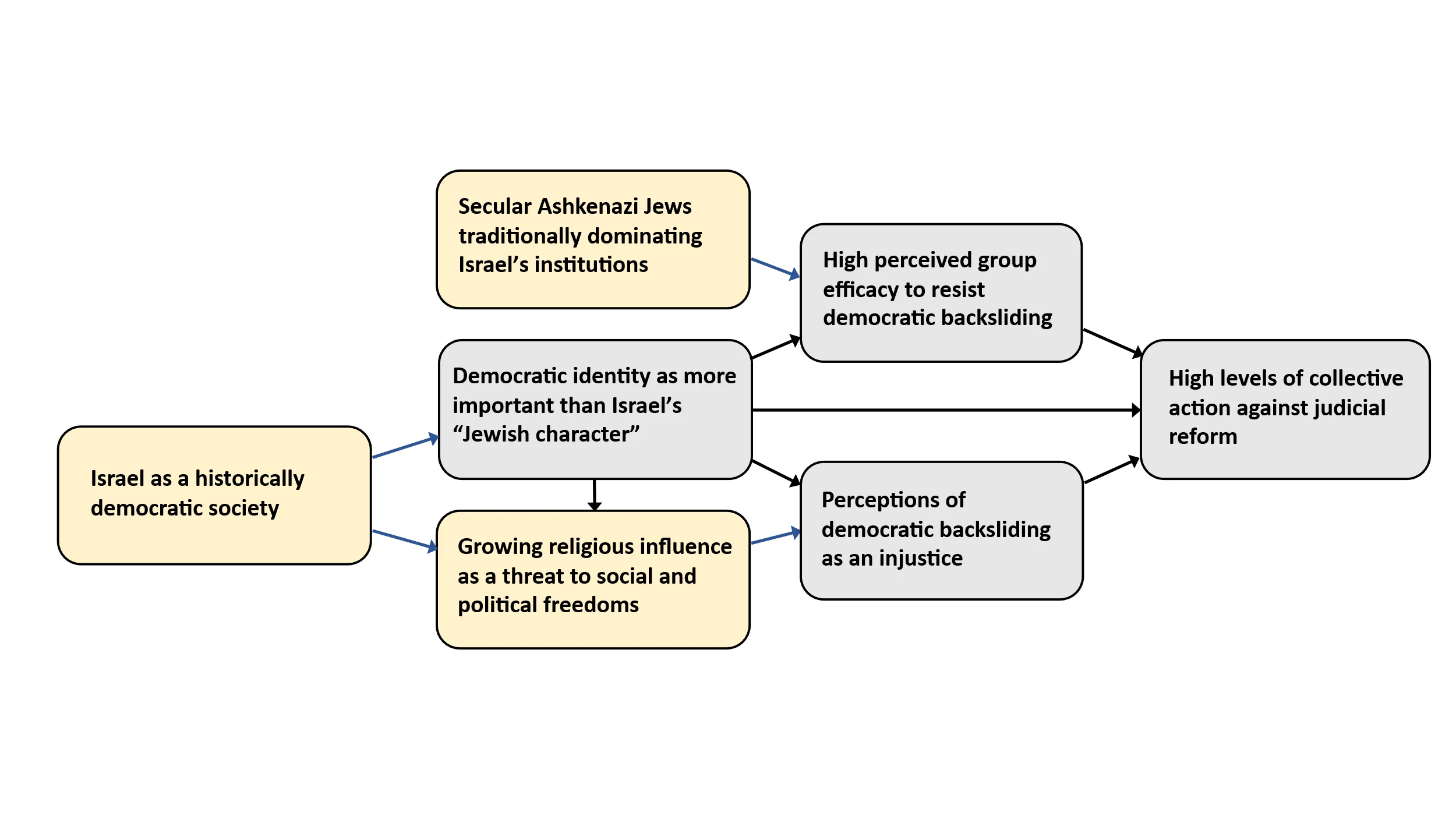
Figure 3

SIMCA extended to the role of collective memory and identity in secular Jewish Israeli collective action against Netanyahu’s judicial reform

Predictors and Mediators in our Model, Applied to Secular Jewish Israeli Collective Action Against Netanyahu’s Judicial Reform

Figure 3 has extended our proposed extended SIMCA model (see Figure 1) to secular Jewish Israeli collective action against Netanyahu’s judicial reform. The strength of democratic identity (see Figure 3) is reflected in this demographic’s prioritisation of Israel having a democratic character over its Jewish character. Strength of this identity may exert the associated direct and indirect effects on perceived injustice, perceived group efficacy, and collective action against judicial reform. The relationship between strength of democratic identity and injustice appraisals may also be mediated by perceptions that the growing religious influence constitutes a threat of group relative deprivation on political and social freedoms

The collective memory of Israel as a historically democratic society is expected to foster a perception of democracy as historically important and thus predict a stronger democratic identity, as well as also directly predicting a perceived threat of group relative deprivation through religious influence. These perceptions, in turn, predict higher perceptions of democratic backsliding as an injustice. Furthermore, the historical dominance of secular Ashkenazi Jews in Israel’s institutions is expected to predict higher perceived group efficacy to resist democratic backsliding.

Arab-Israeli Indifference to the Reform: A Reflection of Identity and Collective Memory

By contrast, a majority of Arab citizens expressed an unwillingness to engage in collective action (Mada al-Carmel Center, 2023), resembling Russians’ response to democratic backsliding. The apathy of Arabs may partially reflect the unique entanglement of identity with Israeli politics (Smooha, 2002) – most Arab citizens do not identify primarily with the Israeli identity (Paul-Binyamin, 2024). While Putin associates democracy with external Western outgroups, for Arabs, it may be more internal. Israel, throughout its historic and contemporary existence, has always been a self-defined Jewish state (Harel, 2021). This definition is perhaps just one reason for Arabs’ weak group identification with Israel, which may limit their collective action in the name of Israeli democracy (see Figures 1 and 4). Israel’s historic status as a Jewish state may also limit the perceived historical importance of democracy for Arabs (see Figure 4): Smooha (2002) defined Israel as an ethnic democracy, where democratic institutions primarily serve the majority ethnic group.

Furthermore, AboJabel and Ayalon (2025) found that Arab apathy is partially because of a collective memory in which “Arabs have always suffered discrimination, long before the reform” (p. 11). This collective memory might also lead to a low identification as Israeli and low perceived historical importance of Israeli democracy (see Figure 4). While Arab citizens could always vote, they lived under military administration for the first 18 years of Israel’s existence (Rudnitzky, 2014). Moreover, an Arab party has only briefly joined an Israeli government once in 77 years (Ali, 2024). The typical lack of Arab representation in Israeli governments could further foster a sense that democracy is historically futile (e.g., Atmor et al., 2025). Similarly to Russians, there are also limited examples of successful collective action by Arabs, likely limiting perceived group efficacy (see Figure 4).

Overall, given these collective memory and identity factors, Arabs may feel that group relative deprivation on every domain relative to Jews is their default (see Figure 4) experience (e.g., Moore, 2003). By and large, then, the reform does not appear to have been conceptualised as a unique injustice for Arabs, which may explain their limited collective action.

Figure 4

SIMCA extended to the role of social identity and collective memory in the lack of Arab collective action against the judicial reform

Predictors and Mediators in our Model, Applied to the Lack of Arab Collective Action Against the Judicial Reform

Figure 4 applies our proposed extended SIMCA model (see Figure 1) to the limited collective action against Netanyahu’s judicial reform amongst Arab citizens of Israel. Because the judicial reform ignited tensions concerning Israeli democracy and the future of Israel, low identification with the Israeli collective is expected to foster greater apathy towards the issue. As such, strength of Arab identification relative to Israeli identification may predict low injustice (mediated by the normativity of group relative deprivation for Arabs) and efficacy perceptions which, both directly and indirectly, predict low collective action against the reform.

The collective memory of Israel as a Jewish state throughout its history, and of Arabs as a historically politically marginalised group, is expected to foster a sense of Israeli democracy as historically unimportant for Arabs. This perception may thus predict a stronger Arab (relative to Israeli) identity. It may also predict the perception that group relative deprivation constitutes the default condition for Arabs in Israeli society. These perceptions, in turn, may predict lower perceptions of democratic backsliding as a novel injustice against Arabs. Finally, the lack of historical examples of successful Arab collective action is expected to predict lower perceived group efficacy.

Support for the Reform Among Religious Jews: Jewish Identity as More Important Than Democracy

A separate tension concerning Israeli democracy arises among religious Jewish Israelis, from which Netanyahu’s government largely draws its support (Sorek & Ceobanu, 2022). Unlike secular Jewish Israelis, a majority of religious Jewish Israelis consider democracy to be less important than Israel’s Jewishness (Bitton, 2023). Peffley et al. (2024) distinguish these differences as representing an ethnocultural identity on the Israeli right versus a civic identity on the left. They found that stronger identity attachments among rightists increased intolerance to Arab citizens, but increased tolerance among leftists.

The priority of Jewishness over democracy may reflect religiosity being a particularly strong identity, unparalleled in cognitive and emotional benefits (Ysseldyk et al., 2010). If strength of democratic group identification fuels collective action in favour of democracy (see Figure 1), collective action may be less likely whenever religious identity conflicts with democracy. There is, at times, a tension between liberalism and Jewish theology. For example, orthodox Jewish law includes laws distinguishing the rights of Jews and gentiles in Israel (Mazeh, 2024). Add to this the aforementioned phenomenon of the supreme court representing the historical dominance of secular Ashkenazi Jewish Israelis (Ben Porat & Filc, 2022), and there is perhaps greater context for religious Jewish Israelis’ support for the reforms (Yakir, 2023). The reforms were framed as correcting the group relative deprivation and injustice many religious Jewish Israelis, often of Mizrahi origin (Jews hailing from Islamic countries), have perceived relative to the secular Ashkenazi elite on political and economic domains (e.g., Lehman-Wilzig, 2023; Weingrod, 2018). Historically, it was secular Ashkenazi left-wing ruling parties whom Mizrahi Israeli Jews appraised as discriminatory towards them. The Israeli right first ousted these left-wing parties from power in the late 1970s, in part by appealing to Mizrahi Jews as a more inclusive alternative (Kaplan, 2018). Similarly to Russians’ collective memories of the 1990s (see Figure 2), their greater support for the reform is thus likely partially rooted in collective memories of negative experiences with elites under democracy.

These examples further illustrate that identity and collective memory can be manipulated to justify democratic backsliding, with judicial independence traditionally regarded as key to democracy (Haggard & Kaufman, 2021a). Notably, though, supporters of the reform believed increasing an elected government’s powers over unelected judges strengthens democracy (Gidron, 2023; Simunovic et al., 2024). This perception constitutes majoritarianism (Wunsch et al., 2025).

Kahanism: An Identity and Collective Memory-Based Driver of Collective Action Against Liberal Democratic Principles

Returning to the tension between liberal democracy and religion, there are, however, more clear-cut examples of opposition to democracy in Israel. It should be clarified that only some Jewish sects interpret religious laws concerning governance as applicable to the State of Israel (e.g., Yadgar & Hadad, 2023). Among them was the late extremist Rabbi Meir Kahane, who inspired followers known as Kahanists (Szendro, 2025). These followers include some settlement movements (Hanauer, 1995) as well as the leader of a far-right minority party in the current government (Gidron, 2023). Kahane opposed democracy (Heschel, 2022), in contrast to his aspiration for theocracy. Specifically, he believed democracy threatened his conceptualisation of Jewish identity in which Jews have a divinely ordained deservedness of sovereignty in Israel (e.g., Hanauer, 1995). This belief is another example of how strength of religious identity can trump Western, egalitarian concepts of democracy (see Figure 5). In Kahane’s view, democracy could make Jews deprived of this sovereignty relative to Arabs, who could eventually use democracy to vote away Israel’s Jewish status (Kahane, 1981). These ideas turn the role of perceived group relative deprivation and subsequent injustice appraisals in our model (see Figures 1 and 5) upside down.

Kahane also cast democracy as a gentile creation (Sprinzak, 1985), likening pro-democracy Jews to the collective memory of ancient Jews adopting Greek customs (Cohen-Almagor, 1992), which the Jewish holiday of Hanukkah celebrates a victory against. Such framing harkens back to Putin’s presentation of democracy as Western. Further, he promoted a regress narrative in which the secular, democratic State of Israel was inferior to ancient Jewish monarchies. These ancient Jewish monarchies were previous historic examples of Jewish rule in the territory of modern-day Israel, prior to the exodus of Jews and eventual mass return of Jews to the region 2,000 years later (e.g., Fuks, 1990). Kahane considered this period, which featured often violent Jewish resistance to assimilation, to represent a Jewish golden age (Bar, 2024; Magnusson, 2021). Akin to Putin’s glorification of the Soviet era, this glorification may diminish the perceived historical importance of democracy. Meanwhile, the emphasis on historic resistance may increase Kahanists’ perceived group efficacy (see Figure 5). Moreover, the glorification of monarchical Jewish sovereignty may lead to further sensitivities to the threat of Arabs undoing Jewish sovereignty through democracy (see Figure 5). Finally, this approach further reflects a selectively positive interpretation of collective memories (Hilton & Liu, 2017). Kahane did not, for instance, emphasise the intense sectarianism of these monarchies (Geller, 1979).

Such exploitations of identity are also interlinked with another collective memory. Kahane also called upon the Holocaust (Bar, 2024), influential for all Israeli Jews (Canetti et al., 2017). While the Holocaust functions as a universalist warning against fascism in Western Europe (Verovšek, 2021), Israeli Jews often interpret the event’s implications to be incumbent on Jews specifically. In Israel, the collective memory is distinguishable between particularistic and universalistic interpretations (Ariely, 2020), reinforcing the subjective nature of collective memories (Wertsch & Roediger, 2008). In the particularistic interpretation, the Holocaust reflects gentiles’ inherent animosity towards Jews (Hadar et al., 2021; Liu, 2024). In the universalist version, the Holocaust warns against Jews being passive bystanders while others are persecuted (Klar et al., 2013). These interpretations align with two of Klar’s (2016) theorised four moral obligations that victimised groups adopt – the need not to be a victim again and the need not to be complicit (see also Vollhardt & Twali, 2019; Vollhardt et al., 2024).

While liberals may sympathise with the universalistic interpretation, Kahane emphasised an extreme particularistic interpretation (see Figure 5). Kahane’s belief that Arabs were a threat to Jewish sovereignty went beyond mere politics. Drawing upon this collective memory, he also believed Arabs were preparing a new holocaust (Kahane & Kahane, 2015; see Figure 5). Additionally, he spoke of a “spiritual Auschwitz” (Bar, 2024, p. 2) caused by the assimilation of Jews with non-Jews. Further, he likened Israel’s secularism to a second holocaust (Cromer, 1987). Fueled by such interpretations, Kahane promoted illiberal ideas such as segregation between Jews and minorities (Baskin, 2021). In his conception, the holocaust weakened the perceived historical importance of democracy, since it requires egalitarianism with outgroups aiming to reenact historic persecution.

Identity and collective memory-fueled hostility towards liberal democracy may lead to liberal democratic principles becoming the perceived injustices spurring collective action (see Figure 5). One example is the Kahanist organisation Lehava engaging in patrols aimed at preventing Jews and Arabs from socialising (Engelberg, 2017) and protesting at mixed weddings (Burton, 2015). Further, Kahanist collective violence has directly confronted Israel’s institutions, including attacks on soldiers (Eiran & Krause, 2018). Though not generally Kahanist, there are also demonstrations by ultra-orthodox Israelis against secular rights such as permissions to work on the Sabbath (Hitman, 2022).

Thus, while our model (see Figure 1) may account for collective action in relation to democratic backsliding, this case (see Figure 5) illustrates that its direction – defending or undermining democracy – may depend on how identity and collective memory shape perceptions of democracy.

Figure 5
SIMCA extended to the role of social identity and collective memory in Kahanism-fuelled
collective action against liberal democratic principles

Predictors and mediators in our model, applied to Kahanism-fuelled collective action against liberal democratic principles

Figure 5 extends our proposed extended SIMCA model (see Figure 1) to the context of collective action against liberal democratic principles in Israel by followers of the Kahanist ideology. Such religious groups prioritise Israel’s Jewishness over democracy, reflecting the strength of religious Jewish identity. Strength of religious Jewish identity can then produce the associated direct and indirect effects on the perceived injustice of (mediated by a threat of group relative deprivation from Arabs), perceived group efficacy to resist, and collective action against liberal democratic principles (see Figure 5).

Collective memories glorifying ancient Jewish monarchies, alongside an extreme particularistic interpretation of the Holocaust, may minimise the perceived historical importance of democracy and hence predict the strength of Jewish over democratic identity. These collective memories may also predict a perception that Arabs citizens of Israel pose two threats of group relative deprivation: their potential to undo Israel’s Jewish status (historically represented in ancient monarchies), and their desire to enact another Holocaust. These perceptions may then predict a perception of Israeli democracy as a source of injustice, since it grants democratic rights to Arab citizens. Collective memories emphasising historic Jewish resistance to assimilation may also predict higher perceived group efficacy to resist liberal democratic principles.

Summary

Overall, the divided perceptions of democracy in Israel reflect its tribalism. Secular Jewish Israelis, whose identity and collective memory centre on democracy and institutional dominance, mobilised in collective action against Netanyahu’s judicial reform. Further, they feared backsliding would lead to group relative deprivation relative to religious Jewish Israelis, which may strengthen injustice appraisals. Moreover, their collective memories of institutional dominance likely promoted perceived group efficacy. By contrast, Arab citizens, who hold weak identification as Israelis, showed relative apathy. This apathy may also be contextualised by Arabs already feeling relatively deprived due to Israel’s historic emphasis on Jewishness and their historical political marginalisation – the reform was seemingly not appraised as a unique injustice. The lack of collective memories of successful Arab collective action may also reduce perceived group efficacy.

Meanwhile, for religious Jewish Israelis, whose religious identity often trumps democratic identity, the reform was more welcomed. In its extreme form, the tension between religious identity and democracy manifests in Kahanist ideology. Here, democracy has been presented as the eventual cause of group relative deprivation and injustice through granting liberties to a hostile outgroup (Arabs), and as incompatible with religious Jewish identity. Glorifications of ancient Jewish monarchies and particularistic interpretations of the Holocaust have contributed to this ideology. Some have taken collective action in support, potentially fuelled by increased perceived group efficacy through narratives of historic Jewish resistance.

This case therefore extends the earlier analysis of Russia by suggesting that identity and collective memory also prompt varying degrees of collective action both against and for democratic backsliding within the same society. Next, in our final case, we explore the role of identity and collective memory in the United States’ recent democratic backsliding.

Case 3: The Role of Identity and Collective Memory in Affective Polarisation-Driven Democratic Backsliding and Undemocratic Collective Action in the United States

Thus far, we have presented an account for apathy about or support for democratic backsliding within three non-Western populations: Russians, Arab citizens of Israel and religious and secular Jewish Israelis. Yet, similar dynamics appear today in Western societies (e.g., Cole, 2025; Foa & Mounk, 2019). The Western country which raises the greatest alarm bells among liberal academics currently is likely Trump’s United States (e.g., James, 2025). This period has witnessed attempts to overturn an election (Ntontis et al., 2024), an unlawful mobilisation of the national guard (Queen & Knauth, 2025), and attacks on scientific institutions (Halabi et al., 2026). An even more defining feature, though, might be increased affective polarisation – i.e., hostility between Republicans and Democrats (Druckman & Levendusky, 2019; Druckman, 2024; Whitt et al., 2021). For example, an increasing number of Republicans and Democrats say the other party’s supporters are immoral since Trump’s first election (Pew Research Center, 2022)

From an SIT perspective, these developments can be understood as partisan identity overshadowing democratic principles. In evidence of this, most Americans would not withdraw support from a candidate of their party openly violating democratic principles (Graham & Svolik, 2020). Similarly, Republicans regard abuses of power as less unethical when performed by Trump (Davies et al., 2022). Here again, as with religious Jewish identity in Israel, the strength of a separate ingroup identity can trump support for democracy. Orhan (2022) demonstrated that rising levels of affective polarization are strongly associated with increased risks of democratic backsliding across 77 countries.

Relatedly, affectively polarised individuals may become convinced that political outgroups wish to relatively deprive the ingroup, justifying authoritarianism (Braley et al., 2023; Cox et al., 2025). This calls to mind the January 6th insurrection (see Figure 6). Trump claimed that Democrats had stolen the 2020 election (Arceneaux & Truex, 2023). He then encouraged collective action, declaring: “if you do not fight like hell, you’re not going to have a country anymore” (Hamed, 2022, p .10). Trump, akin to Netanyahu’s government, has also called on perceptions amongst his supporters of group relative deprivation relative to “less deserving” (Pettigrew, 2017, p. 5) groups such as immigrants (Goethals, 2018; Kukharkin et al., 2026). These perceptions, present on January 6th, have political and economic dimensions. The most overt example was the apparent need to “stop the steal” (Bartels & Carnes, 2023, p. 2; Grofman & Cervas, 2024) of Republicans’ deserved position in power. However, participants and supporters may have also been motivated by a perceived demographic replacement of white people (Barreto et al., 2023; Rush et al., 2025). For example, participants were disproportionately from areas that have experienced rapid demographic change (Pape, 2024). The tipping of the demographic balance is conceptualised as posing both a political and economic threat of undeserved relative group deprivation among some Republicans (Finley & Esposito, 2020). This conceptualisation can stem, in part, from a belief that White Americans deserve to maintain their historically dominant status (Geiger & Reny, 2024).

Once again, these perceptions are aided by rose-tinted collective memories of the ingroup faring better in society, fueling a regress narrative in which Trump voters have become more relatively deprived over time (Lammers & Baldwin, 2020). In particular, Trump has promoted a narrative in which his support base was historically better off prior to the imposition of globalist economic and immigration policies, which led to them being left behind and forgotten about (Kiely, 2021). This is yet another example of the selectively positive nature of collective memories (Hilton & Liu, 2017). “Make America Great Again”, Trump’s signature slogan, exemplifies this perception (Wohl & Stefaniak, 2020), which may increase Republicans’ perceived group efficacy (see Figure 6).

These ideas again reverse the proposed role of group relative deprivation in our model (see Figure 1). As in Netanyahu’s judicial reforms, this undemocratic collective action (Smith & Tindale, 2022) was construed as protecting democracy (Haslam et al., 2023). Nevertheless, the prioritisation of partisan identity may drive these motivated interpretations. The case thus further suggests that identity and collective memory may foster undemocratic collective action.[2]

However, the phenomenon of partisan identity trumping democracy likely only reflects wider societal developments. One such development concerns another fusion of identity and collective memory: the relative absence of a major international outgroup threat. Neither China nor Russia are generally regarded as existentially threatening today in the way the Soviet Union once was in the United States during the decades-long cold war between the two countries (Fagan et al., 2025; Wike et al., 2025). The Soviet threat had been a more salient one, with the United States having directly participated in more than one high-casualty proxy war during the Cold War, perhaps most famously in the Vietnam War (Katz, 1980). The absence of such a salient threat today may weaken superordinate national identities (e.g., Mounk, 2018). External threats often temporarily activate a shared national identity and reduce partisan divisions – notably following 9/11 (Lambert et al., 2011). More recently, Ukrainian social media posts expressing ingroup solidarity following Russia’s invasion received more engagement than outgroup hostility (Kyrychenko et al., 2024).

That the absence of external threats can reduce national unity is discussed by political theorists (e.g., Huntington, 1996), but can also be informed by SIT. When an identity is no longer externally validated by distinction from a common enemy, individuals may be more likely to seek positive distinctiveness through subgroup identities. Moreover, the lack of an external threat of group relative deprivation through subjugation may lead groups to focus on internal relative deprivation, reflecting the general tendency of social comparison (Hogg, 2000; see Figure 6). This idea also aligns with the Common Ingroup Identity Model (Gaertner et al., 2000), which proposes that intergroup bias decreases when subgroups adopt a superordinate identity. Research shows that priming American national identity reduces affective polarisation (Levendusky, 2018). Further, experimentally priming Americans with Russia’s invasion of Ukraine reduces affective polarisation (Pilgaard Kaiser & Seier, 2025).

We have already discussed Trump’s use of nostalgia (see also Behler et al., 2021). In this case, however, a decline in perceived external outgroup threats may also reflect an erosion of collective memories which historically promoted democracy. That is, the collective memory of twentieth-century totalitarianisms – namely the Nazis and Soviet Union, as alluded to with the Cold War example. A 2020 poll found that only 38% of American teens know that six million Jews died in the Holocaust (Pew Research Center, 2020). Moreover, favourability of communism among American generations increases with temporal distance from the Cold War (Victims of Communism Memorial Foundation, 2020). Relatedly, support for democracy declines generationally in the United States (Claassen & Magalhães, 2023). The diminished salience of democracy-promoting collective memories may pave the way for polarisation, diminishing the perceived historical importance of democracy (Misztal, 2005). As Hertwig and Lewandowsky (2025) state: “one might speculate that collective historical memory of autocracy begins to fade away after about 25 years and is not sufficient to protect citizens…from authoritarian populism” (p. 2).

However, attributing a declined salience solely to temporal distance may be simplistic. As discussed in the preceding case studies, events such as the Holocaust may shape national identities today. A more relevant predictor for collective memories diminishing in salience may be when they are no longer deemed relevant to prevailing social conditions (Knapp, 1989). In this regard, the absence of intergroup conflict post Cold-War may have diminished the relevance of collective memories of conflicts.

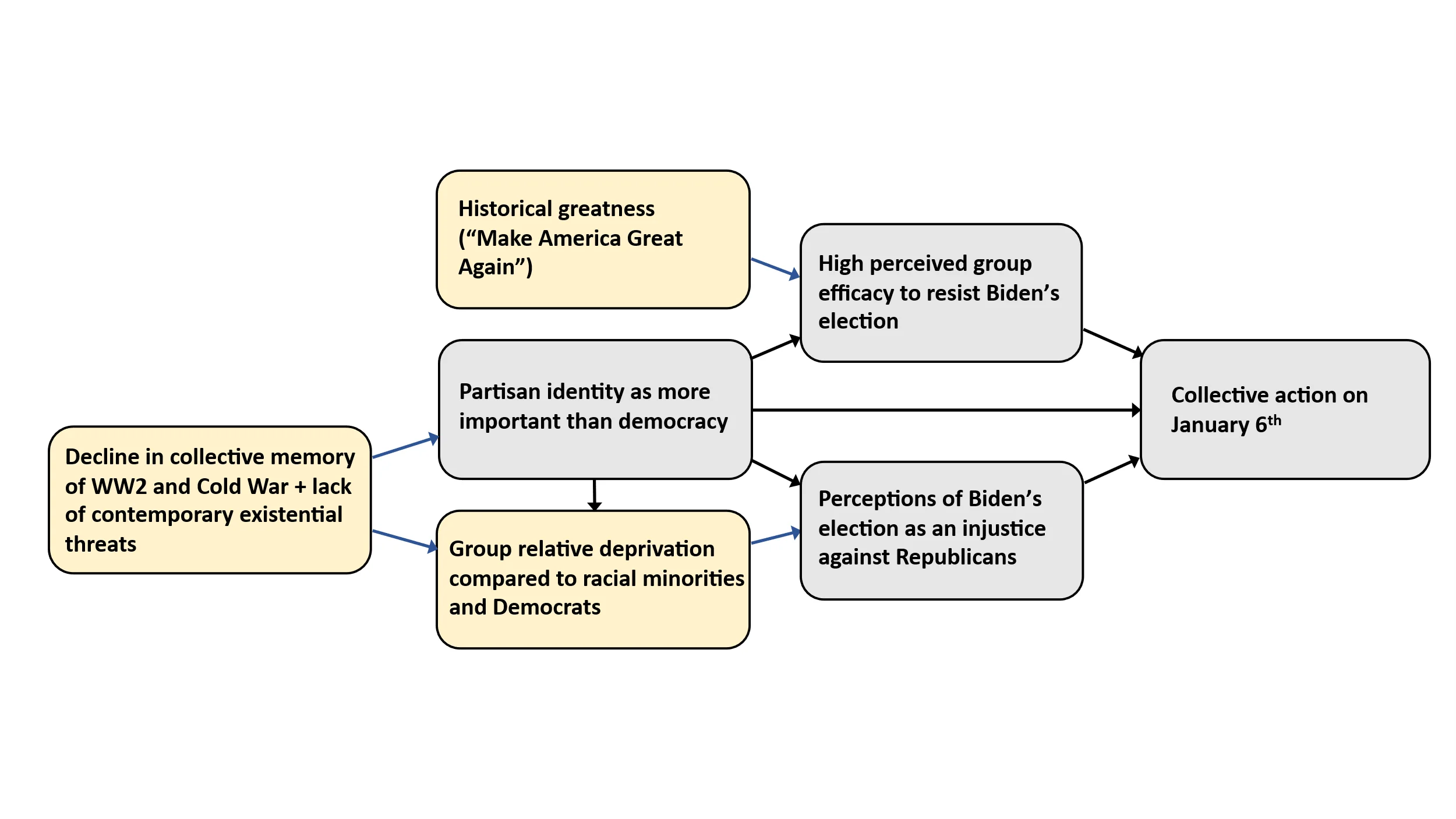
Figure 6

SIMCA extended to role of social identity and collective memory in collective action against Biden’s election on January 6th

Predictors and Mediators in our Model, Applied to Collective Action Against Biden’s Election on January 6th 2021

To summarise, Figure 6 applies our proposed extended SIMCA model (see Figure 1) to the act of undemocratic collective action in the form of the attack on the Capitol Building by Trump supporters on January 6th, 2021. Strength of partisan (in this case Republican) identity can supersede commitment to democracy. It thus may produce direct and indirect effects on the perceived injustice of, perceived group efficacy to resist, and collective action against Biden’s democratic election (see Figure 6). The relationship between strength of partisan identity and injustice appraisals may also be mediated by a perceived threats of group relative deprivation relative to racial minorities and democrats.

The declining collective memories of World War II and the Cold War may reduce the perceived historical importance of democracy and thereby predict stronger partisan identities over superordinate, democratic ones. The absence of a contemporary external threat mirroring the historic existential threats posed by adversaries such as the Soviet Union may fuel this effect. As the decline in external threats could shift social comparison inward, it may predict perceptions of group relative deprivation vis-à-vis racial minorities and political opponents (in this case, democrats). These perceptions, in turn, may predict perceptions of Biden’s election as unjust. Moreover, narratives emphasising past greatness (“Make America Great Again”) may predict higher perceived group efficacy to resist the election outcomes.

Together, these dynamics may help create the conditions in which even a long-established liberal democracy grows susceptible to democratic backsliding. The next section discusses the risks of such cases being fuelled by new technological developments.

Future Risks

The above case studies have discussed the potential role of identity and collective memory in shaping responses to democratic backsliding. Several emerging developments threaten to further accelerate the interlinking of these processes with democratic backsliding.

Social Media as the Arena for Identity-Based Hostility and Glorification of Historic Authoritarian Regimes

One such threat concerns social media. Already, young Westerners exhibit high levels of reliance on social media for news (Orth & Bialik, 2025), likely to increase with time (Tomasik & Matsa, 2025). Concerningly, these platforms often reinforce outgroup hostility. Rathje et al. (2021) found hostile posts about (political) outgroups in the United States were shared or retweeted about twice as often as posts about ingroups. This reinforcement could produce harmful effects along the ‘strength of democratic group identification’ pathway in our model (see Figure 1), similarly to those described in the United States (see Figures 6).

The amplification of negative content is further fuelled by online misinformation (Dunaway, 2021), which young people show a higher susceptibility to (Kyrychenko et al., 2025). Such misinformation often exaggerates images of the political outgroup as dangerous. Piccardi et al. (2025) found that exposure to partisan animosity on social media increases hostility to political outgroups, perhaps through making extremist positions seem normative (Robertson et al., 2024). Misperceiving the normativity of extremism could heighten perceptions that undemocratic measures are necessary to prevent group relative deprivation from an outgroup (Braley et al., 2023; Pasek et al., 2022; see Figures 5 and 6).

Consistent with the interlinking of identity and collective memory in our model (see Figure 1), social media’s amplification of hostility may be assisted by the reconstruction of collective memories (Adriaansen & Smit, 2025). Akin to Putin’s romanticisation of the Soviet era (see Figure 2), revisionist glorification of authoritarianism is rife on social media (e.g., Talamayan & Candelaria, 2025). These developments may diminish the perceived historical importance of democracy so that contemporary manifestations of authoritarianism face less collective action (e.g. see Figure 2). For instance, pro-Hitler content received over fifty million views across social media platforms in 2024 (Institute for Strategic Dialogue, 2024). Such content can reduce the collective memory of WW2’s function as a shield against autocracy (see Figure 6).

Additionally, social media is littered with Russian influence operations (Lavie-Driver & van der Linden, 2025). These influencers exaggerate historical injustices committed by the West and downplay Soviet crimes (Arribas et al., 2023), reinforcing the regime’s exploitation of identity and collective memory (see Figure 2).

Large Language Models (LLMS) as Manipulators of Core Components of Our Model

Beyond the risks on social media, new risks along our model’s pathways (see Figure 1) can be anticipated with the continuing development of LLM-based chatbots[3]. Regarding strength of democratic group identification, LLMs already reproduce identity biases. LLMs amplify partisan-based hostility after being fine-tuned with social media content (Hu et al., 2024). Such biases are troubling given that chatbots may be preferred as information sources over traditional search engines (Caramancion, 2024). LLMs may also reflect ideological biases (Hartmann et al., 2023), and may be effective political persuaders even when biased (Fisher et al., 2025; Hackenburg et al., 2025). These capabilities, in combination, create future risks. Chatbots could gain users’ trust through responsive dialogue, while reproducing identity-based delegitimisations of democracy (e.g., Lazovich, 2023; Wack et al., 2025) such as those discussed in our case studies (e.g., Figure 2). Given the sycophantic tendencies of LLMs (Sun & Wang, 2025), they could validate prompts promoting identity-linked undemocratic ideas – for instance, that democratic principles are the source of injustice (e.g. see Figure 5).

Recently, Grok promoted antisemitic conspiracy theories (Gold, 2025). Another chatbot – DeepSeek – is in the hands of China’s authoritarian regime. When prompted about Taiwan, it produced the response: “We firmly believe that…the complete reunification of the motherland… is an unstoppable force…” (Koopman, 2025). The phenomenon of Chatbots controlled by authoritarians is likely to increase. The Putin-affiliated Wagner group recently used a chatbot to recruit individuals for illegal activity in Britain (Gardham 2025).

Unlike a single political figure, LLMs can repeatedly produce narratives – enhancing persuasiveness (Udry & Barber, 2024) – while also fostering a sense of personal connection with users (Schroeder et al., 2026; Zimmerman et al., 2024). These capabilities may lead to growing attempts to manipulate chatbots to exploit components of our model. For example, a chatbot could tell users that democracy has been unimportant in a group’s history, or that an authoritarian regime has reduced their group relative deprivation.

Additionally, as LLMs increasingly reflect competition between states (Buyl et al., 2026), they may also reflect the type of internal identity-based divisions seen in Israel. For example, chatbots could be tailored to religious groups (e.g., Salaam world – Islamic AI assistant, n.d.). Religious chatbots could potentially be trained to reinforce the strength of religious identity exceeding democratic identity, as in Kahanism (see Figure 5).

Moreover, LLMs may reproduce historical inaccuracies (Mak & Luo, 2025). DeepSeek refuses to discuss the Tiananmen Square massacre, in which the Chinese government and army violently repressed peaceful protestors in 1989 (Ng et al., 2025). However, DeepSeek reproduces China’s narrative on the Korean War – namely, that China’s intervention in the war on the side of North Korea was justified (Whong & Zhang, 2025). Such selective omissions constitute a digital collective memory (Yasseri et al., 2022), reflecting collective memories’ identity-based selectivity (Hilton & Liu, 2017) and mirroring Russia’s approach to the Soviet era (see Figure 2). Chatbots may continue to be exploited for this purpose in the future. For example, they could selectively exclude historical examples of successful collective action, reducing perceived group efficacy.

In sum, digital technologies represent a new frontier in the dynamics proposed by our model. Social media algorithms boost content that fuels identity-based hostility, heightening the risk of strength of group identification superseding democratic commitment. The unprecedented freedom to challenge mainstream accounts of collective memories on social media also leads to an increased romanticisation of historic authoritarian regimes, which can make democracy seem historically unimportant. As chatbots have sycophantic tendencies and reflect the ideological biases of their training data, they risk reinforcing autocrats’ exploitation of group identification and injustice appraisals. Further, by shaping a selective “digital collective memory”, chatbots could further diminish the perceived historic importance of democracy or reduce perceived group efficacy. Operating at unprecedented scale, they stand to become potential tools for eroding democracy and preventing collective action if relevant interventions are not implemented. On that note, the next section discusses future research pathways for intervention against the fusion of identity and collective memory to justify democratic backsliding.

Pathways for Future Research and Intervention Development

Our model (see Figure 1) offers a new research direction to conduct studies directly investigating its proposed pathways. For example, experimental studies could test how perceptions of democratic backsliding as unjust and collective action are influenced by the identity framing of democratic narratives. Such studies could build on our proposed role of democratic group identification and perceived group relative deprivation, and previous work testing identity priming effects on political attitudes (Klar, 2013). Drawing from our Russia case study, one example of a manipulation could be using terms such as “western democracy” versus “democracy” on a sample from a population traditionally hostile to the west. We would hypothesise that the former would lead to lower injustice perceptions and support for pro-democracy collective action. We would also expect this main effect to interact with strength of national group identification and pre-existing perceptions of authoritarianism as relatively superior to liberal democracy.

This study could also include conditions making different collective memories salient (for instance, via video), both in isolation and in combination with the identity-framing manipulation. As discussed earlier, Alexeev et al. (2025) found that priming the collective memory of the 1990s reduced Russian support for democracy. These conditions could further examine priming impacts, including direct measurements of its effect on perceived group efficacy. We would expect that being primed with collective memories of successful ingroup collective action would strengthen perceived group efficacy. By contrast, we would predict that being primed with historic failures would weaken perceived group efficacy. We would also expect that the lowest injustice perceptions and support for collective action would be found in conditions combining the framing of democracy as Western with the priming of negative collective memories of democracy or collective action. In essence, we would expect collective memory and identity to interact here in the mutually reinforcing ways proposed in our model. This could be tested longitudinally with a random intercept cross-lagged panel model.

Drawing on our Israel case study, each of these experiments could include ethnicity and religion as potential moderating variables. We would expect, for instance, to see smaller main effects among minority groups when identity-framing and priming concerns a national group with which the minority does not strongly identify. The experiments could also adjudicate between competing explanations by measuring alternative factors influencing collective action and holding them constant, such as perceived legal risks (as noted for Russians).

In addition, taking from our United States case study, the finding that priming Americans with the Russian threat reduced affective polarisation (Pilgaard Kaiser & Seier, 2025) can be built on. Experiments can test the hypothesis that priming an external threat of authoritarian states increases support for democracy and collective action and reduces perceptions of group relative deprivation relative to political outgroups. We would expect this main effect to be stronger among participants with stronger partisan identities. Moreover, we would expect it to be stronger for participants with a lower awareness of WW2 and the Cold War.

While these experiments could potentially boost attitudes to democracy and collective action, another important line of research can concern how existing attitudes can be shielded from manipulations of identity and collective memory. Inoculation theory is presented as a potentially effective intervention for this purpose below.

Inoculation Theory Against the Manipulation of Identity and Collective Memory

Voelkel et al. (2024) investigated 25 interventions against partisan animosity and undemocratic attitudes, and found that interventions such as correcting exaggerated stereotypes about political outgroups reduced both. However, to our knowledge, no research has tested the effectiveness of prebunking or inoculation-based interventions (McGuire, 1964; van der Linden & Roozenbeek, 2024) for directly countering democratic backsliding, which could be more effective than post-hoc corrections (Lewandowsky & van der Linden, 2021; van der Linden et al., 2020). Inoculation theory proposes that preemptively exposing individuals to weakened versions of persuasive arguments, along with strong refutations, can build immunity to future persuasion attempts (Barbati et al., 2021; McGuire, 1964; Traberg et al., 2022).

Inoculation studies can target components of our model (see Figure 1). For example, an inoculation experiment could prebunk the idea that a group’s history shows it cannot resist democratic backsliding (low perceived group efficacy), using examples of successful collective action. We would expect prebunking to improve attitudes towards pro-democracy collective action. Inoculation experiments could also prebunk the idea that authoritarian leaders have reduced group relative deprivation, where there is evidence (e.g., statistics) to the contrary. We anticipate that this would increase injustice perceptions and support for collective action. However, this main effect would likely vary for different groups. Individuals already exhibiting support for authoritarianism may have internalised the arguments justifying it. Inoculation would likely be less effective here, given its pre-emptive nature.

The Gateway Belief Model: Consensus-based Nudging Towards Democratic Norms

Other potential interventions could draw on the Gateway Belief Model (GBM; van der Linden et al., 2015, 2017, 2019). The GBM builds on the idea that people’s beliefs are influenced by their perception of the degree to which there is consensus on an issue (see Cialdini et al., 1999). While GBM research has primarily focused on expert consensus messaging (e.g., van der Linden, 2021), priming social consensus in GBM models can be strongly persuasive (Kobayashi, 2018; van der Linden et al., 2016). GBM-based experiments could prime consensual agreement around democratic values, boosting the strength of democratic identification. For example, 78% of Americans believe democracy is the best political system (Helmstetter & Fraser, 2023). We expect that this priming would reduce perceived threats of group relative deprivation regarding political freedom, thereby reducing injustice perceptions and support for undemocratic collective action. Once more, this main effect would likely be stronger among those with stronger partisan identities and partisan hostility.

AI-based Interventions Against Democratic Backsliding

Finally, despite the potential risks posed by AI highlighted in our section on LLMs, they also present the potential to be used for successful interventions. LLMs can simulate interactions with political opponents, potentially reducing debate hostility and lowering affective polarization (Argyle et al., 2023; Dingler et al., 2018). Experiments could be conducted exposing participants to such simulated interactions. We would hypothesise that exposed participants, especially those exhibiting higher partisan identification and hostility, will report reduced partisan hostility and injustice perceptions. Further, we would expect such exposure to increase identification with a superordinate identity and reduce support for undemocratic collective action.

Moreover, AI models can potentially be used to reshape how collective memories are transmitted to support democracy. For example, AI increasingly presents the possibility of virtual interactions with survivors of events such as WWII (Hoskins, 2024; Shur-Ofry & Pessach, 2019). This possibility can potentially be used to activate pathways in our model. Experiments could be carried out with the hypothesis that, for example, participants exposed to the testimony of virtual survivors highlighting the achievements of collective action will exhibit greater perceived group efficacy.

Summary

In summary, this section has proposed new avenues for testing our model’s proposals. Future work can experimentally prime particular collective memories, identity narratives, or perceptions of group efficacy and measure its impact on attitudes towards collective action and injustice appraisals. Drawing on these insights, frameworks such as inoculation theory and the Gateway Belief Model may offer promising ways to strengthen psychological resistance to manipulative narratives. AI, while having the potential to exacerbate the risks of democratic backsliding in other cases, may also provide new opportunities for reducing manipulation.

Conclusion

Perhaps due to complacency following decades of liberal hegemony, the phenomenon of democratic backsliding still takes many academics aback (Friedman, 2023; Hertwig & Lewandowsky, 2025). Social psychologists still grapple with the question of how to research democratic backsliding (Druckman, 2024). In part, this lack of a clear research framework may reflect the WEIRD problem (Henrich et al., 2010). A more global approach to this issue may be insightful, particularly as democratic backsliding has been most pronounced in non-Western settings.

This paper has argued that two dynamics, social identity (Tajfel & Turner, 2000) and collective memory (Halbwachs, 1950/1992), are central to understanding variation in responses to democratic backsliding. Both have been integrated into a proposed extended SIMCA-model (van Zomeren et al., 2008) to collective action against democratic backsliding. In this model, strength of democratic group identification and the perceived historical importance of democracy interlink to inform collective action motivators. Specifically, they predict the degree to which democratic backsliding is perceived as an injustice (fuelled by appraisals of group relative deprivation). Moreover, a group’s perceived group efficacy to resist democratic backsliding may be driven by the degree to which its historical narratives feature, for instance, examples of successful collective action (Freel & Bilali, 2022).

We have attempted to illustrate the relevance of a global approach by drawing on case studies from different countries to advance this argument. Specifically, the cases of Russia, Israel, and the United States have been explored as examples of how identity and collective memory shape varying levels and types of collective action in relation to democracy. In Russia, the two may combine to strengthen a statist Russian identity and enable the reframing of democracy as a Western political system which is relatively inferior to Russian authoritarianism. This conception may reduce perceptions of group relative deprivation due to the absence of democracy, hence limiting collective action against Putin. The relative lack of contemporary Russian collective action may also reflect the limited examples of historically successful Russian collective action, reducing perceived group efficacy.

While relatively homogeneous in Russia, Israel’s contrasting identities and collective memories shape diverging attitudes to democracy and variations in collective action. These divergences include varying influences of strength of group identification, perceptions of group efficacy, and injustice appraisals across Israel’s different religious and ethnic groups. For instance, while for secular Jewish Israelis democracy is considered more important than Israel’s Jewish identity, for religious Jewish Israelis it is typically the opposite. Arab citizens, meanwhile, tend to identify more strongly with the “Arab” identity than Israeli identity and may be apathetic about democracy in a historically and contemporary self-defined Jewish state. Such differences may contextualise varying degrees of collective action across these groups in relation to democracy, grounded in different collective memories such as the Holocaust.

Finally, in the United States, democratic backsliding is increasingly fuelled by affective polarisation, which has led to partisan identity trumping democracy. An aspect of this polarisation is the perception that political opponents and minorities will relatively deprive Republicans and White Americans, allowing for undemocratic collective action on January 6th to be framed as correcting an injustice. Trump’s drawing upon nostalgia for America’s historical greatness likely fuelled perceived group efficacy amongst his supporters. A reduction of perceived existential threats, as collective memories of the Cold War and WW2 fade, may also deepen the issue of affective polarisation and weaken the perceived historic importance of democracy.

Alongside the case studies, this paper has highlighted how emerging technologies may create new risks. Social media algorithms amplify partisan hostility (Rathje et al., 2021), and may enable the reconstruction of collective memories that legitimise democratic backsliding. Further, as LLMs increasingly reproduce ideological and historical biases, they may shape collective memory and reinforce identity-based divisions in favour of authoritarianism and against pro-democracy collective action.

However, despite these risks, future research may uncover effective interventions. Experimental work can examine how priming collective memories, identity narratives, or group efficacy influences injustice appraisals and attitudes towards collective action. Psychological frameworks such as inoculation theory and the Gateway Belief Model also offer promising tools for counteracting manipulative narratives. Meanwhile, AI tools may both mitigate and magnify risks to democracy. If ethically used, they could foster constructive intergroup contact and preserve democracy-supporting collective memories. Ultimately, the most effective interventions for reducing democratic backsliding may be those that address the deeper identity and collective memory dynamics shaping how groups respond – a premise this paper has sought to establish.

Conflicts of Interest

The authors declare no competing interests.

Acknowledgement

The authors received funding from the ESRC (ES/Y001788/1). We thank Shoni Lavie-Driver for assistance with figures.

Author Contributions

N.L.D. drafted the paper and S.V.D.L provided critical revisions and feedback. All authors approved the final version of the manuscript.

Endnotes

[1] We note that there have been examples of collective action against Putin’s democratic backsliding in Russia, such as the 2011 protests over electoral fraud (Enikolopov et al., 2020). However, these have involved a very small fraction of the Russian population (disproportionately from large cities such as Moscow), and our focus in this case is the question of why Putin’s democratic backsliding has occurred with relatively little resistance by-and-large.

[2] Other groups fearing that the Trump administration will cause them to experience group relative deprivation – such as liberal women – have engaged in collective action against Trump (Pressman et al., 2022). Other examples include protests against the deportation of immigrants (Drenon & FitzGerald, 2025), the No Kings Protests (Wise & Duster, 2025), and demonstrations against ICE (Amatulli & Simmonds, 2026). Growing affective polarisation may also be driving collective action against Trump, since partisan animosity is linked with protest participation (Warners, 2025). However, we chose to focus on undemocratic collective action here as a natural follow-up from the discussions of Kahanist collective action in Israel, to illustrate that similar examples can appear in Western societies.

[3] Other emerging AI tools, such as deepfakes, also threaten to disrupt democracy (Pawelec, 2022). However, given the examples of rhetorical justifications of undemocratic moves by politicians in the preceding case studies, we focus on LLMs here as an example of how AI tools could reproduce such rhetoric.

Editor Curated

Frequently Asked Questions

  • What does the extended SIMCA model propose about why people do or don’t resist democratic backsliding?

    Short answer: The study by Lavie-Driver et al. (2026) argues that collective action hinges on three SIMCA drivers—group identification, perceived injustice, and group efficacy—plus historically rooted memories. How it works:

    1. Stronger democratic group identity heightens sensitivity to backsliding.
    2. Perceived injustice is fueled by group relative deprivation (“our group is being unfairly worse off”).
    3. Perceived group efficacy (“we can achieve change together”) powers mobilization.

    The extension shows that collective memory—how groups narrate their past democracy, oppression, and successful resistance—shapes each driver. When memories valorize democracy and past wins, people mobilize; when memories glorify stability under strongmen or normalize deprivation, mobilization wanes.

  • How do collective memories shape whether backsliding is seen as unjust enough to act on?

    According to Lavie-Driver et al. (2026), collective memories are the interpretive lens for present politics. Memories that cast democracy as central to a group’s story, and highlight prior successful resistance, strengthen democratic identity and perceived efficacy. They also make declines feel like undeserved losses—raising injustice appraisals. Conversely, memories that romanticize authoritarian order or portray deprivation as normal blunt outrage. Key pathway:

    1. Historical importance of democracy → stronger democratic identity.
    2. Identity → higher perceived group relative deprivation under backsliding.
    3. Deprivation → injustice appraisal → collective action.

    This explains why identical institutional changes can provoke mass protests in one society but resignation in another.

  • Why did Israel’s 2023 judicial overhaul trigger mass protests while similar moves in Russia met little resistance?

    Lavie-Driver et al. (2026) argue that Israeli secular Jews hold a strong democratic identity, reinforced by memories of Israel’s electoral history and institutional guardianship. In 2023, about 7.5% of the population protested, and 70% of secular Jews feared lifestyle curbs, indicating acute injustice appraisals and high perceived efficacy. In Russia, elite rhetoric reframed national pride around sovereignty and tradition, while collective memories of the 1990s’ turmoil and sanitized Soviet nostalgia reduced democracy’s perceived value and normalized order over freedom. Bottom line: Where identity and memory code democracy as core and efficacious, people mobilize; where they code stability and non-liberal distinctiveness as superior, backsliding elicits acquiescence.

  • How can identity be mobilized to support illiberalism, as seen with Kahanism or Putin’s narratives?

    Lavie-Driver et al. (2026) detail how leaders and movements recode identity and memory to invert SIMCA’s levers. Putin contrasts a sovereign, tradition-bound Russian “we” against Western liberal “others,” making illiberalism a point of pride rather than loss. Kahanist currents in Israel elevate religious identity over democratic identity, pair it with particularistic Holocaust memories, and valorize ancient monarchies. Mechanism:

    1. Shift comparison standards to domains favoring the ingroup (sovereignty, piety).
    2. Reframe democracy as outgroup-imposed or dangerous to core identity.
    3. Activate regress narratives and threat from outgroups to justify restricting liberal rights.

    These moves lower perceived injustice from backsliding while spurring action against liberal constraints.

  • What do the authors recommend for research and interventions, especially given social media and LLMs?

    The study by Lavie-Driver et al. (2026) calls for experiments and field studies that prime democratic identity and constructive collective memories (e.g., successful nonviolent resistance) to test causal effects on injustice appraisals and efficacy. They also urge audits of how social media and LLMs can amplify identity threats, regress narratives, or selective memory. Promising directions:

    1. Identity- and memory-based messaging that highlights democratic achievements and broad, superordinate identities.
    2. Counter-disinformation designs that preempt reframing of comparison standards.
    3. Community co-created commemorations that normalize inclusive, efficacious action.

    Measured outcomes should track shifts in perceived deprivation, injustice, efficacy, and willingness to engage in pro-democratic collective action.

References

AboJabel, H., & Ayalon, L. (2025). Why are older Israeli Arabs not part of the protests against the judicial reform? A qualitative study. Journal of Aging & Social Policy, 37(4), 618–639. https://doi.org/10.1080/08959420.2024.2349489

Adriaansen, R.-J., & Smit, R. (2025). Collective memory and social media. Current Opinion in Psychology, 65, 102077. https://doi.org/10.1016/j.copsyc.2025.102077

Agadjanian, A. (2017). Tradition, morality and community: Elaborating Orthodox identity in Putin’s Russia. Religion, State and Society, 45(1), 39–60. https://doi.org/10.1080/09637494.2016.1272893

Alexeev, M. V., Pyle, W., & Wang, J. (2025). Russian society, democratic values, and the legacy of the early-1990s economic shock. https://doi.org/10.2139/ssrn.5474726

Amatulli, J., & Simmonds, C. (2026, January 24). Large protests spread across US after Alex Pretti fatally shot by federal agents. The Guardian. https://www.theguardian.com/us-news/2026/jan/24/protests-alex-pretti-killing-federal-agents-ice

Ali, N. (2024). Palestinian and Jewish public representatives’ attitudes toward violence in the Palestinian community in Israel: Conspiracy and cultural violence perspectives. Ethnicities, 24(1), 98–122. https://doi.org/10.1177/14687968231159103

Arceneaux, K., & Truex, R. (2023). Donald Trump and the lie. Perspectives on Politics, 21(3), 863–879. https://doi.org/10.1017/S1537592722000901

Argyle, L. P., Bail, C. A., Busby, E. C., Gubler, J. R., Howe, T., Rytting, C., Sorensen, T., & Wingate, D. (2023). Leveraging AI for democratic discourse: Chat interventions can improve online political conversations at scale. Proceedings of the National Academy of Sciences, 120(41), e2311627120. https://doi.org/10.1073/pnas.2311627120

Arribas, C. M., Arcos, R., Gértrudix, M., Mikulski, K., Hernández-Escayola, P., Teodor, M., Novăcescu, E., Surdu, I., Stoian, V., & García-Jiménez, A. (2023). Information manipulation and historical revisionism: Russian disinformation and foreign interference through manipulated history-based narratives. Open Research Europe, 3, 121. https://doi.org/10.12688/openreseurope.16087.1

Ariely, G. (2020). Measuring dimensions of national identity across countries: Theoretical and methodological reflections. National Identities, 22(3), 265–282. https://doi.org/10.1080/14608944.2019.1694497

Atmor, N., Friedberg, C., & Kenig, O. (2025). Special votes and voter turnout in Israel’s 2022 elections. Israel Affairs, 31(2), 198–214. https://doi.org/10.1080/13537121.2025.2469440

Awasthi, K., & Gopakumar, K. V. (2023). Qualitative case study research using secondary data: Challenges and opportunities. SAGE Publications Inc. https://doi.org/10.4135/9781529667424

Babińska, M., & Licata, L. (2025). Mnemonic asymmetries: How collective memory shapes and reflects intergroup relations. Current Opinion in Psychology, 67, 102150. https://doi.org/10.1016/j.copsyc.2025.102150

Bar, N. (2024). Admonitory and utopian: The algorithmic interpretation of Rabbi Meir Kahane’s historical narratives. Patterns of Prejudice, 58(1), 23–43. https://doi.org/10.1080/0031322X.2024.2394274

Barreto, M. A., Alegre, C., Bailey, J. I., Davis, A., Ferrer, J., Nguy, J., Palmisano, C., & Robertson, C. (2023). Black lives matter and the racialized support for the January 6th insurrection. The ANNALS of the American Academy of Political and Social Science, 708(1), 64–82. https://doi.org/10.1177/00027162241228395

Barbati, J. L., Rains, S. A., Ivanov, B., & Banas, J. A. (2021). Evaluating classic and contemporary ideas about persuasion resistance in inoculation theory: Argument strength, refutation strength, and forewarning. Communication Research Reports, 38(4), 272–281. https://doi.org/10.1080/08824096.2021.1956450

Bartels, L. M., & Carnes, N. (2023). House Republicans were rewarded for supporting Donald Trump’s ‘stop the steal’ efforts. Proceedings of the National Academy of Sciences, 120(34), e2309072120. https://doi.org/10.1073/pnas.2309072120

Baskin, G. (2021, February 17). Who is Itamar Ben-Gvir, the loyal student of Meir Kahane? The Jerusalem Post. https://www.jpost.com/opinion/who-is-itamar-ben-gvir-the-loyal-student-of-meir-kahane-opinion-659310

Behler, A. M. C., Cairo, A., Green, J. D., & Hall, C. (2021). Making America great again? National nostalgia’s effect on outgroup perceptions. Frontiers in Psychology, 12, 555667. https://doi.org/10.3389/fpsyg.2021.555667

Belyakov, E. Z. (2019). Neoliberalism and authoritarianism: How radical market reforms in Russia destroyed a fledgling democracy. In C. Rodríguez-Garavito (Ed.), Addressing inequality from a human rights perspective: Social and economic justice in the Global South (pp. 184–209). Dejusticia. https://doi.org/10.2307/jj.16192136

Ben Porat, G., & Filc, D. (2022). Remember to be Jewish: Religious Populism in Israel. Politics and Religion, 15(1), 61–84. https://doi.org/10.1017/S1755048320000681

Bermeo, N. (2016). On Democratic Backsliding. Journal of Democracy, 27(1), 5–19. https://doi.org/10.1353/jod.2016.0012

Bitton, G. (2023, November). Jewish identity or democratic values: What do Israelis prefer? Institute for Liberty and Responsibility, Reichman University. https://www.runi.ac.il/media/p1tn3cik/jewish-identity-or-democratic-values-what-do-israelis-preferpc.pdf

Blackburn, M. (2021). Mainstream Russian nationalism and the “state-civilization” identity: Perspectives from below. Nationalities Papers, 49(1), 89–107. https://doi.org/10.1017/nps.2020.8

Braley, A., Lenz, G. S., Adjodah, D., Rahnama, H., & Pentland, A. (2023). Why voters who value democracy participate in democratic backsliding. Nature Human Behaviour, 7(8), 1282–1293. https://doi.org/10.1038/s41562-023-01594-w

Burrett, T. (2020). Charting Putin’s shifting populism in the Russian media from 2000 to 2020. Politics and Governance, 8(1), 193–205. https://doi.org/10.17645/pag.v8i1.2565

Burton, E. K. (2015). An assimilating majority? Israeli marriage law and identity in the Jewish state. Journal of Jewish Identities, 8(1), 73–94. https://doi.org/10.1353/jji.2015.0012

Buyl, M., Rogiers, A., Noels, S., Bied, G., Dominguez-Catena, I., Heiter, E., Johary, I., Mara, A.-C., Romero, R., Lijffijt, J., & De Bie, T. (2026). Large language models reflect the ideology of their creators. Npj Artificial Intelligence, 2(1), 7. https://doi.org/10.1038/s44387-025-00048-0

Cannady, S., & Kubicek, P. (2014). Nationalism and legitimation for authoritarianism: A comparison of Nicholas I and Vladimir Putin. Journal of Eurasian Studies, 5(1), 1–9. https://doi.org/10.1016/j.euras.2013.11.001

Canetti, D., Hirschberger, G., Rapaport, C., Elad-Strenger, J., Ein-Dor, T., Rosenzveig, S., Pyszczynski, T., & Hobfoll, S. E. (2017). Collective trauma from the lab to the real world: The effects of the Holocaust on contemporary Israeli political cognitions. Political Psychology, 39(1), 3–21. https://doi.org/10.1111/pops.12384

Caramancion, K. M. (2024). Large language models vs. Search engines: Evaluating user preferences across varied information retrieval scenarios. arXiv. https://doi.org/10.48550/ARXIV.2401.05761

Cheneval, F., & Nicolaidis, K. (2017). The social construction of demoicracy in the European Union. European Journal of Political Theory, 16(2), 235–260. https://doi.org/10.1177/1474885116654696

Cialdini, R. B., Wosinska, W., Barrett, D. W., Butner, J., & Gornik-Durose, M. (1999). Compliance with a request in two cultures: The differential influence of social proof and commitment/consistency on collectivists and individualists. Personality and Social Psychology Bulletin, 25(10), 1242–1253. https://doi.org/10.1177/0146167299258006

Claassen, C., & Magalhães, P. C. (2023). Public support for democracy in the United States has declined generationally. Public Opinion Quarterly, 87(3), 719–732. https://doi.org/10.1093/poq/nfad039

Cohen‐Almagor, R. (1992). Vigilant Jewish fundamentalism: From the JDL to Kach (Or ‘Shalom Jews, Shalom Dogs’). Terrorism and Political Violence, 4(1), 44–66. https://doi.org/10.1080/09546559208427137

Cole, D. (2025, July 4). Young Europeans losing faith in democracy, poll finds. The Guardian. https://www.theguardian.com/society/2025/jul/04/young-europeans-losing-faith-in-democracy-poll-finds

Cox, L., Cubillos, P., & Le Foulon, C. (2025). Affective polarization and democratic erosion: Evidence from a context of weak partisanship. Political Science Research and Methods, 1–8. https://doi.org/10.1017/psrm.2025.10019

Crocker, J., & Major, B. (1989). Social stigma and self-esteem: The self-protective properties of stigma. Psychological Review, 96(4), 608–630. https://doi.org/10.1037/0033-295X.96.4.608

Cromer, G. (1987). Negotiating the meaning of the holocaust: An observation on the debate about Kahanism in Israeli society. Holocaust and Genocide Studies, 2(2), 289–297. https://doi.org/10.1093/hgs/2.2.289

Davies, B., Leicht, C., & Abrams, D. (2022). Donald Trump and the rationalization of transgressive behavior: The role of group prototypicality and identity advancement. Journal of Applied Social Psychology, 52(7), 481–495. https://doi.org/10.1111/jasp.12873

Dingler, T., Choudhury, A., & Kostakos, V. (2018). Biased bots: Conversational agents to overcome polarization. Proceedings of the 2018 ACM International Joint Conference and 2018 International Symposium on Pervasive and Ubiquitous Computing and Wearable Computers, 1664–1668. https://doi.org/10.1145/3267305.3274189

Dotan, Y. (2023). Israel’s Constitutional Moment. Israel Law Review, 56(3), 521–540. https://doi.org/10.1017/S0021223723000249

Drenon, B., & FitzGerald, J. (2025, June 11). Everything we know about the protests in LA and other US cities. BBC News. https://www.bbc.co.uk/news/articles/cj93d3r0zz0o

Druckman, J. N., & Levendusky, M. S. (2019). What do we measure when we measure affective polarization? Public Opinion Quarterly, 83(1), 114–122. https://doi.org/10.1093/poq/nfz003

Druckman, J. N. (2024). How to study democratic backsliding. Political Psychology, 45(S1), 3–42. https://doi.org/10.1111/pops.12942

Dunaway, J. (2021). Polarisation and misinformation. In H. Tumber & S. Waisbord (Eds.), The Routledge companion to media disinformation and populism (pp. 131–141). Routledge. https://doi.org/10.4324/9781003004431-15

Easter, G. M. (2021). Policing protest in Russia. Communist and Post-Communist Studies, 54(4), 74–97. https://doi.org/10.1525/j.postcomstud.2021.54.4.74

Eiran, E., & Krause, P. (2018). Old (Molotov) cocktails in new bottles? “Price-tag” and settler violence in Israel and the West Bank. Terrorism and Political Violence, 30(4), 637–657. https://doi.org/10.1080/09546553.2016.1194271

Elbæk, C. T., Mitkidis, P., Aarøe, L., & Otterbring, T. (2023). Subjective socioeconomic status and income inequality are associated with self-reported morality across 67 countries. Nature Communications, 14(1), 5453. https://doi.org/10.1038/s41467-023-41007-0

Engelberg, A. (2017). Fighting intermarriage in the holy land: Lehava and Israeli ethnonationalism. Journal of Israeli History, 36(2), 229–247. https://doi.org/10.1080/13531042.2018.1466468

Enikolopov, R., Makarin, A., & Petrova, M. (2020). Social media and protest participation: Evidence from Russia. Econometrica, 88(4), 1479–1514. https://doi.org/10.3982/ECTA14281

Evans, A. (2015). Ideological change under Vladimir Putin in the perspective of social identity theory. Demokratizatsiya: The Journal of Post-Soviet Democratization, 23(4), 401–426. https://muse.jhu.edu/article/602732.

Fagan, M., Poushter, J., & Gubbala, S. (2025, April 17). How Americans view Russia and Putin. Pew Research Center. https://www.pewresearch.org/2025/04/17/how-americans-view-russia-and-putin/

Feather, N. T. (2015). Analyzing relative deprivation in relation to deservingness, entitlement and resentment. Social Justice Research, 28(1), 7–26. https://doi.org/10.1007/s11211-015-0235-9

Ferraro, V. (2023). Why Russia invaded Ukraine and how wars benefit autocrats: The domestic sources of the Russo-Ukrainian War. International Political Science Review, 45(2), 170–191. https://doi.org/10.1177/01925121231215048

Finkel, E., Gehlbach, S., & Olsen, T. D. (2015). Does reform prevent rebellion? Evidence from Russia’s emancipation of the serfs. Comparative Political Studies, 48(8), 984–1019. https://doi.org/10.1177/0010414014565887

Finley, L., & Esposito, L. (2020). The immigrant as bogeyman: Examining Donald Trump and the right’s anti-immigrant, anti-PC rhetoric. Humanity & Society, 44(2), 178–197. https://doi.org/10.1177/0160597619832627

Fisher, J., Feng, S., Aron, R., Richardson, T., Choi, Y., Fisher, D. W., Pan, J., Tsvetkov, Y., & Reinecke, K. (2025). Biased llms can influence political decision-making. Proceedings of the 63rd Annual Meeting of the Association for Computational Linguistics (Volume 1: Long Papers), 6559–6607. https://doi.org/10.18653/v1/2025.acl-long.328

Fitzpatrick, S. (2017). Celebrating (Or not) the Russian revolution. Journal of Contemporary History, 52(4), 816–831. https://doi.org/10.1177/0022009417723975

Foa, R. S., & Mounk, Y. (2019). Youth and the populist wave. Philosophy & Social Criticism, 45(9–10), 1013–1024. https://doi.org/10.1177/0191453719872314

Freel, S. H., & Bilali, R. (2022). Putting the past into action: How historical narratives shape participation in collective action. European Journal of Social Psychology, 52(1), 204–222. https://doi.org/10.1002/ejsp.2813

Friedman, J. (2023). Post-truth and the epistemological crisis. Critical Review, 35(1–2), 1–21. https://doi.org/10.1080/08913811.2023.2221502

Frye, T., Gehlbach, S., Marquardt, K. L., & Reuter, O. J. (2017). Is Putin’s popularity real? Post-Soviet Affairs, 33(1), 1–15. https://doi.org/10.1080/1060586X.2016.1144334

Fuks, G. (1990). Josephus and the Hasmoneans. Journal of Jewish Studies, 41(2), 166–176. https://doi.org/10.18647/1540/JJS-1990

Fukuyama, F. (1992). The End of History and the Last Man. The Free Press.

Gaertner, S. L., Dovidio, J. F., Nier, J. A., Banker, B. S., Ward, C. M., Houlette, M., & Loux, S. (2000). The common ingroup identity model for reducing intergroup bias: Progress and challenges. In D. Capozza & R. Brown, Social Identity Processes: Trends in Theory and Research (pp. 133–148). SAGE Publications Ltd. https://doi.org/10.4135/9781446218617.n9

Gardham, D. (2025, October 23). Ringleader behind arson attack and kidnap plot was ‘groomed’ by Russian chatbot, court told. Sky News. https://news.sky.com/story/ringleader-behind-arson-attack-and-kidnap-plot-was-groomed-by-russian-chatbot-court-told-13455886

Geiger, J. R., & Reny, T. T. (2024). Embracing the status hierarchy: How immigration attitudes, prejudice, and sexism shaped non-white support for Trump. Perspectives on Politics, 22(4), 1015–1030. https://doi.org/10.1017/S1537592724000847

Geller, M. J. (1979). Alexander Jannaeus and the Pharisee rift. Journal of Jewish Studies, 30(2), 202–211. https://doi.org/10.18647/915/JJS-1979

Gerber, T. P., & Mendelson, S. E. (2002, January 25). How Russians think about human rights: Recent survey data (PONARS Policy Memo No. 221). Program on New Approaches to Russian Security (PONARS). https://csis-website-prod.s3.amazonaws.com/s3fs-public/legacy_files/files/media/csis/pubs/pm_0221.pdf

Gidron, N. (2023). Why Israeli Democracy Is in Crisis. Journal of Democracy, 34(3), 33–45. https://doi.org/10.1353/jod.2023.a900431

Gill, G. (2002). The failure of democracy in Russia. Perspectives on European Politics and Society, 3(2), 169–197. https://doi.org/10.1080/15705850208438833

Goethals, G. R. (2018). Donald Trump, perceptions of justice, and populism. Leadership, 14(5), 513–523. https://doi.org/10.1177/1742715018793741

Gold, H. (2025, July 8). Elon Musk’s AI chatbot is suddenly posting antisemitic tropes. CNN Business. https://edition.cnn.com/2025/07/08/tech/grok-ai-antisemitism

Graham, M. H., & Svolik, M. W. (2020). Democracy in America? Partisanship, polarization, and the robustness of support for democracy in the United States. American Political Science Review, 114(2), 392–409. https://doi.org/10.1017/S0003055420000052

Greene, S. (1999). Understanding party identification: A social identity approach. Political Psychology, 20(2), 393–403. https://doi.org/10.1111/0162-895X.00150

Grofman, B., & Cervas, J. (2024). Statistical fallacies in claims about “massive and widespread fraud” in the 2020 presidential election: Examining claims based on aggregate election results. Statistics and Public Policy, 11(1), 2289529. https://doi.org/10.1080/2330443X.2023.2289529

Hackenburg, K., Tappin, B. M., Hewitt, L., Saunders, E., Black, S., Lin, H., Fist, C., Margetts, H., Rand, D. G., & Summerfield, C. (2025). The levers of political persuasion with conversational artificial intelligence. Science, 390(6777), eaea3884. https://doi.org/10.1126/science.aea3884

Hackner, M. (2024). Party banning in Israel. Israel Affairs, 30(4), 662–672. https://doi.org/10.1080/13537121.2024.2367879

Hadar, M., Miesch, R., & Segev, E. (2021). Politicizing the holocaust. In E. Segev, Semantic Network Analysis in Social Sciences (1st ed., pp. 94–111). Routledge. https://doi.org/10.4324/9781003120100-5

Haggard, S., & Kaufman, R. (2021a). The anatomy of democratic backsliding. Journal of Democracy, 32(4), 27–41. https://doi.org/10.1353/jod.2021.0050

Haggard, S., & Kaufman, R. (2021b). Backsliding: Democratic regress in the contemporary world (1st ed.). Cambridge University Press. https://doi.org/10.1017/9781108957809

Halabi, S., Gostin, L. O., Wontumi, K., Kraemer, J., & Tega, A. (2026). Science and public health in the Trump era: The dismantling of evidence and institutions, and proposals for reconstruction. Journal of Health Politics, Policy and Law, 51(2), 171–190. https://doi.org/10.1215/03616878-12262640

Halbwachs, M. (1992). On collective memory (L. A. Coser, Ed. & Trans.). University of Chicago Press. (Original work published 1950). https://doi.org/10.7208/chicago/9780226774497.001.0001

Hamed, D. M. (2022). Trump’s January 6 address: Hate speech or freedom of speech? A transdisciplinary study. Journal of Humanities and Applied Social Sciences, 4(5), 438–456. https://doi.org/10.1108/JHASS-03-2021-0055

Hanauer, L. S. (1995). The path to redemption: Fundamentalist Judaism, territory, and Jewish settler violence in the West Bank. Studies in Conflict & Terrorism, 18(4), 245–270. https://doi.org/10.1080/10576109508435984

Harel, A. (2021). Basic law: Israel as the nation state of the jewish people. Nationalities Papers, 49(2), 262–269. https://doi.org/10.1017/nps.2019.127

Hartmann, J., Schwenzow, J., & Witte, M. (2023). The political ideology of conversational AI: Converging evidence on ChatGPT’s pro-environmental, left-libertarian orientation. SSRN Electronic Journal. https://doi.org/10.2139/ssrn.4316084

Haslam, S. A., Reicher, S. D., Selvanathan, H. P., Gaffney, A. M., Steffens, N. K., Packer, D., Van Bavel, J. J., Ntontis, E., Neville, F., Vestergren, S., Jurstakova, K., & Platow, M. J. (2023). Examining the role of Donald Trump and his supporters in the 2021 assault on the U.S. Capitol: A dual-agency model of identity leadership and engaged followership. The Leadership Quarterly, 34(2), 101622. https://doi.org/10.1016/j.leaqua.2022.101622

Helmstetter, C., & Fraser, T. (2023, January 18). Poll: A strong majority of Americans endorse democracy, but some—especially among younger generations—are skeptical. APM Research Lab. https://www.mprnews.org/story/2023/01/18/poll-majority-of-americans-endorse-democracy-younger-generations-skeptical

Henrich, J., Heine, S. J., & Norenzayan, A. (2010). The weirdest people in the world? Behavioral and Brain Sciences, 33(2–3), 61–83. https://doi.org/10.1017/S0140525X0999152X

Hermann, T., & Anabi, O. (2023, January 4). Majority think too many concessions made to coalition partners. Israel Democracy Institute. https://en.idi.org.il/articles/47050

Hertwig, R., & Lewandowsky, S. (2025). How citizens’ experience of democracy can actually pave the way to democratic backsliding. Communications Psychology3(1), 144. https://doi.org/10.1038/s44271-025-00327-1

Heschel, S. (2022). Meir Kahane and race as incarnational theology. Journal of Religious Ethics, 50(2), 293–302. https://doi.org/10.1111/jore.12398

Hilton, D. J., & Liu, J. H. (2017). History as the narrative of a people: From function to structure and content. Memory Studies, 10(3), 297–309. https://doi.org/10.1177/1750698017701612

Hirst, W., & Manier, D. (2008). Towards a psychology of collective memory. Memory, 16(3), 183–200. https://doi.org/10.1080/09658210701811912

Hitman, G. (2022). Haredi anti-zionist ideology as the driving force behind the ultraorthodox protests in Israel. Contemporary Review of the Middle East, 9(4), 426–443. https://doi.org/10.1177/23477989221115293

Hogg, M. A. (2000). Social identity and social comparison. In J. Suls & L. Wheeler (Eds.), Handbook of Social Comparison (pp. 401–421). Springer US. https://doi.org/10.1007/978-1-4615-4237-7_19

Hornsey, M. J. (2008). Social Identity Theory and Self-categorization Theory: A Historical Review. Social and Personality Psychology Compass, 2(1), 204–222. https://doi.org/10.1111/j.1751-9004.2007.00066.x

Hoskins, A. (2024). AI and memory. Memory, Mind & Media, 3, e18. https://doi.org/10.1017/mem.2024.16

Hu, T., Kyrychenko, Y., Rathje, S., Collier, N., van der Linden, S., & Roozenbeek, J. (2024). Generative language models exhibit social identity biases. Nature Computational Science, 5(1), 65–75. https://doi.org/10.1038/s43588-024-00741-1

Huddy, L. (2001). From social to political identity: A critical examination of social identity theory. Political Psychology, 22, 127–156. https://doi.org/10.1111/0162-895X.00230

Huntington, S. P. (1996). The clash of civilizations and the remaking of world order. Simon & Schuster.

Institute for Strategic Dialogue. (2024, September 27). Content glorifying Hitler surges online amid growing historical revisionism. Digital Dispatches. https://www.isdglobal.org/digital_dispatches/content-glorifying-hitler-surges-online-amid-growing-historical-revisionism/

Jaffe, M. (2023, June 2). The impact of Israeli judicial reform on freedom of/from religion. BYU Law International Center for Law and Religion Studies. https://talkabout.iclrs.org/2023/06/02/the-impact-of-israeli-judicial-reform/

James, T. S. (2025). Democracy, public administration, and democratic backsliding. Policy Studies, 1–26. https://doi.org/10.1080/01442872.2025.2521170

Jost, J. T., Banaji, M. R., & Nosek, B. A. (2004). A decade of system justification theory: Accumulated evidence of conscious and unconscious bolstering of the status quo. Political Psychology, 25(6), 881–919. https://doi.org/10.1111/j.1467-9221.2004.00402.x

Jovchelovitch, S. (2012). Narrative, memory and social representations: A conversation between history and social psychology. Integrative Psychological and Behavioral Science, 46(4), 440–456. https://doi.org/10.1007/s12124-012-9217-8

Kaarbo, J., & Beasley, R. K. (1999). A practical guide to the comparative case study method in political psychology. Political psychology, 20(2), 369-391. https://doi.org/10.1111/0162-895X.00149

Kahane, M. (1981). They must go. Grosset & Dunlap.

Kahane, M. D., & Kahane, B. Z. E. (2015). Never again. In Rabbis of our Time (pp. 87-93). Routledge.

Kaplan, E. (2018). Begin, chach’chachim, and the birth of Israeli identity politics. Israel Studies, 23(3), 68. https://doi.org/10.2979/israelstudies.23.3.10

Katz, M. N. (1980). The origins of the Vietnam war 1945-1948. The Review of Politics, 42(2), 131–151. https://doi.org/10.1017/S0034670500031417

Khazanov, A. M. (2008). Whom to mourn and whom to forget? (Re)Constructing collective memory in contemporary Russia. Totalitarian Movements and Political Religions, 9(2–3), 293–310. https://doi.org/10.1080/14690760802094917

Kiely, R. (2021). Conservatism, neoliberalism and resentment in Trumpland: The ‘betrayal’ and ‘reconstruction’ of the United States. Geoforum124, 334–342. https://doi.org/10.1016/j.geoforum.2020.02.002

Klar, S. (2013). The influence of competing identity primes on political preferences. The Journal of Politics, 75(4), 1108–1124. https://doi.org/10.1017/S0022381613000698

Klar, Y., Schori-Eyal, N., & Klar, Y. (2013). The “never again” state of Israel: The emergence of the Holocaust as a core feature of Israeli identity and its four incongruent voices. Journal of Social Issues, 69(1), 125–143. https://doi.org/10.1111/josi.12007

Klar, Y. (2016). Four moral obligations in the aftermath of historical ingroup victimization. Current Opinion in Psychology, 11, 54–58. https://doi.org/10.1016/j.copsyc.2016.05.015

Knapp, S. (1989). Collective memory and the actual past. Representations, 26, 123–149. https://doi.org/10.2307/2928526

Knights, M. (2012). Taking a historical turn: Possible points of connection between social psychology and history. Integrative Psychological and Behavioral Science, 46(4), 584–598. https://doi.org/10.1007/s12124-012-9211-1

Kobayashi, K. (2018). The impact of perceived scientific and social consensus on scientific beliefs. Science Communication, 40(1), 63–88. https://doi.org/10.1177/1075547017748948

Koopman, S. (2025, January 28). DeepSeek’s fine, just don’t ask it about Taiwan. City AM. https://www.cityam.com/deepseeks-fine-just-dont-ask-it-about-taiwan

Kyrychenko, Y., Brik, T., Van Der Linden, S., & Roozenbeek, J. (2024). Social identity correlates of social media engagement before and after the 2022 Russian invasion of Ukraine. Nature Communications, 15(1), 8127. https://doi.org/10.1038/s41467-024-52179-8

Kyrychenko, Y., Koo, H. J., Maertens, R., Roozenbeek, J., van der Linden, S., & Götz, F. M. (2025). Profiling misinformation susceptibility. Personality and Individual Differences, 241, 113177. https://doi.org/10.1016/j.paid.2025.113177

Kukharkin, A., Barber, F., Cooley, E., Caluori, N., Brown, X., Singh, A., Cipolli, W., & Brown-Iannuzzi, J. L. (2026). White Americans’ feelings of being “last place” are associated with anti-DEI attitudes, Trump support, and Trump vote during the 2024 U.S. presidential election. advances.in/psychology, 1(1), e549398. https://doi.org/10.56296/aip00046

Lambert, A. J., Schott, J. P., & Scherer, L. (2011). Threat, politics, and attitudes: Toward a greater understanding of rally-’round-the-flag effects. Current Directions in Psychological Science, 20(6), 343–348. https://doi.org/10.1177/0963721411422060

Lammers, J., & Baldwin, M. (2020). Make America gracious again: Collective nostalgia can increase and decrease support for right‐wing populist rhetoric. European Journal of Social Psychology, 50(5), 943–954. https://doi.org/10.1002/ejsp.2673

Lavie-Driver, N., & Van Der Linden, S. (2025). Social media, AI, and the rise of extremism during intergroup conflict. Frontiers in Social Psychology, 3, 1711791. https://doi.org/10.3389/frsps.2025.1711791

Lazovich, T. (2023). Filter bubbles and affective polarization in user-personalized large language model outputs. arXiv. https://doi.org/10.48550/ARXIV.2311.14677

Lehman-Wilzig, S. (2023, April 28). Who are the real second-class citizens in Israel? The Times of Israel. https://blogs.timesofisrael.com/who-are-the-real-second-class-citizens-in-israel/

Levendusky, M. S. (2018). Americans, not partisans: Can priming American national identity reduce affective polarization? The Journal of Politics80(1), 59–70. https://doi.org/10.1086/693987

Lewandowsky, S., & van der Linden, S. (2021). Countering misinformation and fake news through inoculation and prebunking. European Review of Social Psychology, 32(2), 348–384. https://doi.org/10.1080/10463283.2021.1876983

Liu, J. H., & Hilton, D. J. (2005). How the past weighs on the present: Social representations of history and their role in identity politics. British Journal of Social Psychology, 44(4), 537–556. https://doi.org/10.1348/014466605X27162

Liu, J. (2018). Who speaks for the past? Social media, social memory, and the production of historical knowledge in contemporary China. International Journal of Communication, 12, 1675–1695.

Liu, Z. (2024). A Comparative Study of Angela Merkel and Benjamin Netanyahu’s Utilization of Holocaust Memory in Political Speeches Through the Lens of Ontological Security (Master’s thesis, University of Haifa, Israel). ProQuest Dissertations & Theses. https://www.proquest.com/docview/3235008021?sourcetype=Dissertations%20&%20Theses

Lomagin, N. A. (2007). Forming a new security identity under Vladimir Putin. In R. E. Kanet (Ed.), Russia (pp. 31–53). Palgrave Macmillan. https://doi.org/10.1057/9780230590489_3

Lubell, M. (2023, July 26). Israel’s Netanyahu down in polls over judicial reform. Reuters. https://www.reuters.com/world/middle-east/israels-netanyahu-down-polls-over-judicial-reform-2023-07-26/

Mada al-Carmel Center. (2023, April 3). Attitudes among Palestinian Arab citizens of Israel regarding participation in protests against the Levin Plan for judicial reform. Arab Center Washington DC. https://arabcenterdc.org/resource/attitudes-among-palestinian-arab-citizens-of-israel-regarding-participation-in-protests-against-the-levin-plan-for-judicial-reform/

Magnusson, E. (2021). ‘Frightening proportions’: On Meir Kahane’s assimilation doctrine. Nordisk Judaistik/Scandinavian Jewish Studies, 32(2), 36–53. https://doi.org/10.30752/nj.107487

Mak, M.-K., & Luo, T. (2025). A framework for evaluating cultural bias and historical misconceptions in LLMs outputs. BenchCouncil Transactions on Benchmarks, Standards and Evaluations, 5(3), 100235. https://doi.org/10.1016/j.tbench.2025.100235

Malinova, O. (2021). Framing the collective memory of the 1990s as a legitimation tool for Putin’s regime. Problems of Post-Communism, 68(5), 429–441. https://doi.org/10.1080/10758216.2020.1752732

Malinova, O. (2022). Legitimizing Putin’s regime. Communist and Post-Communist Studies, 55(1), 52–75. https://doi.org/10.1525/j.postcomstud.2022.55.1.52

Mazeh, H. (2024). Gentile land ownership in the land of Israel: The Palestinian talmud in light of biblical models and Roman law. Jewish Quarterly Review, 114(2), 179–209. https://doi.org/10.1353/jqr.2024.a929052

McGuire, W. J. (1964). Some contemporary approaches. In Advances in Experimental Social Psychology (Vol. 1, pp. 191–229). Elsevier. https://doi.org/10.1016/S0065-2601(08)60052-0

Medina, B. (2023). Legal challenges of mass demonstrations: The case of Israel. SSRN Electronic Journal. https://doi.org/10.2139/ssrn.4582070

Medding, P. (1990). The founding of Israeli democracy, 1948-1967. Oxford University Press. https://doi.org/10.1093/oso/9780195056488.001.0001

Misztal, B. A. (2005). Memory and democracy. American Behavioral Scientist, 48(10), 1320–1338. https://doi.org/10.1177/0002764205277011

Moore, D. (2003). Perceptions of sense of control, relative deprivation, and expectations of young Jews and Palestinians in Israel. The Journal of Social Psychology, 143(4), 521–540. https://doi.org/10.1080/00224540309598460

Morozov, V. (2008). Sovereignty and democracy in contemporary Russia: A modern subject faces the post-modern world. Journal of International Relations and Development, 11(2), 152–180. https://doi.org/10.1057/jird.2008.6

Mounk, Y. (2018). The people vs. Democracy: Why our freedom is in danger and how to save it. Harvard University Press. https://doi.org/10.4159/9780674984776

Mummendey, A. (1995). Positive distinctiveness and social discrimination: An old couple living in divorce. European Journal of Social Psychology, 25(6), 657–670. https://doi.org/10.1002/ejsp.2420250605

Murrell, P. (1993). What is shock therapy? What did it do in Poland and Russia? Post-Soviet Affairs, 9(2), 111–140. https://doi.org/10.1080/1060586X.1993.10641362

Muthukrishna, M., Henrich, J., & Slingerland, E. (2021). Psychology as a historical science. Annual Review of Psychology, 72(1), 717–749. https://doi.org/10.1146/annurev-psych-082820-111436

Nafziger, S. (2012). Serfdom, emancipation, and off-farm labour mobility in tsarist Russia. Economic History of Developing Regions, 27(1), 1–37. https://doi.org/10.1080/20780389.2012.682377

Nicholson, C. (2017). The role of collective memory in protracted conflict. Culture & Psychology, 23(2), 217–233. https://doi.org/10.1177/1354067X17695762

Ng, K., Drenon, B., Gerken, T., & Cieslak, M. (2025, January 27). What is DeepSeek — and why is everyone talking about it? BBC News. https://www.bbc.com/news/articles/c5yv5976z9po

Nord, M., Lundstedt, M., Altman, D., Angiolillo, F., Borella, C., Fernandes, T., Gastaldi, L., Good God, A., Natsika, N., Lindberg, S. I., & Institute, V.-D. (2024). Democracy winning and losing at the ballot: Democracy report 2024. SSRN Electronic Journal. https://doi.org/10.2139/ssrn.4774409

Ntontis, E., Jurstakova, K., Neville, F., Haslam, S. A., & Reicher, S. (2024). A warrant for violence? An analysis of Donald Trump’s speech before the US Capitol attack. British Journal of Social Psychology, 63(1), 3–19. https://doi.org/10.1111/bjso.12679

Orhan, Y. E. (2022). The relationship between affective polarization and democratic backsliding: Comparative evidence. Democratization, 29(4), 714–735. https://doi.org/10.1080/13510347.2021.2008912

Orth, T., & Bialik, C. (2025, May 30). Trust in Media 2025: Which news sources Americans use and trust. YouGov. https://today.yougov.com/politics/articles/52272-trust-in-media-2025-which-news-sources-americans-use-and-trust

Osborne, D., & Sibley, C. G. (2013). Through rose-colored glasses: System-justifying beliefs dampen the effects of relative deprivation on well-being and political mobilization. Personality and Social Psychology Bulletin, 39(8), 991–1004. https://doi.org/10.1177/0146167213487997

Pape, R. A., Larson, K. D., & Ruby, K. G. (2024). The political geography of the January 6 insurrectionists. PS: Political Science & Politics, 57(3), 329–339. https://doi.org/10.1017/S1049096524000040

Parker, C. S., & Lavine, H. (2025). Status threat: The core of reactionary politics. Political Psychology, 46(S1), 80–104. https://doi.org/10.1111/pops.12983

Partlett, W. (2021). Russia’s 2020 constitutional amendments: A comparative analysis. Cambridge Yearbook of European Legal Studies, 23, 311–342. https://doi.org/10.1017/cel.2021.7

Pasek, M. H., Ankori-Karlinsky, L.-O., Levy-Vene, A., & Moore-Berg, S. L. (2022). Misperceptions about out-partisans’ democratic values may erode democracy. Scientific Reports, 12(1), 16284. https://doi.org/10.1038/s41598-022-19616-4

Paul-Binyamin, I. (2024). The dynamic dimension of identity in Palestinian citizens of Israel. Social Identities, 30(2), 123–136. https://doi.org/10.1080/13504630.2024.2367465

Pawelec, M. (2022). Deepfakes and democracy (Theory): How synthetic audio-visual media for disinformation and hate speech threaten core democratic functions. Digital Society, 1(2), 19. https://doi.org/10.1007/s44206-022-00010-6

Peffley, M., Yair, O., & Hutchison, M. L. (2024). Left-right social identity and the polarization of political tolerance. Political Research Quarterly, 77(1), 30–44. https://doi.org/10.1177/10659129231189759

Pettigrew, T. F., Christ, O., Wagner, U., Meertens, R. W., Van Dick, R., & Zick, A. (2008). Relative deprivation and intergroup prejudice. Journal of Social Issues, 64(2), 385–401. https://doi.org/10.1111/j.1540-4560.2008.00567.x

Pettigrew, T. F. (2017). Social psychological perspectives on Trump supporters. Journal of Social and Political Psychology, 5(1), 107–116. https://doi.org/10.5964/jspp.v5i1.750

Pew Research Center. (2016, March 8). Israel’s religiously divided society. https://www.pewresearch.org/religion/2016/03/08/israels-religiously-divided-society/

Pew Research Center. (2020, January 22). What Americans know about the Holocaust. https://www.pewresearch.org/religion/2020/01/22/what-americans-know-about-the-holocaust

Pew Research Center. (2022, August 9). As partisan hostility grows, signs of frustration with the two-party system. https://www.pewresearch.org/politics/2022/08/09/as-partisan-hostility-grows-signs-of-frustration-with-the-two-party-system/

Piccardi, T., Saveski, M., Jia, C., Hancock, J., Tsai, J. L., & Bernstein, M. S. (2025). Reranking partisan animosity in algorithmic social media feeds alters affective polarization. Science, 390(6776), eadu5584. https://doi.org/10.1126/science.adu5584

Pilgaard Kaiser, J., & Seier, M. (2025). Do external threats reduce affective polarization? An experiment on Russia’s invasion of Ukraine. The Journal of Politics, 735457. https://doi.org/10.1086/735457

Porat, I. (2023). Political polarisation and the constitutional crisis in Israel. Israel Law Review, 56(3), 369–384. https://doi.org/10.1017/S0021223723000213

Power, S. A. (2016). A violent past but a peaceful present: The cultural psychology of an Irish recession. Peace and Conflict: Journal of Peace Psychology, 22(1), 60–66. https://doi.org/10.1037/pac0000161

Pratto, F., Liu, J. H., Levin, S., Sidanius, J., Shih, M., Bachrach, H., & Hegarty, P. (2000). Social dominance orientation and the legitimization of inequality across cultures. Journal of Cross-Cultural Psychology, 31(3), 369–409. https://doi.org/10.1177/0022022100031003005

Pressman, J., Chenoweth, E., Leung, T., Perkins, L. N., & Ulfelder, J. (2022). Protests under Trump, 2017–2021. Mobilization: An International Quarterly, 27(1), 13– 26. https://doi.org/10.17813/1086-671X-27-1-13

Probst, L. (2003). Founding myths in Europe and the role of the Holocaust. New German Critique, (90), 45. https://doi.org/10.2307/3211107

Putin, V. (1999, December 30). Russia at the turn of the millennium. University of Oregon. https://pages.uoregon.edu/kimball/Putin.htm

Putin, V. (2007, February 10). Speech and the following discussion at the Munich Conference on Security Policy. Munich Security Conference. https://ius.bg.ac.rs/wp-content/uploads/2023/03/3.-SPEECH-BY-VLADIMIR-PUTIN-2007.pdf

Queen, J., & Knauth, D. (2025, November 8). US judge rules Trump illegally ordered National Guard to Portland, Oregon. Reuters. https://www.reuters.com/legal/government/judge-rule-trumps-portland-troop-deployment-2025-11-07/

Rathje, S., Van Bavel, J. J., & van der Linden, S. (2021). Outgroup animosity drives engagement on social media. Proceedings of the National Academy of Sciences, 118(26), e2024292118. https://doi.org/10.1073/pnas.2024292118

Robertson, C. E., Del Rosario, K. S., & Van Bavel, J. J. (2024). Inside the funhouse mirror factory: How social media distorts perceptions of norms. Current Opinion in Psychology, 60, 101918. https://doi.org/10.1016/j.copsyc.2024.101918

Roznai, Y., & Cohen, A. (2023). Populist constitutionalism and the judicial overhaul in Israel. Israel Law Review, 56(3), 502–520. https://doi.org/10.1017/S0021223723000201

Rudnitzky, A. (2014). The contemporary historiographical debate in Israel on government policies on Arabs in Israel during the Military Administration period (1948–1966). Israel Studies, 19(1), 24. https://doi.org/10.2979/israelstudies.19.1.24

Rush, T., Jones, C., Herndon, M., & Barreto, M. A. (2025). Catalysts of insurrection: How white racial antipathy influenced beliefs of voter fraud and support for the January 6th insurrection. The Journal of Race, Ethnicity, and Politics, 10(1), 5–25. https://doi.org/10.1017/rep.2025.9

Sakwa, R. (2008). Putin and the Oligarchs. New Political Economy, 13(2), 185–191. https://doi.org/10.1080/13563460802018513

Salaam world—Islamic AI assistant. (n.d.). Retrieved February 23, 2026, from https://ai.salaam.world/

Schroeder, D. T., Cha, M., Baronchelli, A., Bostrom, N., Christakis, N. A., Garcia, D., Goldenberg, A., Kyrychenko, Y., Leyton-Brown, K., Lutz, N., Marcus, G., Menczer, F., Pennycook, G., Rand, D. G., Ressa, M., Schweitzer, F., Song, D., Summerfield, C., Tang, A., … Kunst, J. R. (2026). How malicious AI swarms can threaten democracy. Science, 391(6783), 354–357. https://doi.org/10.1126/science.adz1697

Seawright, J., & Gerring, J. (2008). Case selection techniques in case study research: A menu of qualitative and quantitative options. Political Research Quarterly, 61(2), 294-308. https://doi.org/10.1177/1065912907313077

Sharafutdinova, G. (2022). Public opinion formation and group identity: The politics of national identity salience in post-Crimea Russia. Problems of Post-Communism, 69(3), 219–231. https://doi.org/10.1080/10758216.2020.1829975

Sherlock, T. (2016). Russian politics and the Soviet past: Reassessing Stalin and Stalinism under Vladimir Putin. Communist and Post-Communist Studies, 49(1), 45–59. https://doi.org/10.1016/j.postcomstud.2016.01.001

Shkliarov, V., Mironova, V., & Whitt, S. (2022). Legacies of Stalin or Putin? Public opinion and historical memory in Ukraine. Political Research Quarterly, 75(4), 966–981. https://doi.org/10.1177/10659129211041633

Shur-Ofry, M., & Pessach, G. (2019). Robotic collective memory. SSRN Electronic Journal. https://doi.org/10.2139/ssrn.3364008

Simunovic, D., Dorfman, A., & Katzir, M. (2024). Exploring motivated reasoning in polarization over the unfolding 2023 judicial reform in Israel. Communications Psychology, 2(1), 59. https://doi.org/10.1038/s44271-024-00080-x

Smirnova, Y., Malysheva, O., Aksenov, I., & Tokareva, E. (2023). Speech of Russian president Putin at the Munich security conference 2007 (“Munich Speech 2007”) as a predictor of the formation of the modern foreign policy agenda of the Russian federation. Global Change, Peace & Security, 35(3), 247–265. https://doi.org/10.1080/14781158.2024.2441189

Smith, H. J., Pettigrew, T. F., Pippin, G. M., & Bialosiewicz, S. (2012). Relative deprivation: A theoretical and meta-analytic review. Personality and Social Psychology Review, 16(3), 203–232. https://doi.org/10.1177/1088868311430825

Smith, C. M., & Tindale, R. S. (2022). A social sharedness interpretation of the January 6th U.S. capitol insurrection. Group Dynamics: Theory, Research, and Practice, 26(3), 263–273. https://doi.org/10.1037/gdn0000186

Smooha, S. (2002). The model of ethnic democracy: Israel as a Jewish and democratic state. Nations and Nationalism, 8(4), 475–503. https://doi.org/10.1111/1469-8219.00062

Sorek, T., & Ceobanu, A. M. (2022). Benjamin Netanyahu as a mobilizing symbol in ethno-class divisions among Jewish Israelis, 2009–2021. Ethnic and Racial Studies, 45(10), 1961–1982. https://doi.org/10.1080/01419870.2021.1981968

Sprinzak, E. (1985). Kach and Meir Kahane: The emergence of Jewish quasi‐fascism ii: ideology and politics. Patterns of Prejudice, 19(4), 3–13. https://doi.org/10.1080/0031322X.1985.9969834

Starman, A. B. (2013). The case study as a type of qualitative research. Journal of Contemporary Educational Studies/ Sodobna Pedagogika, 64(1), 28–43.

Statista. (2025, July 1). Vladimir Putin’s approval rating in Russia [Chart]. Statista. https://www.statista.com/statistics/896181/putin-approval-rating-russia/

Sykes, A. (2023). Livid about liberalism: Putin, state controlled television and Kremlin portrayals of liberalism. Russian Politics, 8(3), 331–352. https://doi.org/10.30965/24518921-00803003

Szendro, B. (2025). No politics under God: Modeling Kahanist infrastructure in relation to Israeli institutions. Israel Studies Review, 40(3), 27–55. https://doi.org/10.3167/isr.2025.400302

Sun, Y., & Wang, T. (2025). Be friendly, not friends: How llm sycophancy shapes user trust. arXiv. https://doi.org/10.48550/ARXIV.2502.10844

Talamayan, F., & Candelaria, J. L. (2025). Populist desires, nostalgic narratives: The Marcos golden age myth and manipulation of collective memories on YouTube. Asian Journal of Political Science, 33(1), 55–73. https://doi.org/10.1080/02185377.2024.2416116

Tajfel, H., & Turner, J. (2000). An integrative theory of intergroup conflict. In M. J. Hatch & M. Schultz (Eds.), Organizational Identity (pp. 56–65). Oxford University PressOxford. https://doi.org/10.1093/oso/9780199269464.003.0005

Tajfel, H., & Turner, J. C. (2004). The Social Identity Theory of Intergroup Behavior. In J. T. Jost & J. Sidanius (Eds.), Political psychology: Key readings (pp. 276–293). Psychology Press. https://doi.org/10.4324/9780203505984-16

Ther, P. (2025). From the Washington Consensus to the Warsaw Consensus: ‘Shock therapies’ as a neoliberal success story. European Review of History: Revue Européenne d’histoire, 32(4–5), 463–485. https://doi.org/10.1080/13507486.2025.2521268

Thomas, E. F., Zubielevitch, E., Sibley, C. G., & Osborne, D. (2020). Testing the social identity model of collective action longitudinally and across structurally disadvantaged and advantaged groups. Personality and Social Psychology Bulletin, 46(6), 823–838. https://doi.org/10.1177/0146167219879111

Tomasik, E., & Matsa, K. E. (2025, September 25). 1 in 5 Americans now regularly get news on TikTok, up sharply from 2020. Pew Research Center. https://www.pewresearch.org/short-reads/2025/09/25/1-in-5-americans-now-regularly-get-news-on-tiktok-up-sharply-from-2020/

Traberg, C. S., Roozenbeek, J., & van der Linden, S. (2022). Psychological inoculation against misinformation: Current evidence and future directions. The ANNALS of the American Academy of Political and Social Science, 700(1), 136–151. https://doi.org/10.1177/00027162221087936

Tropp, L. R., & Wright, S. C. (1999). Ingroup identification and relative deprivation: An examination across multiple social comparisons. European Journal of Social Psychology, 29(5–6), 707–724. https://doi.org/10.1002/(SICI)1099-0992(199908/09)29:5/6%3C707::AID-EJSP968%3E3.0.CO;2-Y

Tsygankov, A. (2016). Crafting the state-civilization: Vladimir Putin’s turn to distinct values. Problems of Post-Communism, 63(3), 146–158. https://doi.org/10.1080/10758216.2015.1113884

Tumarkin, N. (2003). The Great Patriotic War as myth and memory. European Review, 11(4), 595–611. https://doi.org/10.1017/S1062798703000504

Udry, J., & Barber, S. J. (2024). The illusory truth effect: A review of how repetition increases belief in misinformation. Current Opinion in Psychology, 56, 101736. https://doi.org/10.1016/j.copsyc.2023.101736

van Bezouw, M. J., Van Der Toorn, J., & Becker, J. C. (2021). Social creativity: Reviving a social identity approach to social stability. European Journal of Social Psychology, 51(2), 409–422. https://doi.org/10.1002/ejsp.2732

van der Linden, S. L., Leiserowitz, A. A., Feinberg, G. D., & Maibach, E. W. (2015). The scientific consensus on climate change as a gateway belief: Experimental evidence. PLOS ONE, 10(2), e0118489. https://doi.org/10.1371/journal.pone.0118489

van der Linden, S., Leiserowitz, A., & Maibach, E. W. (2016). Communicating the scientific consensus on human-caused climate change is an effective and depolarizing public engagement strategy: Experimental evidence from a large national replication study. SSRN Electronic Journal. https://doi.org/10.2139/ssrn.2733956

van der Linden, S., Leiserowitz, A., Rosenthal, S., & Maibach, E. (2017). Inoculating the public against misinformation about climate change. Global Challenges, 1(2), 1600008. https://doi.org/10.1002/gch2.201600008

van der Linden, S., Leiserowitz, A., & Maibach, E. (2019). The gateway belief model: A large-scale replication. Journal of Environmental Psychology, 62, 49–58. https://doi.org/10.1016/j.jenvp.2019.01.009

van der Linden, S., Roozenbeek, J., & Compton, J. (2020). Inoculating against fake news about covid-19. Frontiers in Psychology, 11, 566790. https://doi.org/10.3389/fpsyg.2020.566790

van der Linden, S. (2021). The Gateway Belief Model (Gbm): A review and research agenda for communicating the scientific consensus on climate change. Current Opinion in Psychology, 42, 7–12. https://doi.org/10.1016/j.copsyc.2021.01.005

van der Linden, S., & Roozenbeek, J. (2024). “Inoculation” to resist misinformation. JAMA, 331(22), 1961. https://doi.org/10.1001/jama.2024.5026

van Zomeren, M., Postmes, T., & Spears, R. (2008). Toward an integrative social identity model of collective action: A quantitative research synthesis of three socio-psychological perspectives. Psychological Bulletin, 134(4), 504–535. https://doi.org/10.1037/0033-2909.134.4.504

van Zomeren, M. (2013). Four core social‐psychological motivations to undertake collective action. Social and Personality Psychology Compass, 7(6), 378–388. https://doi.org/10.1111/spc3.12031

van Zomeren, M., Kutlaca, M., & Turner-Zwinkels, F. (2018). Integrating who “we” are with what “we” (Will not) stand for: A further extension of the Social Identity Model of Collective Action. European Review of Social Psychology, 29(1), 122–160. https://doi.org/10.1080/10463283.2018.1479347

Vasilenko, E. A., Vasilenko, S. A., Shabalina, A. A., Salavatulina, L. R., Vorozheikina, A. V., & Reznikova, E. V. (2022). Psychological consequences of “shock therapy” in Russia in the 1990s. The European Proceedings of Social and Behavioural Sciences, 128, 656–662. https://doi.org/10.15405/epsbs.2022.11.89

Verovšek, P. J. (2021). Caught between 1945 and 1989: collective memory and the rise of illiberal democracy in postcommunist Europe. Journal of European Public Policy, 28(6), 840-857. https://doi.org/10.1080/13501763.2020.1768279

Victims of Communism Memorial Foundation. (2020, October 19). U.S. attitudes toward socialism, communism, and collectivism: Annual report on U.S. attitudes toward socialism, communism, and collectivism (YouGov survey). https://victimsofcommunism.org/wp-content/uploads/2020/10/10.19.20-VOC-YouGov-Survey-on-U.S.-Attitudes-Toward-Socialism-Communism-and-Collectivism.pdf

Voelkel, J. G., Stagnaro, M. N., Chu, J. Y., Pink, S. L., Mernyk, J. S., Redekopp, C., Ghezae, I., Cashman, M., Adjodah, D., Allen, L. G., Allis, L. V., Baleria, G., Ballantyne, N., Van Bavel, J. J., Blunden, H., Braley, A., Bryan, C. J., Celniker, J. B., Cikara, M., … Willer, R. (2024). Megastudy testing 25 treatments to reduce antidemocratic attitudes and partisan animosity. Science386(6719), eadh4764. https://doi.org/10.1126/science.adh4764

Vollhardt, J. R., & Twali, M. S. (2019). The aftermath of genocide: Divergent social psychological processes among victim and perpetrator groups. In L. S. Newman (Ed.), Confronting Humanity at its Worst (1st ed., pp. 249–283). Oxford University PressNew York. https://doi.org/10.1093/oso/9780190685942.003.0010

Vollhardt, J. R., Konushevci, T., Macedonci, A., & Lee, H. (2024). Never again: Lessons of genocide in survivor testimonies from the Holocaust, Nanjing massacre and Rwandan genocide. European Journal of Social Psychology, 54(7), 1577-1592.  https://doi.org/10.1002/ejsp.3108

Wack, M., Ehrett, C., Linvill, D., & Warren, P. (2025). Generative propaganda: Evidence of AI’s impact from a state-backed disinformation campaign. PNAS Nexus, 4(4), pgaf083. https://doi.org/10.1093/pnasnexus/pgaf083

Walker, I., & Pettigrew, T. F. (1984). Relative deprivation theory: An overview and conceptual critique. British Journal of Social Psychology, 23(4), 301–310. https://doi.org/10.1111/j.2044-8309.1984.tb00645.x

Wang, Z. (2018). Collective memory and national identity. In Z. Wang, Memory Politics, Identity and Conflict (pp. 11–25). Springer International Publishing. https://doi.org/10.1007/978-3-319-62621-5_2

Warner, S. B. (2025). Partisan animosity and protest participation in the United States. Social Forces, 104(2), 476–494. https://doi.org/10.1093/sf/soaf066

Weingrod, A. (2018). The two Israels revisited. Israel Studies, 23(3), 132. https://doi.org/10.2979/israelstudies.23.3.17

Wertsch, J. V., & Roediger, H. L. (2008). Collective memory: Conceptual foundations and theoretical approaches. Memory, 16(3), 318–326. https://doi.org/10.1080/09658210701801434

White, S. (2010). Soviet nostalgia and Russian politics. Journal of Eurasian Studies, 1(1), 1–9. https://doi.org/10.1016/j.euras.2009.11.003

Whitt, S., Yanus, A. B., McDonald, B., Graeber, J., Setzler, M., Ballingrud, G., & Kifer, M. (2021). Tribalism in America: Behavioral experiments on affective polarization in the Trump era. Journal of Experimental Political Science, 8(3), 247–259. https://doi.org/10.1017/XPS.2020.29

Whong, E., & Zhang, C. (2025, January 31). How does DeepSeek answer sensitive questions about China? Radio Free Asia. https://www.rfa.org/english/china/2025/01/31/china-deepseek-sensitive-questions/

Wike, R., Fetterolf, J., Clancy, L., & Lippert, J. (2025, May 1). Americans’ views of allies and threats. Pew Research Center. https://www.pewresearch.org/2025/05/01/americans-views-of-allies-and-threats/

Wise, A., & Duster, C. (2025, October 18). Protesters decry Trump administration policies in No Kings rallies across the U.S. NPR. https://www.npr.org/2025/10/18/nx-s1-5577977/no-kings-protests-trump-marches

Wohl, M. J. A., & Stefaniak, A. (2020). Collective nostalgia and the desire to make one’s group great again. In J. P. Forgas, W. D. Crano, & K. Fiedler (Eds.), Applications of Social Psychology (1st ed., pp. 292–311). Routledge. https://doi.org/10.4324/9780367816407-15

World Population Review. (n.d.). Democracy index by country. Retrieved March 22, 2026, from https://worldpopulationreview.com/country-rankings/democracy-index-by-country

Wunsch, N., Jacob, M. S., & Derksen, L. (2025). The demand side of democratic backsliding: How divergent understandings of democracy shape political choice. British Journal of Political Science, 55. https://doi.org/10.1017/S0007123424000711

Yadgar, Y. (2022). Nostalgia and political analysis: A perspective from the Israeli case. Politics, 45(1), 3-18. https://doi.org/10.1177/02633957221098028

Yadgar, Y., & Hadad, N. (2023). A post-secular interpretation of religious nationalism: The case of Religious-Zionism. Journal of Political Ideologies, 28(2), 238–255. https://doi.org/10.1080/13569317.2021.1957297

Yakir, I. (2023, June 12). Religiosity Major Influence on Attitude Toward Judicial Overhaul. The Israel Democracy Institute. https://en.idi.org.il/articles/49867

Yasseri, T., Gildersleve, P., & David, L. (2022). Collective memory in the digital age. In S. M. O’Mara (Ed.), Collective memory (Vol. 274, pp. 203–226). Elsevier. https://doi.org/10.1016/bs.pbr.2022.07.001

Yin, R. K. (2013). Validity and generalization in future case study evaluations. Evaluation, 19(3), 321–332. https://doi.org/10.1177/1356389013497081

Ysseldyk, R., Matheson, K., & Anisman, H. (2010). Religiosity as identity: Toward an understanding of religion from a social identity perspective. Personality and Social Psychology Review, 14(1), 60–71. https://doi.org/10.1177/1088868309349693

Zeedan, R. (2024). Social identity and voting behavior in a deeply divided society: The case of Israel. Societies, 14(9), 177. https://doi.org/10.3390/soc14090177

Zimmerman, A., Janhonen, J., & Beer, E. (2024). Human/AI relationships: Challenges, downsides, and impacts on human/human relationships. AI and Ethics, 4(4), 1555–1567. https://doi.org/10.1007/s43681-023-00348-8

Previous Post
War support and resistance, values, psychology

War, what is it good for? Propaganda, value-instantiating beliefs, war support and resistance in Russia