



The paradoxical effect of emotional acculturation in discriminatory contexts: School adjustment of immigrant minority youth

ORCID logo, ORCID logo, & ORCID logo

Received: February 2, 2025. Accepted: July 31, 2025. Published: August 21, 2025. https://doi.org/10.56296/aip00039 · © 2025 The Author(s)

Author Details

Alba Jasini: Center for Social and Cultural Psychology, KU Leuven

Anouck Cochez: Center for Social and Cultural Psychology, KU Leuven

Batja Mesquita: Center for Social and Cultural Psychology, KU Leuven

*Please address correspondence to Alba Jasini, alba.jasini@kuleuven.be or Batja Mesquita, mesquita@kuleuven.be, Center for Social and Cultural Psychology, University of Leuven, Tiensestraat 102, box 3727, 3000, Leuven, Belgium.

Transparent Peer Review

The current article passed two rounds of double-blind peer review. The anonymous review report can be found here.

Abstract

When individuals of immigrant-descent engage in the majority culture, they acculturate. Most research has focused on explicit acculturation processes (i.e., acculturation orientations towards the majority and heritage cultures) and found their effects on adjustment to be modest and inconsistent. The current study sheds light on the understudied impact of implicit acculturation of emotions - i.e., the extent to which immigrant minorities adopt the majority culture emotion norms, without necessarily being aware that they do – on minorities’ adjustment over time. In addition, it considers the role of perceptions of discrimination in the acculturation context. A 2-year longitudinal study with 1588 minority in 68 secondary schools in Belgium revealed that emotional acculturation positively predicted minorities’ majority contact over time, yet it negatively predicted their school engagement over time (i.e., motivation, behavioral engagement, school compliance), particularly among immigrant-descent students who perceived high levels of discrimination at school. Therefore, emotional acculturation may have liabilities, in addition to benefits. Future research should further investigate the (context-dependent) impact of implicit acculturation processes, such as emotional acculturation. It is particularly important to understand under what circumstances, and why, implicit acculturation turns a potential benefit into a liability.
Editor Curated

Key Takeaways

  • While emotional acculturation helped minority students build social bridges by positively predicting contact with majority peers one year later (b = .61, p < .001), it simultaneously acted as a liability for their academic adjustment. Specifically, higher emotional fit with the majority culture significantly predicted lower school motivation (b = -.17, p = .008) and lower behavioral engagement (b = -.15, p = .008) over time.
  • The study identifies perceived discrimination as the critical moderator turning emotional fit into a disadvantage. For students perceiving high levels of discrimination, emotional fit strongly predicted steeper declines in school motivation (β = -.35, p < .001) and behavioral engagement (β = -.36, p < .001), whereas no such negative effects were found for students perceiving low discrimination (p > .05).
  • Beyond disengagement, high emotional fit in discriminatory contexts was linked to an increase in problematic behaviors. Among students perceiving high discrimination, emotional fit significantly predicted increased behavioral disengagement (β = .19, p = .040) and non-compliant behavior (β = .17, p < .001), suggesting that feeling like the majority while being treated differently may fuel resistance or withdrawal.

Introduction

Immigrants and immigrant-descent minority individuals undergo acculturative changes when they come in contact with a new/dominant culture. Two types of acculturative changes have been distinguished (Doucerain, 2019; Mesquita et al., 2019). On the one hand, immigrant minorities position themselves explicitly with regard to both the dominant culture and the culture of heritage; they adopt positive/negative attitudes towards, and identify/disidentify with the majority and heritage cultures (Berry & Sam, 1997; Haritatos & Benet-Martínez, 2002; Phinney, 1999). We have referred to these processes as ‘explicit acculturation’ (Mesquita et al., 2019). On the other hand, as immigrants repeatedly engage in the tasks and interactions of a new culture, their minds appear to wire themselves to better meet the requirements of these new contexts (Doucerain, 2019; Kitayama et al., 2009; Mesquita et al., 2019). Psychological changes of basic processes such as cognition, motivation, personality, and emotion are the result. These psychological adaptations that occur in response to the challenges of the new cultural context may not be subject to conscious awareness. This is why we have referred to them as ‘implicit acculturation.’

A major research assumption has been that processes of acculturation influence the psychological and social adjustment of immigrants and immigrant-descent minority individuals to the majority culture (Berry, 1997; Berry & Sam, 1997; Ward & Kennedy, 1994). Yet, most of the existing research has focused on the outcomes of explicit acculturative changes only (e.g., Abu-Rayya et al., 2023; Berry, Phiney, et al., 2006; Ward & Kennedy, 1994; Ward & Szabó, 2023) , and the evidence is modest at best, and inconsistent (e.g., Berry, Phiney, et al., 2006; Bierwiaczonek & Kunst, 2021; Mesquita et al., 2019; Nguyen & Benet-Martinez, 2013; Ward & Kennedy, 1994). Furthermore, evidence consists of predominantly cross-sectional and correlational data and is, therefore, inconclusive with regard to the direction of the association between acculturation processes and psychological and social adjustment (Kunst, 2021).

Acculturation ReimaginedPart of a Special IssueAcculturation ReimaginedThis article belongs to a curated special issue. Discover more research on this topic from the full collection.Explore the special issue →

In this paper, we study the adjustment outcomes of emotional acculturation, an aspect of implicit acculturation, over time. We are broadly interested in the benefits and potential costs of emotional fit among youth of immigrant minority background attending ethnically diverse schools. As in previous research, we conceptualizeemotional fit as the fit between minorities’ emotional patterns and the normative emotional patterns in the majority culture (e.g., De Leersnyder et al., 2011; Jasini, De Leersnyder, Ceulemans, et al., 2023).

Emotional Acculturation and its Associated Adjustment Outcomes

Emotional acculturation can be understood against the background of cultural differences in the prevalent emotional patterns (e.g., Kitayama et al., 2006; Mesquita et al., 2016). There is an initial misfit between the prevalent emotion patterns in the culture of origin (or heritage) and those in the new or dominant culture. We have found that the degree to which individuals from immigrant-descent engage with the dominant culture (e.g., time in the new culture, number of dominant culture friends) is in fact associated  with their emotional acculturation; i.e. the fit of their patterns of emotions with the normative patterns of the dominant culture (De Leersnyder et al., 2011; Jasini et al., 2019; Jasini, De Leersnyder, Ceulemans, et al., 2023; Jasini, De Leersnyder, Gagliolo, et al., 2023).

There is good reason to assume that emotional acculturation benefits the psychological and social adjustment outcomes of immigrant minorities. Emotion acculturation –i.e., having emotions that match the norm of the majority culture—may provide minorities with tools to understand and fulfil the cultural demands in their everyday life. Emotional fit with culture may enable minorities to view social situations through the lenses of the majority culture members but may also give them a sense of belonging or of being part of the culture, which in turn may lead to adaptive behaviors in contexts emphasizing the majority culture values.

There are additional reasons to assume emotional acculturation may have positive outcomes. First, emotions play an important role in forging and maintaining good relationships with others (Boiger & Mesquita, 2012; Fischer & Manstead, 2016; Parkinson, 1996; Parkinson et al., 2005). Second, emotional similarity is beneficial, even outside of migration contexts. Emotional similarity, whether between close friends, the partners of romantic relationships, or the members of work teams, has been linked to relationship satisfaction and (group) identification (e.g., Anderson et al., 2003; Delvaux et al., 2015; Rosenblatt & Greenberg, 1988; Schachter, 1959). Furthermore, having emotions that fit those of a group also predicts self-categorization as a group member (Livingstone et al., 2011), which in the case of immigrant minorities, may be consequential for their sense of belonging in the majority culture group (e.g., Phinney et al., 2001). Consistent with previous research, studies on individuals from immigrant-descent have found that their fit to the normative emotions in the majority culture is associated with relational and health benefits (Consedine et al., 2014; Jasini et al., 2018, 2019; Jasini, De Leersnyder, Gagliolo, et al., 2023).

Evidence for the benefits of minorities’ emotional fit with the majority culture norm is still limited in scope and largely based in cross-sectional research. One exception is longitudinal research with middle school students from immigrant-descent (Jasini, De Leersnyder, Gagliolo, et al., 2023). The study yielded bidirectional longitudinal associations between immigrant-descent minority students’ emotional fit to the majority norm and their contact with majority peers the next year. Emotional acculturation (measured as fit with the majority norm) predicted contact with majority peers one year later, and was also predicted by contact with majority a year earlier. The current study both replicates and expands on these results, and does so in a school context.

Potential Benefits and Costs of Emotional Fit in Multicultural Secondary Schools  

Acculturation processes are domain-specific: In the realm of explicit acculturation, both the types of acculturation orientations, and their respective links to adjustment outcomes have been found to be dependent on the specific context (e.g., Arends-Tóth & van de Vijver, 2004; Karataş, 2025). We expect implicit acculturation that results from adjustments to the task requirements of the sociocultural context, to be equally domain-specific. For this reason, and given pragmatic considerations, we chose to conduct our research in one particular domain: the school context.

Understanding the consequences that emotional acculturation may have for minority youth in school contexts is important considering that the school may be the primary and most significant majority culture context for minority youth. School is the context that provides continuous opportunity for contact with majority culture members and exposure to the majority culture norms (Schachner et al., 2018; Vedder & Motti-Stefanidi, 2016). Here we focus specifically on the link between minorities’ emotional fit and social outcomes in the context of secondary schools. Acculturation research has referred to these outcomes as ‘sociocultural adjustment’ – i.e., the extent to which one has the cultural competence to navigate effectively and function well in the social networks and social situations in the majority culture (Berry, Phiney, et al., 2006; Searle & Ward, 1990; Ward & Kennedy, 1999).

In the context of the school, emotional fit may help minorities to meet the cultural tasks in that particular context and function well in peer relationships, the learning domain, as well as in the students’ relationship with the school in general (i.e., complying with the values, norms and expectations of the school). Alongside the previously documented role of emotional fit in peer relationships (Jasini, De Leersnyder, Ceulemans, et al., 2023) we expect emotional fit to positively predict the extent to which minorities like being in school and are motivated to learn, feel active and engaged rather than passive and disengaged in the learning process, and show behaviors that are in line with the prescribed school norms (cf. Stephens et al., 2012). School motivation, school behavioral engagement and disengagement, and norm-related behaviors at school are considered some of the most important indicators of socio-cultural adjustment of minority youth in schools (Bond et al., 2007; Chase et al., 2014; Dotterer & Lowe, 2011; Finn & Rock, 1997). While the role of explicit acculturation processes on these indicators has been studied (Baysu et al., 2014; Benner et al., 2018; Civitillo et al., 2024), this study is the first to examine the role of implicit acculturation processes such as emotional acculturation on sociocultural adjustment.

Finally, we explore whether sociocultural adjustment outcomes of emotional acculturation differ depending on perceived school climate. Perceived discrimination may harm minority students’ willingness to interact with majority culture members as well as to engage in educational tasks (Civitillo et al., 2023, 2024; Cooper & Sánchez, 2016; Hood et al., 2017; Titzmann & Jugert, 2015; Verkuyten et al., 2019). Relatedly, previous research has shown that whereas a strong orientation towards the majority can be positively associated with school adjustment (e.g., high motivation, good school engagement, and low school maladaptive behaviors; Berry, Phinney, et al., 2006; Hillekens et al., 2023; Schachner et al., 2016, 2018), in contexts where students report high levels of perceived discrimination, having a strong orientation towards both the majority culture and the heritage culture, can become  a liability, and is associated with lower academic adjustment and achievement (Baysu et al., 2011). One reason may be that perceptions of discrimination become more hurtful as minority youth adopt the majority culture norms and belong, as they may start comparing themselves to their majority peers, noticing their disadvantage to them (Verkuyten, 2024). This may lead to disengagement.

The Present Study

In the present study, we focus on the longitudinal sociocultural adjustment consequences of emotional acculturation for immigrant-origin minority youth in a school context. We are interested in both benefits and costs of emotional acculturation in immigrant minority youth and how these relate to varying levels of perceived discrimination at school. Our first hypothesis is that emotional fit with the majority culture is positively associated with sociocultural adjustment over time. As part of testing this hypothesis, we seek to replicate findings from previous research that the emotional acculturation of minority students of immigrant-descent predicts their contact with majority peers over time. As another part, we test the role of minority students’ emotional acculturation in longitudinally predicting their school motivation/engagement, another aspect of their sociocultural adjustment that has not been studied in conjunction with emotional acculturation. Our second hypothesis is that the longitudinal association between minority students’ emotional fit and their sociocultural adjustment outcomes is negatively affected to the extent they perceive discrimination in school. Emotional acculturation may be less adaptive or even disruptive when perceived discrimination is high.

Method

Participants

Participants were 1588 minority students who attended waves 1 and 2 of the Leuven-CILS study.[i] Minority students were classified as such when they, or at least one of their parents or grandparents, were born in a non-neighboring country to Belgium. We specifically focused on non-neighboring minorities based on findings from previous research showing that whereas minorities from neighboring countries to Belgium (i.e., France, Germany, Luxembourg, the Netherlands, the UK) do not differ in their emotional fit to the majority culture compared to the majority group (Jasini et al., 2019), minorities from non-neighboring countries had on average a lower emotional fit than the majority culture members.   

To account for potential contact with majority members within the school context, we excluded participants from schools where 60% or more of the student body consisted of minority students (N = 626 minority students excluded). Additionally, to ensure consistency in the school context over the course of the study, we excluded participants who changed schools between the two data collection waves (N = 13 minority students excluded).

The final sample included in the analyses is 949 minority students from 53 secondary schools. On average, participants were 14.93 years old in wave 1 of data collection (range 12.57 – 19.41 years old; SD = 1.27). Fifty-five % of the participants identified themselves as female (N = 519), 43% identified themselves as male (N = 412) and 2% of the participants did not report their gender (N = 18). Of the final sample, 28% were foreign-born (i.e., 1st generation minorities, N = 264). Another 34% were second generation minorities, with both parents born outside of Belgium (N = 326). A total of 25% were classified as 2.5 generation, with one parent born abroad and one born in Belgium (N = 234). Additionally, 7% were third generation, with parents born in Belgium and at least one foreign-born grandparent (N = 64). For 6% of the minority participants, generational status could not be determined due to missing data (N = 61). In terms of country of origin, most participants came from Poland (37%, N = 353), Turkey (24%, N = 224), and Morocco (21%, N = 197). The remaining participants originated from a range of other countries (e.g., Italy, Congo; 15%, N = 144). For 3% of participants (N = 31), the country of origin could not be determined due to missing data. About half of the participants reported that their mothers and fathers had a lower than higher vocational education or university degree (52% of mothers completed high school [N = 493]; 51% of fathers completed high school [N = 488]).

Procedure

For this study, we utilized data from the first two waves of the Leuven-CILS study (Leuven Children of Immigrants Longitudinal Study; Phalet et al., 2018). The Leuven-CILS study, which took place from 2012 throughout 2015, had a three-wave longitudinal design (i.e., with one year between two consecutive data collection waves) and aimed to uncover the processes behind the achievement gap between majority and immigrant minority students in Flemish secondary schools. Both majority and minority students were recruited through a stratified random sampling method, departing from a list of secondary schools provided by the Flemish Ministry of Education (Phalet et al., 2018). Before data collection, the ethical considerations and guidelines were approved by the ethical committee for the social sciences at KU Leuven. Informed active consent was obtained from participants as well as from their parents, teachers, and school administrators. Participants completed questionnaires in Dutch, their language of instruction, during class time and under the supervision of a teacher and a research assistant.

Materials

Emotional Fit With Majority Culture

Participants’ emotional fit with the majority emotion norms was assessed in each wave using the Emotional Patterns Questionnaire (EPQ; De Leersnyder et al., 2011). Participants were asked to recall two emotional experiences in the school context that aligned with two out of four different prompts. The prompts varied in two main dimensions of emotional experience (i.e., Kitayama et al., 2000); valence (positive or negative) and social engagement of the situation (i.e., socially engaging or a socially disengaging). Half of the participants received two socially engaging prompts (i.e., “Think about an event that you experienced at school not so long ago, as a result of which you felt good/bad about your relationships with other people”). The other half were asked to recall two socially disengaging emotional situations (i.e., “Think about an event that you experienced at school not so long ago, as a result of which you felt good/bad about yourself”).

For each of the two recalled emotional experiences, participants were asked to rate the degree in which they experienced a list of 15 emotions on a Likert scale ranging from 1 (very much) to 5 (not at all): I felt good, happy, sad, proud, guilty, connected, frustrated, elated, ashamed, angry, surprised, indebted, reliant, disappointed, and respectful. This specific list was constructed to capture positive vs. negative emotions, as well as socially engaging (emotions that mark relatedness; e.g., “I felt ashamed”) and socially disengaging emotion words (emotions that mark individuality; e.g., “I felt proud”).

The “I felt good” and “I felt sad” emotion items were omitted as they served as general checks (i.e., whether participants described an emotional prompt that aligned with the prompt in terms of valence). We conducted a Simultaneous Component Analysis (SCA; De Roover et al., 2012) to assess the measurement equivalence of the remaining 13 emotion items across the majority and minority group. The results showed that “I felt surprised” was not structurally equivalent across both groups and was therefore omitted from further analyses (see Jasini et al., 2019; Jasini, De Leersnyder, Gagliolo, et al., 2023 for an overview of the analysis).

We computed participants’ emotional fit scores at each wave by means of profile correlations. In a first step, for each type of situation, we computed the average 12-emotion item profile of all the majority participants in the sample by calculating the average intensity on each of the 12 emotion items across the majority sample. Next, we correlated each participant’s emotional profile with the average majority profile of the corresponding situation. Thus, up to two emotional fit scores were computed for every participant, one emotional fit score for positive situations, and one for negative situations. We calculated emotional fit scores only for participants who rated at least nine out of 12 emotion items (i.e., for participants with valid data on 75% of the variables needed for the correlation analysis) to ensure that we get reliable correlation scores. We further transformed these two correlation scores into Fisher z-values and computed their average. At the end of this procedure, each participant had one final emotional fit score that was included in the analyses.

Perceived Discrimination at School

We captured participants’ perceived discrimination at school at wave 1 via four items, introduced by the prompt “In my school…”: (1) “different cultures and religions are treated with respect”, (2) “they take strong action against racism and discrimination”, (3) “teachers treat all students equally regardless of their religion or descent”, and(4) “teachers say that you shouldn’t discriminate against students with another culture or origin (α = .66; adapted from Teachers’ Multicultural Attitude Scale, Thijs et al., 2012; and used in previous studies, Baysu et al., 2024). All items were rated on a scale from 1 (strongly agree) to 5 (strongly disagree). These items were averaged to denote the participants’ individual perceptions of discrimination at school.

Majority Contact

Contact with majority members was measured with two items: (1) “How many of your friends are of Belgian origin” (rated on a Likert scale ranging from 1 [almost all or all] to 5 [almost none or none at all]) and (2) “How often do you spend your school breaks with students of Belgian origin?” (rated on a Likert scale ranging from 1 [every day] to 5 [never]). The ratings were reverse-scored and combined into a composite index (Spearman-Brown coefficients were .71 at wave 1 and .66 at wave 2) with higher scores reflecting higher majority contact.

School Engagement

School engagement was assessed separately for motivation in school ([1] “I like to learn new things in class”,  [2] “I feel good in class”, and [3] “I like to be in class”; wave 1 α = .71, wave 2 α = .73), behavioral engagement ([1] “I work as hard as I can in class”, [2] “I listen carefully during the class”, and [3] “I pay attention in class”; wave 1 α = .80, wave 2 α = .83), behavioral disengagement ([1] “In class my thoughts easily wander away”, [2] “I often think of other things during class”, and [3] “I do not really do my best at school”; wave 1 α = .63, wave 2 α = .61) (the items of these three scales were adapted from the Engagement versus Disaffection with Learning scale; Skinner et al., 2008). The items were rated on a Likert scale ranging from 1 (strongly disagree) to 5 (strongly agree). For each of the three constructs, the ratings were averaged so that each participant had one score for motivation in school, one score for behavioral engagement, and one score for behavioral disengagement. We furthermore assessed non-compliant behaviorat school by means of three items (How often do you [1] “get a punishment in school?”, [2] “skip a lesson without permission?”, and [3] “come late to school?”; wave 1 α = .55, wave 2 α = .54) which were adapted from (Wang et al., 2011). The items were rated on a Likert scale ranging from 1 (never) to 5 (every day). The ratings were averaged to denote participants’ non-compliant behavior at school.

Control Variables

We controlled for participants’ age reported at wave 1 and gender (dummy-coded with “boy” as a reference group).[ii]

Analytical Strategy

We tested two hypotheses for each outcome using multilevel regressions where students were nested in schools. In each regression model, we used outcome variables that were measured at the second wave, and predictors and control variables that were measured at wave 1.

To test H1, we included emotional fit at wave 1 as a predictor of the outcome variables (i.e., majority contact and school engagement), while we controlled for age, gender, and the outcome variable measured at wave 1. To test H2, we carried out multilevel moderation analyses, in which we included an interaction term between perceived discrimination at wave 1 and emotional fit at wave 1 as predictor of outcomes at wave 2, controlling for age, gender, and outcome variable measured at wave 1. Perceived discrimination was modeled at the individual level. For all analyses, we centered the continuous predictors around the grand mean. In these analyses, we aimed to test only the time-lagged effect of emotional fit and perceived discrimination on adjustment outcomes and therefore, we did not control for the autoregressive effects between emotional fit at wave 1 and 2, and between perceived discrimination at wave 1 and 2. We established that the hypotheses were met when (i) the model with predictors or the interaction fit the data better than the preceding model and (ii) when the associations (i.e., as indicated by regression coefficients) were found to be significant and in the hypothesized direction.

To account for potential school-level influences, we also conducted additional analyses in which perceived discrimination was modeled at the second level rather than the individual level. First, we examined whether school-level perceptions of discrimination moderated the association between emotional fit and the outcomes. Next, we examined the original individual-level interaction model and included the school-level interaction as an additional control. The pattern of findings remained consistent and the conclusion reported below were unaffected by the inclusion of school-level perceptions. The results of these analyses are reported in the supplementary materials at https://github.com/AnouckCochez/Paradoxical-Effect-of-Emotional-Acculturation.

All statistical analyses[iii] were conducted in R version 4.3.2 (R Core Team, 2023). The multilevel moderation analyses were performed using the lme4 package (version 1.1-35.5; Bates et al., 2015). Simple slope analyses were conducted with the interactions package (version 1.2.0; Long, 2023). Data preprocessing and centering were performed using dplyr (version 1.1.4; Wickham et al., 2023) and misty (version 0.6.8; Revelle & Wilcox, 2021). Additional packages used for descriptive statistics, visualization, and reporting included psych (version 2.4.6.26; Revelle, 2022), ggplot2 (version 3.5.1; Wickham, 2016), patchwork (version 1.3.0; Pedersen, 2020), cowplot (version 1.1.3; Wilke, 2020), and gridExtra (version 2.3; Auguie, 2017). Data were imported using the readxl package (version 1.4.3; Wickham & Bryan, 2023).

Power Considerations

We did not perform power analyses prior to the data collection. However, our sample size is appropriate for estimating multilevel regression models (Hox et al., 2017; Snijders & Bosker, 2012). In this study, we followed a 2-level design with a final sample of 949 minority students nested in 53 schools, with an average of 18 minority students per school. Even though we did not conduct posthoc and sensitivity power analyses since they may often lead to biased results and interpretations (Dziak et al., 2021), following several rules of thumb, we expected the total sample size and its distribution across schools to allow for an unbiased estimation of the level-1 fixed effects. Specifically, our sample exceeds the number of 30 – 50 level-2 clusters (i.e., schools), which is the commonly accepted threshold for ensuring accurate estimation of the standard errors of fixed effects (Hox et al., 2017; Snijders & Bosker, 2012). The number of clusters in combination with the large sample of participants allow for the detection of small level-1 main effects (Maas & Hox, 2005; Snijder et al., 2005). With regard to level-1 interaction effects, the average cluster size is slightly smaller than the recommended thresholds for a balanced design (e.g., at least 20-30 units per cluster for at least 30-50 clusters), especially in the case of relatively high intraclass correlation (Scherbaum & Ferreter 2009). However, given the large sample size spread in an adequate number of clusters, we expect our study to be sufficiently powered to detect small to medium interaction effects at level 1. Very small interaction effects may have not been detected.

Results

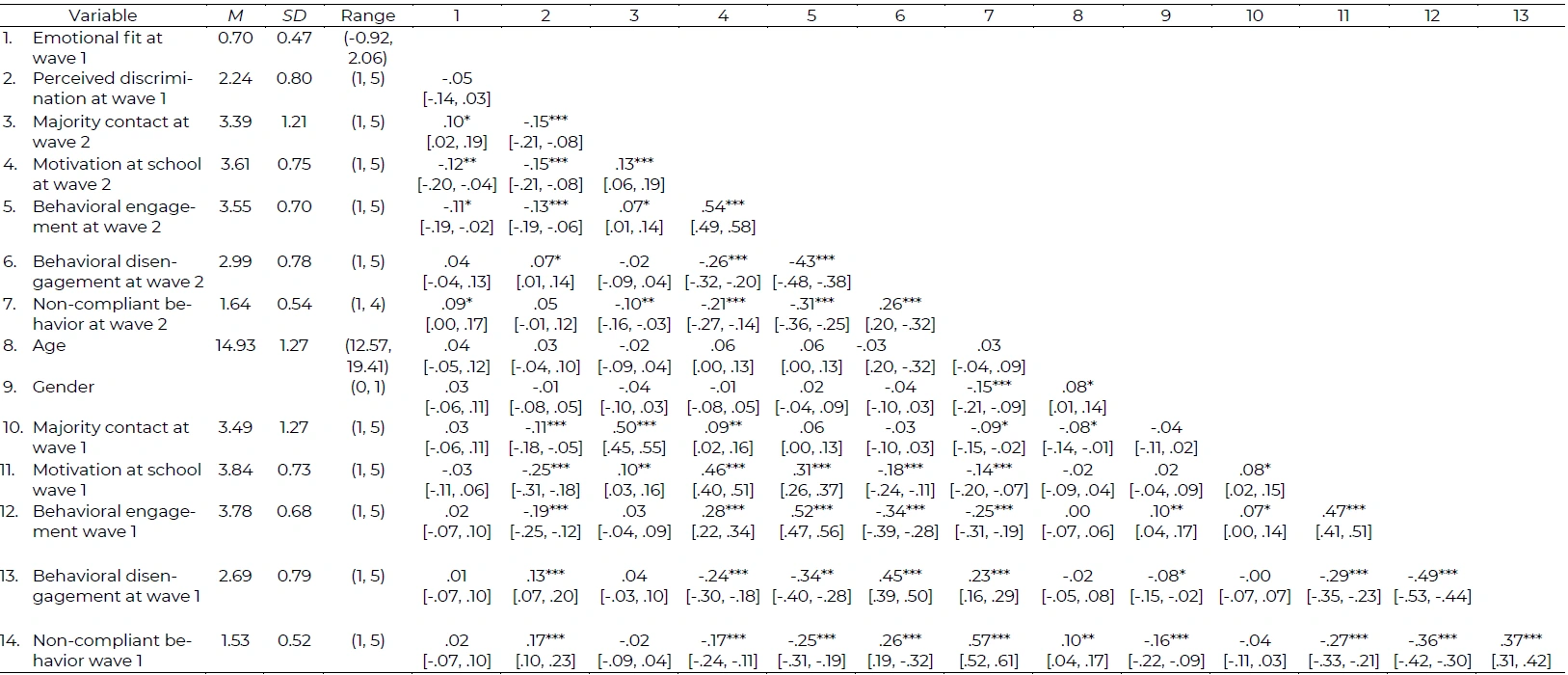
We tested two hypotheses (H1 and H2) for each of the five outcome variables. The results are organized by outcome variable below. Descriptive statistics and multilevel correlations among the study variables are presented in Table 1.

Table 1

Descriptive Statistics and Multilevel Correlations

Majority Contact

Hypothesis 1: Emotional Fit Positively Predicts Minorities’ Contact With Majority Over Time

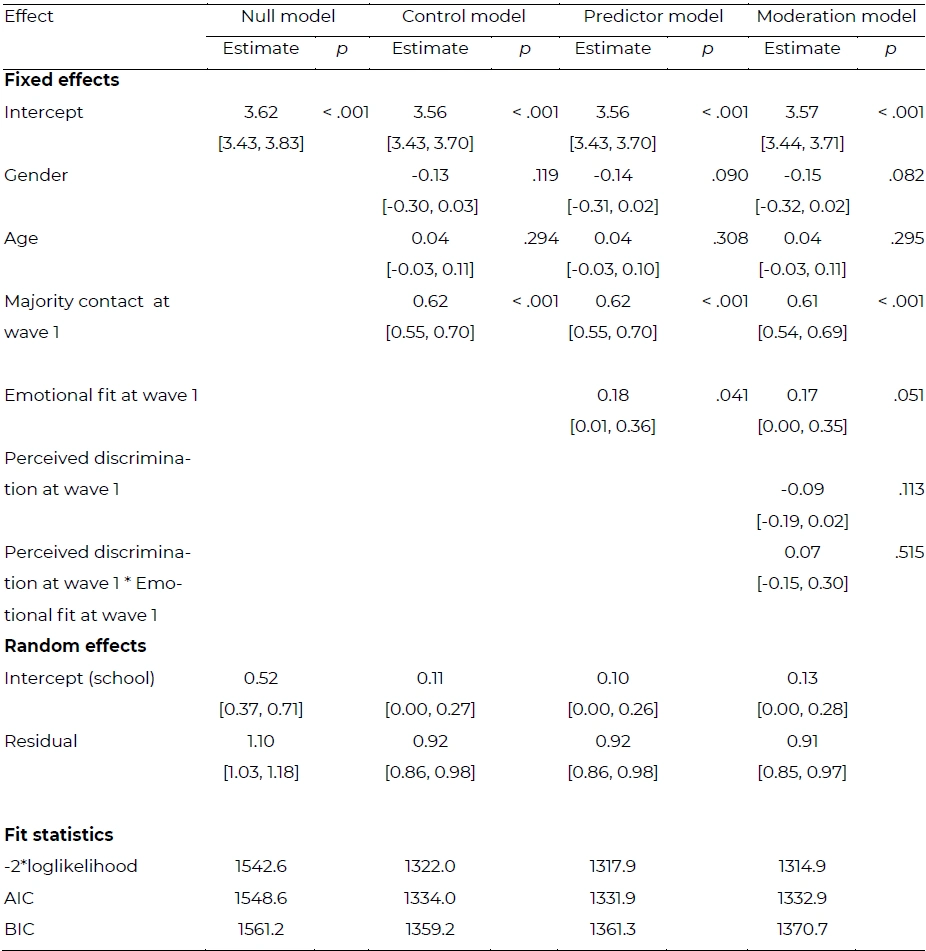
The model with emotional fit at wave 1 as predictor of majority contact at wave 2, controlling for participants’ age, gender, and their majority contact at wave 1, fit the data better than the controls-only model (∆-2LL(1) = 4.16, p = .042). Minorities’ emotional fit positively predicted their contact with majority in the following year t(472.24) = 2.05 (see Table 2, Predictor model).  

Table 2

Predicting MinoritiesMajority Contact at Wave 2: Effects of Emotional Fit at Wave 1 and the Interaction with Perceived Discrimination, Controlling for Age, Gender, and Majority Contact at Wave 1

Hypothesis 2: Perceived Discrimination at School Alters the Longitudinal Association Between Minorities’ Fit and Their Contact With Majority

The model with the interaction effect between perceived discrimination at school at wave 1 and emotional fit at wave 1, did not fit the data better than the predictor-and-controls model (∆-2LL(2) = 2.98, p = .226). No significant interaction effect was found between perceived discrimination and minorities’ emotional fit on their majority contact over time, t(486.22) = .65 (See Table 2, Moderation model).

Motivation at School

Hypothesis 1: Emotional Fit Positively Predicts Minorities’ Motivation at School Over Time

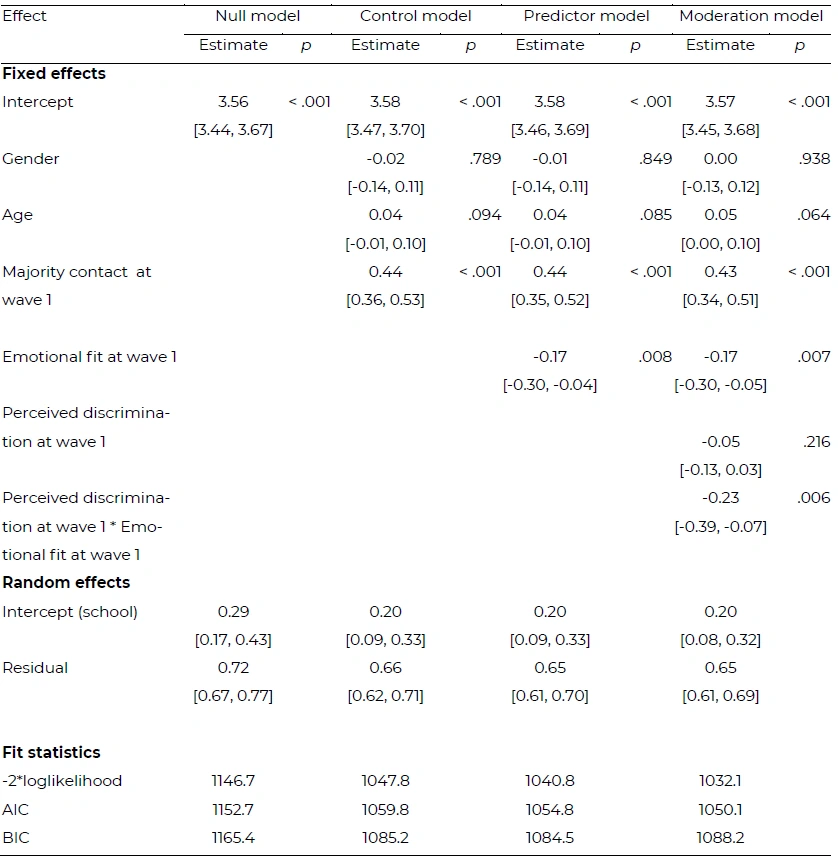
The model with emotional fit at wave 1 as predictor of minorities’ motivation at school at wave 2, controlling for participants’ age, gender, and their motivation at school at wave 1, fit the data better than the controls-only model (∆-2LL(1) = 6.98, p = .008). Minorities’ emotional fit negatively predicted their motivation at school in the following year, t(507.09) = -2.65 (see Table 3, Predictor model).

Table 3

Predicting Minorities’ Majority Motivation at Wave 2: Effects of Emotional Fit at Wave 1 and the Interaction with Perceived Discrimination, Controlling for Age, Gender, and Motivation at Wave 1

Hypothesis 2: Perceived Discrimination at School Alters the Longitudinal Association Between Minorities’  Fit and Their Motivation at School

The model with the interaction effect between perceived discrimination at school at wave 1 and emotional fit at wave 1, fit the data better than the predictor-and-controls model (∆-2LL(2) = 8.73, p = .013). A significant interaction effect was found between perceived discrimination and minorities’ emotional fit on their motivation at school over time, t(483.43) = -2.78 (See Table 3, Moderation model). A plot of the interaction (see Panel A of Figure 1) and simple slopes analyses showed that minorities’ emotional fit negatively predicted minorities’ motivation at school only when the discrimination at school at wave 1 was perceived to be moderate (β = -.17, p = .010, 95% CI [-.30, -.05]) and high (β = -.35, p < .001, 95% CI [-.53, -.18]), but not when the discrimination at wave 1 was perceived to be low (β = .00, p = .970, 95% CI [-.18, .18]).

Figure 1

Interaction Between Perceived Discrimination at Wave 1 and Emotional Fit at Wave 1 as Predictor of Outcomes at Wave 2, Controlling for Age, Gender, and Outcome Variable Measured at Wave 1

Behavioral Engagement at School

Hypothesis 1: Emotional Fit Positively Predicts Minorities’ Behavioral Engagement at School Over Time

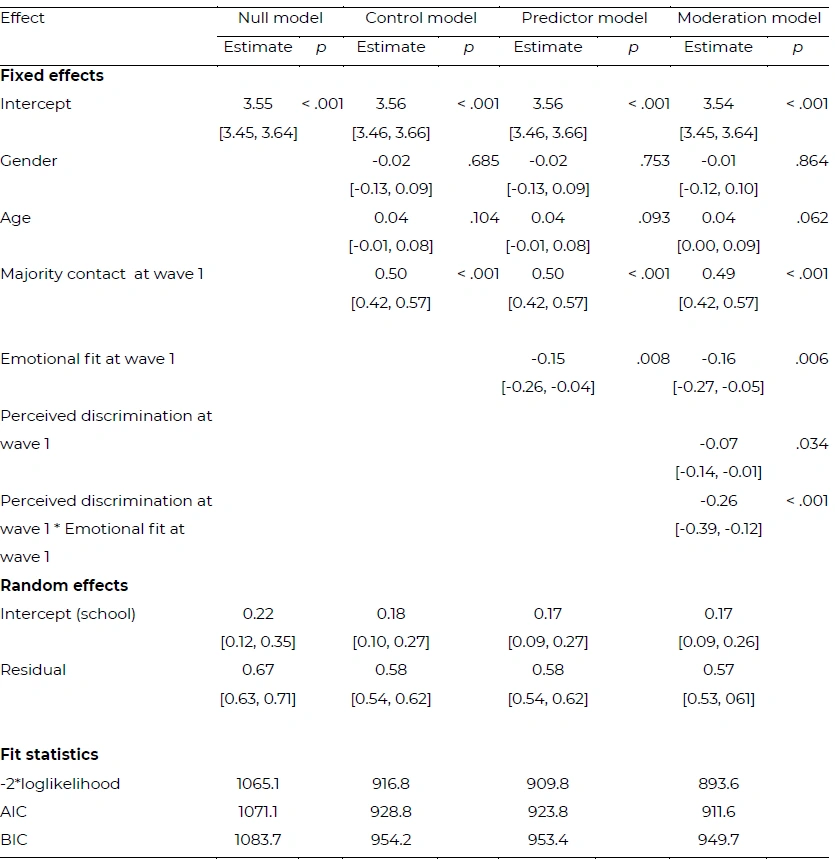
The model with emotional fit at wave 1 as predictor of minorities’ behavioral engagement at school at wave 2, controlling for participants’ age, gender, and their behavioral engagement at school at wave 1, fit the data better than the controls-only model (∆-2LL(1) = 7.06, p = .008). Minorities’ emotional fit negatively predicted their behavioral engagement at school in the following year, t(506.78) = -2.67 (see Table 4, Predictor model).

Table 4

Predicting Minorities’ Majority Behavioral Engagement at Wave 2: Effects of Emotional Fit at Wave 1 and the Interaction with Perceived Discrimination, Controlling for Age, Gender, and Behavioral Engagement at Wave 1

Hypothesis 2: Perceived Discrimination at School Alters the Longitudinal Association Between Minorities’ Fit and Their Behavioral Engagement at School

The model with the interaction effect between perceived discrimination at school at wave 1 and emotional fit at wave 1, fit the data better than the predictor-and-controls model (∆-2LL(2) = 16.17, p <  .001). A significant interaction effect was found between perceived discrimination and minorities’ emotional fit on their behavioral engagement at school over time, t(491.31) = -3.60 (See Table 4, Moderation model). A plot of the interaction (see Panel B of Figure 1) and simple slopes analyses showed that minorities’ emotional fit negatively predicted minorities’ behavioral engagement at school only when the discrimination at school at wave 1 was perceived to be moderate (β = -.16, p = .010, 95% CI [-.27, -.05]) and high (β = -.36, p < .001, 95% CI [-.51, -.20]), but not when the discrimination at wave 1 was perceived to be low (β = .04, p = .570, 95% CI [-.11, .20]).

Behavioral Disengagement at School

Hypothesis 1: Emotional Fit Negatively Predicts Minorities’ Behavioral Disengagement at School Over Time

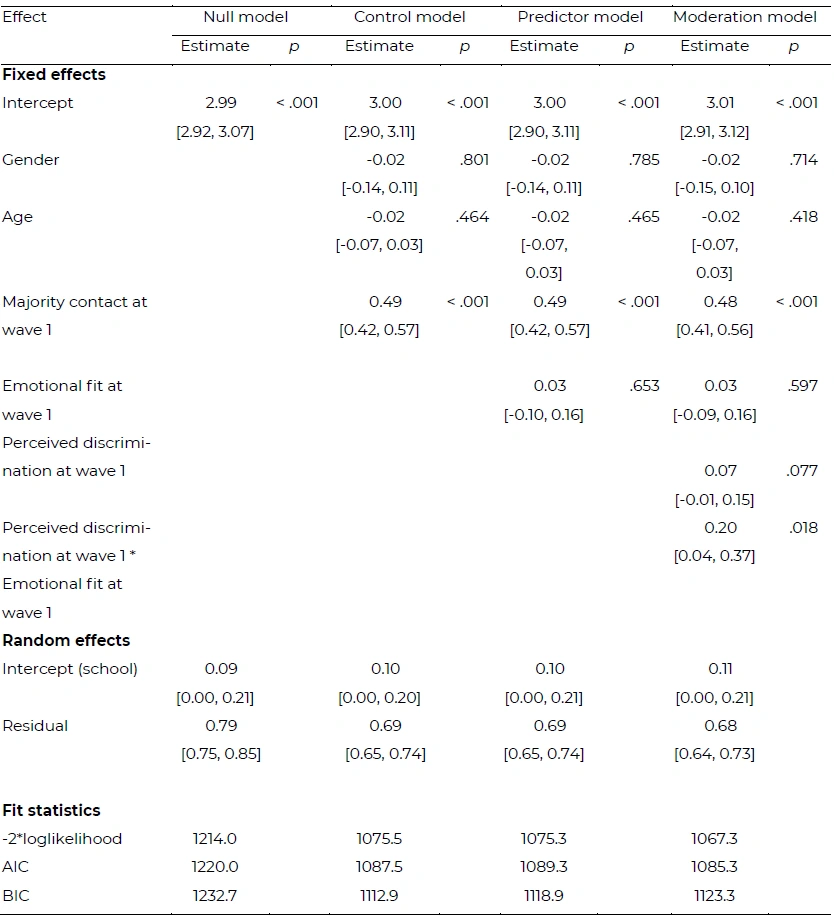
The model with emotional fit at wave 1 as predictor of minorities’ behavioral disengagement at school at wave 2, controlling for participants’ age, gender, and their behavioral disengagement at school at wave 1 did not fit the data better than the controls-only model (∆-2LL(1) = 0.203, p = .653). Minorities’ emotional fit did not predict their behavioral disengagement at school in the following year, t(493.98) = 0.45 (see Table 5, Predictor model).

Table 5

Predicting Minorities’ Majority Behavioral Disengagement at Wave 2: Effects of Emotional Fit at Wave 1 and the Interaction with Perceived Discrimination, Controlling for Age, Gender, and Behavioral Disengagement at Wave 1

Hypothesis 2: Perceived Discrimination at School Alters the Longitudinal Association Between Minorities’ Fit and Their Behavioral Disengagement at School

The model with the interaction effect between perceived discrimination at school at wave 1 and emotional fit at wave 1, did fit the data better than the predictor-and-controls model (∆-2LL(2) = 8.04, p = .018). A significant interaction effect was found between perceived discrimination and minorities’ emotional fit on their behavioral disengagement at school over time, t(499.91) = 2.38 (See Table 5, Moderation model). A plot of the interaction (see Panel C of Figure 1) and simple slopes analyses showed that minorities’ emotional fit positively predicted minorities’ behavioral disengagement at school only when the discrimination at school at wave 1 was perceived to be high (β = .19, p = .040, 95% CI [.01, .38]), but not when the discrimination at school at wave 1 was perceived to be moderate (β = .03, p = .600, 95% CI [-.09, .16]) or low (β = -.12, p = .190, 95% CI [-.31, .06]).

Non-Compliant Behavior at School

Hypothesis 1: Emotional Fit Negatively Predicts Minorities’ Non-Compliant Behavior at School Over Time

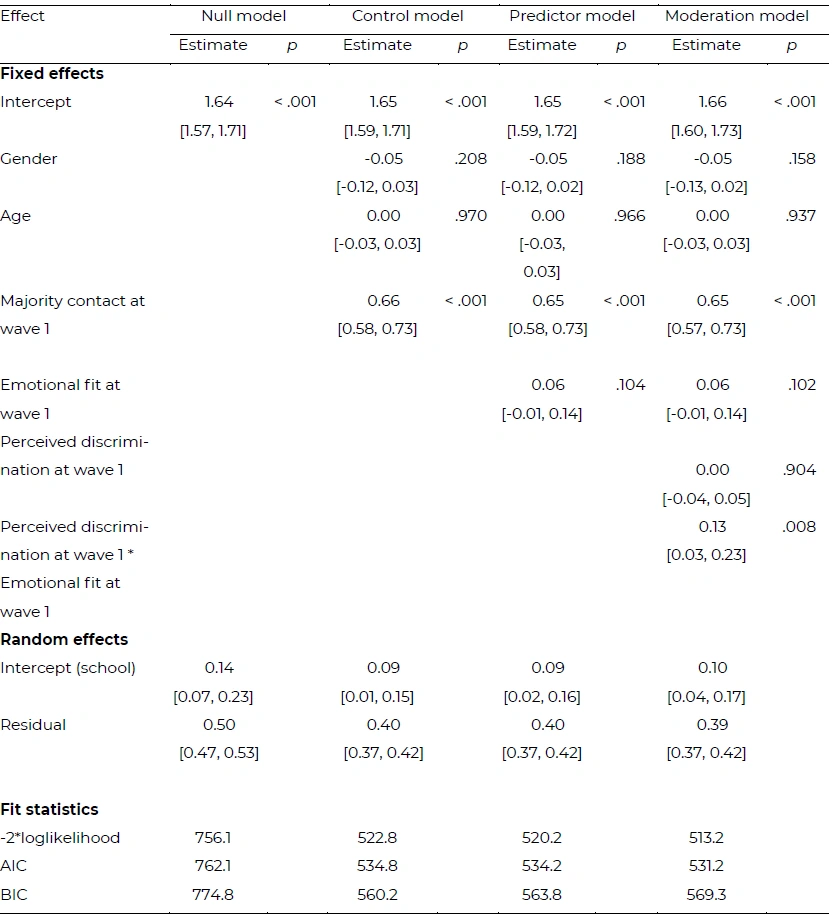
The model with emotional fit at wave 1 as predictor of minorities’ non-compliant behavior at school at wave 2, controlling for participants’ age, gender, and their non-compliant behavior at school at wave 1 did not fit the data better than the controls-only model (∆-2LL(1) = 2.62, p = .106). Minorities’ emotional fit was not associated with their non-compliant behavior at school in the following year, t(500.70) = 1.63 (see Table 6, Predictor model).

Table 6

Predicting Minorities’ Majority Non-Compliant Behavior at Wave 2: Effects of Emotional Fit at Wave 1 and the Interaction with Perceived Discrimination, Controlling for Age, Gender, and Non-Compliant Behavior at Wave 1

Hypothesis 2: Perceived Discrimination at School Alters the Longitudinal Association Between Minorities’  Fit and Their Non-Compliant Behavior at School

The model with the interaction effect between perceived discrimination at school at wave 1 and emotional fit at wave 1, fit the data better than the predictor-and-controls model (∆-2LL(2) = 7.00, p = .030). A significant interaction effect was found between perceived discrimination and minorities’ emotional fit on their non-compliant behavior at school over time, t(490.98) = 2.67 (See Table 6, Moderation model). A plot of the interaction (see Panel D of Figure 1) and simple slopes analyses showed that minorities’ emotional fit positively predicted minorities’ non-compliant behavior at school only when the discrimination at school at wave 1 was perceived to be high (β = .17, p < .001, 95% CI [.06, .27]), but not when the discrimination at school at wave 1 was perceived to be moderate (β = .06, p = .100, 95% CI [-.01, .14]) or low (β = -.04, p = .470, 95% CI [-.15, .07]).

Discussion

The current research provides first evidence on the role of emotional acculturation, an aspect of implicit acculturation, on the sociocultural outcomes of immigrant-descent minority  students in multicultural schools. Whereas explicit acculturation processes involve a conscious stance towards both the heritage and dominant cultures, implicit acculturation refers to (possibly unconscious) attunement of the basic psychological processes to the requirements of the relevant cultural environments (Mesquita et al., 2019). A growing literature suggests that the impact of explicit acculturation may be more limited than previously assumed (Bierwiaczonek & Kunst, 2021). To date, there has been very little research on the role of implicit acculturation in sociocultural adjustment; the current study addressed this gap. We assumed that implicit acculturation – the attunement of emotions, cognitions and motivations to the requirements and expectations of the relevant cultural context(s)—may be a better predictor of sociocultural outcomes than explicit acculturation. Whereas explicit acculturation may be interpreted as a person’s willingness to be part of a culture, implicit acculturation may be closer to their preparedness

In a longitudinal study among immigrant minority youth in ethnically diverse schools, we tested the expectation that emotional fit with the majority norm benefits minorities’ socio-cultural adjustment in school contexts. We also examined the role of perceived discrimination at school on the relationship between emotional acculturation and sociocultural adjustment.

In line with our expectation, and replicating previous research (Jasini, De Leersnyder, Ceulemans, et al., 2023), we showed that emotional fit in one year predicts minorities’ frequent contact with majority peers in the school context the next year. Minority students’ emotional fit predicted majority contact over time regardless of their perceived discrimination at school.

Second, and in contradiction with our expectation, minority students’ level of emotional acculturation did not positively predict their school engagement and motivation the next year. However, as hypothesized, we found an effect of perceived discrimination at school. Emotional fit with the majority culture norm was a liability for those immigrant-descent students who perceived high discrimination. When discrimination was perceived to be high, emotional acculturation predicted worse school adjustment outcomes over time; to the extent that immigrant-descendant students had fitted well emotionally with the majority culture the year before, they reported lower levels of motivation and behavioral engagement as well as higher levels of non-compliant behaviors.

Whereas immigrant-descent individuals’ emotional fit with the majority norm has been associated with majority contact, friendship, and health (Consedine et al., 2014; Jasini et al., 2018, 2019; Jasini, De Leersnyder, Gagliolo, et al., 2023), and has been found to predict majority contact over time (Jasini, De Leersnyder, Ceulemans, et al., 2023), the current study failed to find a beneficial role of emotional fit for immigrant minority youth’s school engagement. To the contrary, our findings suggest that when perceiving high discrimination in school, having emotions that fit well with the emotion norms in the majority culture may backfire and be detrimental to school adjustment. One way of understanding this result is that students with high emotional acculturation, whose emotions are not distinguished from those of their majority peers, may compare themselves to their majority peers, and come to recognize their disadvantaged position (Verkuyten, 2024). The disadvantage may feel particularly hurtful to those emotionally adjusted students who have adopted and mastered intricate aspects of the majority culture, and who may therefore feel, think and behave like majority culture members.

This leaves unexplained why there are no positive associations between emotional acculturation and school engagement for immigrant-descent minority students who perceive less discrimination at school. We had expected that emotional fit with majority culture would be beneficial for immigrant-descent minority youth who did not perceive discrimination. One possibility is that minority youth who perceive less discrimination in their school may also experience a general sense of inclusion and acceptance, which itself may contribute to school engagement and motivation. If the school climate is perceived to be supportive, especially towards minority students, emotional fit might not account for any additional variation. In such contexts, minority students’ social outcomes at school (e.g., school engagement) may depend more on other processes, such as identity development shaped largely by heritage cultural maintenance (not by destination culture adoption; see Crocetti et al., 2024), rather than emotional fit with the majority culture. Future research could examine these additional processes that may render the acquisition of majority emotional norms less significant for minority students’ school engagement.

Alongside the theoretical and empirical contribution, the current research also has an applied value for teachers and school administration staff. Our findings show that perceptions of discrimination in school may affect the process by which fitting in emotionally with the majority culture is related to school outcomes. Such a finding suggests that teachers should pay attention to the climate that is created in class and how that climate is perceived as it interferes with how acquiring the majority culture norm plays out in the learning process. In addition, it is important to acknowledge that individual students’ perceptions of discrimination were decisive for the sociocultural outcomes of emotional acculturation; the aggregate perceptions of discrimination at school were not (See Supplementary materials). Such finding implies the important need for teachers and school administration staff to pay close attention to the perceptions of the school climate that each student holds and uncover as well as address the potential experienced or witnessed discrimination acts that may feed into such perceptions.

Limitations and Recommendations for Future Acculturation Research

Our study has several limitations. First, in this study, we focused on individual perceptions of the discriminatory climate, but other contextual factors in schools may have stronger or similarly moderating effects on the link between emotional acculturation and adjustment, which may be complementary to the effect of perceived discrimination. Examples are school diversity beliefs (i.e., multiculturalist, assimilationist, and colorblindness) in school policies and norms (Celeste et al., 2019), teachers’ multicultural approaches (Brown & Chu, 2012; Verkuyten & Thijs, 2002), the segregation of immigrant minorities in schools, etc. Previous research has suggested that individual perceptions may be unrelated to these school-level factors such as the teachers’ diversity approaches (Schachner et al., 2019). Yet, future acculturation research may further investigate the combination of these different school factors in addition to perceived discrimination, to gain fuller insight into the circumstances under which minorities’ emotional acculturation can be either a liability or a benefit.

Second, even though our study follows a longitudinal design and our findings hint at a temporal effect of emotional acculturation on minorities’ school adjustment outcomes, the associations cannot be interpreted as causal links. We cannot rule out that minority students’ emotional acculturation is a consequence of their past school adjustment. Indeed, previous research has provided support for bidirectional effects between minorities’ majority contact and emotional fit with the majority culture over time (Jasini, De Leersnyder, Ceulemans, et al., 2023). Future longitudinal research may want to examine whether such bidirectional effects exist also between minorities’ emotional acculturation on the one hand and their motivation, behavioral engagement, and school compliance on the other hand.

Third, our research does not speak to the fact that emotional (mis-)fit with the majority culture norms of emotions could itself be an effect of perceived discrimination in the past. Indeed, previous research has shown that discrimination may lead minorities to distance themselves from the majority culture (e.g., Jasinskaja-Lahti et al., 2009) or orient themselves towards the heritage culture (e.g., Dimitrova et al., 2015), which may have consequences for their school adjustment (Guerra et al., 2019). Future studies may explore the mutual influences between emotional acculturation, discrimination, and school adjustment using longitudinal designs spanning multiple years. 

Fourth, the current study does not take into consideration certain additional pathways or variables in the examined models. For example, the current study does not take into account that the perceived discrimination and emotional fit may change over time, and that these changes may play a role in the adjustment outcomes at wave 2. Although previous research has hinted at the possibility that both emotional fit and perceived discrimination may change over time (Baysu et al., 2024; Jasini, De Leersnyder, Ceulemans, et al., 2023), assessing the role of the developmental or dynamic changes in predicting adjustment was beyond the scope of the current research. Yet, modelling the autoregressive pathways of emotional fit and perceived discrimination may be a meaningful avenue for future research, which would build both on the present study and on research showing that accumulating discrimination experiences over time negatively predicts minority youth’s adjustment outcomes (Baysu et al., 2024). Such research may especially benefit from data spanning a longer time frame than the current research.

In addition, in the current study, we did not control for the effect of several important individual characteristics such as the cultural distance and the generational status. Previous research has shown that both cultural distance and generational status are associated with minority individuals’ emotional acculturation (Jasini et al., 2019), but little is known about how they affect the associations reported in this study: the longitudinal association between  emotional and sociocultural adjustment, as well as the impact of perceived discrimination on this association. Future research may further explore these questions.

Fifth, it may also be possible that majority contact influences school engagement outcomes over time and vice versa. Indeed, previous work has suggested that intergroup contact, sociocultural and psychological adjustment outcomes may be related to one another in a bidirectional way over time (Kenfack et al., 2024). Future acculturation research may more closely examine the dynamic feedback loops that emerge over time between various adjustment outcomes due to emotional acculturation and perceptions of discrimination. 

Sixth, the reliability of the non-compliant behavior scale was relatively low. Though the items for this scale were selected based on the best factor solution (i.e., the items loaded meaningfully on the factor) and reliability analysis (i.e., omitting any of the items did not improve the scale reliability), the concept of non-compliance may comprise of different facets that in the future could be teased apart. For example, the item “how often do you get a punishment in school?” is an indirect way of measuring non-compliance, whereas “how often do you skip a lesson without permission?”, and “how often do you come late to school?” are measuring non-compliance directly. A longer scale might have distinguished between the two. It is possible that the reliability of the scale was weakened by including related, but separable aspects of non-compliance. Future research may want to address this concern by including a larger number of items to fully represent different facets of the broader construct of non-compliant behavior.

Finally, the current study does not document the duration of the detrimental effects of emotional fit in contexts perceived to be highly discriminatory, nor does it shed light on the impact on other areas of adjustment (i.e., wellbeing at school), or other domains (e.g., peer relations). Especially, the latter question may be relevant for future investigation given that acculturation impacts adjustment differently in different domains (Arends-Tóth & van de Vijver, 2004; Bornstein, 2017; Karataş, 2025). 

Conclusion

Extant empirical research on the adaptive advantages and disadvantages of acculturation has been inconclusive at best. The current research contributes to our insights into the sociocultural outcomes of  implicit acculturation in school. It yielded paradoxical effects of emotional acculturation on adjustment. Whereas emotional acculturation may over time benefit minority students’ contact with their majority peers regardless of the perceived school climate, it can be maladaptive for their school outcomes in environments perceived as unwelcoming.

Endnotes

[i] A sample of 1419 majority youth from the same schools was also recruited for this study. Their data was used to compute minorities’ emotional fit scores.

[ii] In exploratory analyses, we controlled for the majority proportion in school, which was computed as a fraction representing the number of majority participants in the study sample in wave 1, relative to all participants in wave 1. The analyses showed the same pattern of results, with the exception that the association between emotional fit and majority contact becomes marginally significant in the predictor-and-control model (Hypothesis 1).  

[iii] The R script needed to reproduce the analyses can be found on https://github.com/AnouckCochez/Paradoxical-Effect-of-Emotional-Acculturation.git

Conflicts of Interest

The authors declare no competing interests.

Author Contributions

Alba Jasini: Conceptualization; data curation; formal analysis; methodology; project administration; writing – original draft; writing – review and editing. Anouck Cochez: Conceptualization, data curation; formal analysis; methodology; project administration; writing – original draft; writing – review and editing. Batja Mesquita: conceptualization; funding acquisition; investigation; methodology; project administration; supervision; writing original draft; writing – review and editing.

Data Availability Statement

The data that support the findings of this study are available on request from the corresponding author. The data are not publicly available due to privacy or ethical restrictions.

Acknowledgements

We thank Karen Phalet for her PI role in the Leuven-CILS project. This project has received funding from the European Research Council (ERC) under the European Union’s Horizon 2020 research and innovation program (grant agreement No 834587). This manuscript reflects only the authors’ views and the ERC Executive Agency is not responsible for any use that may be made of the information it contains.

Readers of this article also read
Methods

Comparing bivariate and multivariate approaches to testing individual-level interaction effects in meta-analyses: The case of the integration hypothesis

by Dinh-Hung Vu & Kinga Bierwiaczonek Cited by 1
Commentary

Why longitudinal is not developmental: Clarifying misconceptions in acculturation research – A response to Berry (2025)

by Philipp Jugert & Peter F. Titzmann
Commentary

Unpacking the integration puzzle: Overlooked insights from meta-analytical research. A response to Berry (2025)

by Kinga Bierwiaczonek
Commentary

Comments on the papers in the Special Issue “Acculturation reimagined: Setting the stage for the next era of inquiry”

by John W. Berry
Review

Intercultural contact in the digital age: A review of emerging research on digitally mediated acculturation

by Jaimee Stuart, Colleen Ward, Johannes Alfons Karl, & Ronald Musizvingoza
Perspective

Re-imagining multiculturalism: Small steps towards indigenizing acculturation science

by Colleen Ward, Tia Neha, & Tyler Ritchie
Editorial

Acculturation Reimagined—Charting new directions in a pluralistic world

by David L. Sam & Jonas R. Kunst
Research Article

Solidarity as a bridge: Shared discrimination is indirectly associated with voting intentions among People of Color

by Kasheena G. Rogbeer & Efrén Pérez
Editor Curated

Frequently Asked Questions

  • What is emotional acculturation?

    Emotional acculturation is a type of implicit acculturation. It refers to the process where individuals from immigrant backgrounds gradually, and often without conscious awareness, adopt the emotional patterns and norms of the majority culture they are living in. This happens as they engage more with the new culture, leading their emotional responses in certain situations to become more similar to those considered typical or appropriate in the majority culture.

  • Does fitting in emotionally with the majority culture help immigrant youth adjust to school?

    It’s complicated and can have paradoxical effects. This study found that while emotional acculturation (fitting in emotionally) did positively predict having more contact with majority peers over time, it actually negatively predicted school engagement (like motivation, positive behavior, and following school rules) over time, especially for students who felt highly discriminated against. So, while it helps socially in one way, it can be detrimental to school adjustment in contexts of discrimination.

  • How does perceived discrimination affect the outcomes of emotional acculturation?

    As show in this study in advances.in/psychology, perceived discrimination significantly changes the impact of emotional acculturation on school adjustment. The study found that emotional fit with the majority culture became a liability for school engagement (motivation, behavior, compliance) specifically among immigrant-descent students who perceived high levels of discrimination at school. For these students, higher emotional fit predicted lower school motivation and engagement, and more non-compliant behavior over time. When perceived discrimination was low, emotional fit did not have a significant negative (or positive) effect on school engagement.

  • What is the difference between explicit and implicit acculturation?

    Acculturation involves changes that happen when people encounter a new culture.  Jasini et al. (2025) distinguish between two types:

    1. Explicit Acculturation: This involves conscious choices and attitudes. It’s about how people explicitly position themselves regarding their heritage culture and the dominant majority culture, such as their identification with each group or their attitudes towards maintaining their traditions versus adopting new ones.
    2. Implicit Acculturation: This involves changes in basic psychological processes (like emotions, cognition, motivation) that happen more automatically and often without conscious awareness, as individuals adapt to the demands of the new cultural context. Emotional acculturation is one example of this.
  • What did the study find about emotional acculturation, contact with peers, and school engagement over time?

    The 2-year longitudinal study with immigrant-descent minority youth in Belgian schools found:

    1. Contact with Majority Peers: Emotional acculturation (having emotional patterns similar to the majority culture) at the start of the study positively predicted having more contact with majority Belgian peers one year later. This effect held regardless of perceived discrimination levels.
    2. School Engagement: Emotional acculturation at the start negatively predicted several aspects of school engagement one year later, but only when perceived discrimination was high. Specifically, for those perceiving high discrimination, greater emotional fit predicted lower school motivation, lower behavioral engagement, higher behavioral disengagement, and more non-compliant behavior over time.

References

Abu-Rayya, H. M., Berry, J. W., Sam, D. L., & Grigoryev, D. (2023). Evaluating the integration hypothesis: A meta-analysis of the ICSEY project data using two new methods. British Journal of Psychology, 114(4), 819–837. https://doi.org/10.1111/bjop.12656

Anderson, C., Keltner, D., & John, O. P. (2003). Emotional convergence between people over time. Journal of Personality and Social Psychology, 84(5), 1054–1068. https://doi.org/10.1037/0022-3514.84.5.1054

Arends-Tóth, J., van de Vijver, F. J. R. R. (2004). Domains and dimensions in acculturation: Implicit theories of Turkish-Dutch. International Journal of Intercultural Relations, 28(1), 19–35. https://doi.org/10.1016/j.ijintrel.2003.09.001

Auguie, B. (2017). gridExtra: Miscellaneous functions for “grid” graphics (Version 2.3) [R package]. https://cran.r-project.org/package=gridExtra

Bates, D., Mächler, M., Bolker, B., & Walker, S. (2015). Fitting linear mixed-effects models using lme4. Journal of Statistical Software, 67(1), 1–48. https://doi.org/10.18637/jss.v067.i01

Baysu, G., Grew, E., Hillekens, J., & Phalet, K. (2024). Trajectories of ethnic discrimination and school adjustment of ethnically minoritized adolescents: The role of school diversity climate. Child Development. https://doi.org/10.1111/cdev.14133

Baysu, G., Phalet, K., & Brown, R. (2011). Dual identity as a two edged sword: Identity threat and minority school performance. Social Psychology Quarterly, 74(2), 121–143. https://doi.org/10.1177/0190272511407619

Baysu, G., Phalet, K., & Brown, R. (2014). Relative group size and minority school success: The role of intergroup friendship and discrimination experiences. British Journal of Social Psychology, 53(2), 328–349. https://doi.org/10.1111/bjso.12035

Benner, A. D., Wang, Y., Shen, Y., Boyle, A. E., Polk, R., & Cheng, Y. P. (2018). Racial/ethnic discrimination and well-being during adolescence: A meta-analytic review. American Psychologist, 73(7), 855–883. https://doi.org/10.1037/amp0000204

Berry, J. W. (1997). Immigration, acculturation, and adaptation. Applied Psychology, 46(1), 5–34. https://doi.org/10.1111/j.1464-0597.1997.tb01087.x

Berry, J. W., Phiney, J. S., Sam, D. L., & Vedder, P. (2006). Immigrant youth in cultural transition. Lawrence Erlbaum Associates Publishers.

Berry, J. W., Phinney, J. S., Sam, D. L., & Vedder, P. (2006). Immigrant youth: Acculturation, identity, and adaptation. Applied Psychology, 55(3), 303–332. https://doi.org/10.1111/j.1464-0597.2006.00256.x

Berry, J. W., & Sam, D. L. (1997). Acculturation and adaption. In Handbook of cross-cultural psychology, Vol. 3, Social behavior and applications (pp. 291–326).

Bierwiaczonek, K., & Kunst, J. R. (2021). Revisiting the integration hypothesis: Correlational and longitudinal meta-analyses demonstrate the limited role of acculturation for cross-cultural adaptation. Psychological Science, 32(9), 1476–1493. https://doi.org/10.1177/09567976211006432

Boiger, M., & Mesquita, B. (2012). The construction of emotion in interactions, relationships, and cultures. Emotion Review, 4(3), 221–229. https://doi.org/10.1177/1754073912439765

Bond, L., Butler, H., Thomas, L., Carlin, J., Glover, S., Bowes, G., & Patton, G. (2007). Social and school connectedness in early secondary school as predictors of late teenage substance use, mental health, and academic outcomes. Journal of Adolescent Health, 40(4), 357.e9-357.e18. https://doi.org/10.1016/j.jadohealth.2006.10.013

Bornstein, M. H. (2017). The specificity principle in acculturation science. Perspectives on Psychological Science, 12(1), 3-45. https://doi.org/10.1177/1745691616655997  (Original work published 2017)

Brown, C. S., & Chu, H. (2012). Discrimination, ethnic identity, and academic outcomes of Mexican immigrant children: The importance of school context. Child Development, 83(5), 1477–1485. https://doi.org/10.1111/j.1467-8624.2012.01786.x

Celeste, L., Baysu, G., Phalet, K., Meeussen, L., & Kende, J. (2019). Can school diversity policies reduce belonging and achievement gaps between minority and majority youth? Multiculturalism, colorblindness, and assimilationism assessed. Personality and Social Psychology Bulletin, 1–16. https://doi.org/10.1177/0146167219838577

Chase, P. A., Hilliard, L. J., John Geldhof, G., Warren, D. J. A., & Lerner, R. M. (2014). Academic achievement in the high school years: The changing role of school engagement. Journal of Youth and Adolescence, 43(6), 884–896. https://doi.org/10.1007/s10964-013-0085-4

Civitillo, S., Jugert, P., Yip, T., Lui, P. P., & Titzmann, P. F. (2024). A daily diary study on associations between school-based ethnic discrimination and school engagement. Social Psychology of Education. https://doi.org/10.1007/s11218-024-09919-x

Civitillo, S., Mayer, A. M., & Jugert, P. (2023). A systematic review and meta-analysis of the associations between perceived teacher-based racial–ethnic discrimination and student well-being and academic outcomes. Journal of Educational Psychology, 116(5), 719-741. https://doi.org/10.1037/edu0000818

Consedine, N. S., Chentsova-Dutton, Y. E., & Krivoshekova, Y. S. (2014). Emotional acculturation predicts better somatic health: Experiential and expressive acculturation among immigrant women from four ethnic groups. Journal of Social and Clinical Psychology, 33(10), 867–889. https://doi.org/10.1521/jscp.2014.33.10.867

Cooper, A. C., & Sánchez, B. (2016). The roles of racial discrimination, cultural mistrust, and gender in Latina/o youth’s school attitudes and academic achievement. Journal of Research on Adolescence, 26(4), 1036–1047. https://doi.org/10.1111/jora.12263

Crocetti, E., Karataş, S., Branje, S., Bobba, B., & Rubini, M. (2024). Navigating across heritage and destination cultures: How personal identity and social identification processes relate to domain-specific acculturation orientations in adolescence. Journal of Youth and Adolescence, 53(2), 397–415. https://doi.org/10.1007/s10964-023-01870-y

De Leersnyder, J., Mesquita, B., & Kim, H. S. (2011). Where do my emotions belong? A study of immigrants’ emotional acculturation. Personality and Social Psychology Bulletin, 37(4), 451–463. https://doi.org/10.1177/0146167211399103

De Roover, K., Ceulemans, E., & Timmerman, M. E. (2012). How to perform multiblock component analysis in practice. Behavior Research Methods, 44(1), 41–56. https://doi.org/10.3758/s13428-011-0129-1

Delvaux, E., Meeussen, L., & Mesquita, B. (2015). Feel like you belong: on the bidirectional link between emotional fit and group identification in task groups. Frontiers in Psychology, 6, 1106. https://doi.org/10.3389/fpsyg.2015.01106

Dimitrova, R., Aydinli, A., Chasiotis, A., Bender, M., & Van De Vijver, F. J. R. (2015). Heritage identity and maintenance enhance well-being of Turkish- Bulgarian and Turkish-German Adolescents. Social Psychology, 46(2), 93–103. https://doi.org/10.1027/1864-9335/a000230

Dotterer, A. M., & Lowe, K. (2011). Classroom context, school engagement, and academic achievement in early adolescence. Journal of Youth and Adolescence, 40(12), 1649–1660. https://doi.org/10.1007/s10964-011-9647-5

Doucerain, M. M. (2019). Moving forward in acculturation research by integrating insights from cultural psychology. International Journal of Intercultural Relations, 73, 11–24. https://doi.org/10.1016/j.ijintrel.2019.07.010

Dziak, J. J., Dierker, L. C., & Abar, B. (2021). The interpretation of statistical power after the data have been gathered. Current Psychology, 39, 870–877. https://doi.org/10.1007/s12144-018-0018-1

Finn, J. D., & Rock, D. A. (1997). Academic success among students at risk for school failure. Journal of Applied Psychology, 82(2), 221–234. https://doi.org/10.1037/0021-9010.82.2.221

Fischer, A. H., & Manstead, A. S. R. (2016). Social functions of emotion and emotion regulation. In L. F. Barrett, M. Lewis, & J. M. Haviland-Jones (Eds.), Handbook of emotions (4th ed., pp. 424–439). Guilford.

Guerra, R., Rodrigues, R. B., Aguiar, C., Carmona, M., Alexandre, J., & Lopes, R. C. (2019). School achievement and well-being of immigrant children: The role of acculturation orientations and perceived discrimination. Journal of School Psychology, 75, 104–118. https://doi.org/10.1016/j.jsp.2019.07.004

Haritatos, J., & Benet-Martínez, V. (2002). Bicultural identities: The interface of cultural, personality, and socio-cognitive processes. Journal of Research in Personality, 36(6), 598–606. https://doi.org/10.1016/S0092-6566(02)00510-X

Hillekens, J., Baysu, G., & Phalet, K. (2023). Multiple pathways of integration: Acculturative change and associations with school adjustment in immigrant-origin adolescents. Child Development, 94(2), 544–562. https://doi.org/10.1111/cdev.13876

Hood, W., Bradley, G. L., & Ferguson, S. (2017). Mediated effects of perceived discrimination on adolescent academic achievement: A test of four models. Journal of Adolescence, 54(1), 82–93. https://doi.org/10.1016/j.adolescence.2016.11.011

Hox, J. J., Moerbeek, M., & van de Schoot, R. (2017). Multilevel Analysis : Techniques and Applications, Third Edition (3rd ed.). Routledge. https://doi.org/10.4324/9781315650982

Jasini, A., De Leersnyder, J., Ceulemans, E., Gagliolo, M., & Mesquita, B. (2023). Do minorities’ friendships with majority culture members and their emotional fit with majority culture influence each other over time? Social Psychological and Personality Science, 0. https://doi.org/10.1177/19485506231190699

Jasini, A., De Leersnyder, J., Gagliolo, M., Kende, J., Phalet, K., & Mesquita, B. (2023). Show me your friends, I’ll tell you your emotions: Emotional fit of immigrant minority youth in cross-cultural friendship networks. British Journal of Social Psychology, 00, 1–15. https://doi.org/https://doi.org/10.1111/bjso.12640

Jasini, A., De Leersnyder, J., & Mesquita, B. (2018). Feeling “right” when you feel accepted: Emotional acculturation in daily life interactions with majority members. Frontiers in Psychology, 9, 1093. https://doi.org/10.3389/fpsyg.2018.01093

Jasini, A., De Leersnyder, J., Phalet, K., & Mesquita, B. (2019). Tuning in emotionally: Associations of cultural exposure with distal and proximal emotional fit in acculturating youth. European Journal of Social Psychology, 49(2), 352–365. https://doi.org/10.1002/ejsp.2516

Jasinskaja-Lahti, I., Liebkind, K., & Solheim, E. (2009). To identify or not to identify? National disidentification as an alternative reaction to perceived ethnic discrimination. Applied Psychology, 58(1), 105–128. https://doi.org/10.1111/j.1464-0597.2008.00384.x

Karataş, S. (2025). Zooming in on proximal life domains: A literature review on family, peer, and school dynamics in adolescents’ acculturation and psychosocial adjustment. European Journal of Developmental Psychology, 22(3), 317–339. https://doi.org/10.1080/17405629.2024.2433754

Kenfack, C. S. K., Prati, F., Schaefer, S., Christ, O., Hewstone, M., Moscatelli, S., & Rubini, M. (2024). Positive and negative intergroup contact and newcomer immigrants’ psychological adjustment. Cultural Diversity and Ethnic Minority Psychology, 31(3), 519–534. https://doi.org/10.1037/cdp0000634

Kitayama, S., Markus, H. R., & Kurokawa, M. (2000). Culture, emotion, and well-being: Good feelings in Japan and the United States. Cognition & Emotion, 14(1), 93–124. https://doi.org/10.1080/026999300379003

Kitayama, S., Mesquita, B., & Karasawa, M. (2006). Cultural affordances and emotional experience: Socially engaging and disengaging emotions in Japan and the United States. Journal of Personality and Social Psychology, 91(5), 890–903. https://doi.org/10.1037/0022-3514.91.5.890

Kitayama, S., Park, H., Sevincer, T. A., Karasawa, M., & Uskul, A. K. (2009). A cultural task analysis of implicit independence: Comparing North America, Western Europe, and East Asia. Journal of Personality and Social Psychology, 97(2), 1–68. https://doi.org/10.1037/a0015999

Kunst, J. R. (2021). Are we facing a “causality crisis” in acculturation research? The need for a methodological (r)evolution. International Journal of Intercultural Relations, 85, A4–A8. https://doi.org/10.1016/j.ijintrel.2021.08.003

Livingstone, A. G., Spears, R., Manstead, A. S. R., Bruder, M., & Shepherd, L. (2011). We feel, therefore we are: Emotion as a basis for self-categorization and social action. Emotion, 11(4), 754–767. https://doi.org/10.1037/a0023223

Long, J. A. (2023). interactions: Comprehensive, consistent, and user-friendly tools for probing interactions (Version 1.2.0) [R package]. https://cran.r-project.org/package=interactions

Maas, C. J., & Hox, J. J. (2005). Sufficient sample sizes for multilevel modeling. Methodology, 1(3), 86-92. https://doi.org/10.1027/1614-2241.1.3.86

Mesquita, B., De Leersnyder, J., & Boiger, M. (2016). The cultural psychology of emotion. In L. F. Barrett, M. Lewis, & J. Haviland-Jones (Eds.), Handbook of Emotions (4th ed., pp. 393–411). Guilford Press.

Mesquita, B., De Leersnyder, J., & Jasini, A. (2019). The cultural psychology of acculturation. In S. Kitayama & D. Cohen (Eds.), Handbook of Cultural Psychology (2nd ed., pp. 502–535). Guilford Press.

Nguyen, A.-M. T. D., & Benet-Martinez, V. (2013). Biculturalism and adjustment: A meta-analysis. Journal of Cross-Cultural Psychology, 44(1), 122–159. https://doi.org/10.1177/0022022111435097

Parkinson, B. (1996). Emotions are social. British Journal of Psychology, 87(4), 663–683. https://doi.org/10.1111/j.2044-8295.1996.tb02615.x

Parkinson, B., Fischer, A. H., & Manstead, A. S. R. (2005). Emotion in social relations: Cultural, group, and interpersonal processes. Psychology Press.

Pedersen, T. L. (2020). patchwork: The composer of plots (Version 1.1.2) [R package]. https://cran.r-project.org/package=patchwork

Phalet, K., Meuleman, B., Hillekens, J., & Sekaran, S. (2018). Leuven-CILS Technical Report Longitudinal 2012-2015.

Phinney, J. S. (1999). An intercultural approach in psychology: Cultural contact and identity. Cross-Cultural Psychology Bulletin, 33(2), 24–31.

Phinney, J. S., Horenczyk, G., Liebkind, K., & Vedder, P. (2001). Ethnic identity, immigration, and well-being: An interactional perspective. Journal of Social Issues, 57(3), 493–510. https://doi.org/10.1111/0022-4537.00225

Revelle, W., & Wilcox, R. R. (2021). misty: Miscellaneous tools for psychological, psychometric, and personality research (Version 0.6.8) [R package]. https://cran.r-project.org/package=misty

Revelle, W. (2022). psych: Procedures for personality and psychological research (Version 2.4.6.26) [R package]. Northwestern University. https://cran.r-project.org/package=psych

R Core Team. (2023). R: A language and environment for statistical computing (Version 4.3.2) [Computer software]. R Foundation for Statistical Computing. https://www.R-project.org/

Rosenblatt, A., & Greenberg, J. (1988). Depression and interpersonal attraction: The role of perceived similarity. Journal of Personality and Social Psychology, 55(1), 112–119. https://doi.org/10.1037/0022-3514.55.1.112

Schachner, M. K., Juang, L., Moffitt, U., & Van De Vijver, F. J. R. (2018). Schools as acculturative and developmental contexts for youth of immigrant and refugee background. European Psychologist, 23(1), 44–56. https://doi.org/10.1027/1016-9040/a000312

Schachner, M. K., Noack, P., Van de Vijver, F. J. R., & Eckstein, K. (2016). Cultural diversity climate and psychological adjustment at school-equality and inclusion versus cultural pluralism. Child Development, 87(4), 1175–1191. https://doi.org/10.1111/cdev.12536

Schachner, M. K., Schwarzenthal, M., van de Vijver, F. J. R., & Noack, P. (2019). How all students can belong and achieve: Effects of the cultural diversity climate amongst students of immigrant and nonimmigrant background in Germany. Journal of Educational Psychology, 111(4), 703–716. https://doi.org/10.1037/edu0000303

Schachter, S. (1959). The psychology of affiliation. Stanford University Press.

Searle, W., & Ward, C. (1990). The prediction of psychological and sociocultural adjustment during cross-cultural transitions. International Journal of Intercultural Relations, 14, 449–464. https://doi.org/10.1016/0147-1767(90)90030-Z

Scherbaum, C. A., & Ferreter, J. M. (2009). Estimating statistical power and required sample sizes for organizational research using multilevel modeling. Organizational Research Methods,12, 347-367. https://doi.org/10.1177/1094428107308906

Skinner, E., Furrer, C., Marchand, G., & Kindermann, T. (2008). Engagement and disaffection in the classroom: Part of a larger motivational dynamic? Journal of Educational Psychology, 100(4), 765–781. https://doi.org/10.1037/a0012840

Snijders, T. A. (2005). Power and sample size in multilevel modeling. In: B.S. Everitt and D.C. Howell (eds.), Encyclopedia of statistics in behavioral science, (Volume 3, pp. 1570–1573). Chicester (etc.): Wiley.

Snijders, T. A. B., & Bosker, R. J. (2012). Multilevel Analysis: An Introduction to Basic and Advanced Multilevel Modeling (2nd ed.). Sage.

Stephens, N. M., Fryberg, S. A., Markus, H. R., Johnson, C. S., & Covarrubias, R. (2012). Unseen disadvantage: How American universities’ focus on independence undermines the academic performance of first-generation college students. Journal of Personality and Social Psychology, 102(6), 1178–1197. https://doi.org/10.1037/a0027143

Thijs, J., Westhof, S., & Koomen, H. (2012). Ethnic incongruence and the student-teacher relationship: The perspective of ethnic majority teachers. Journal of School Psychology, 50(2), 257–273. https://doi.org/10.1016/j.jsp.2011.09.004

Titzmann, P. F., & Jugert, P. (2015). Acculturation in context: The moderating effects of immigrant and native peer orientations on the acculturation experiences of immigrants. Journal of Youth and Adolescence, 44(11), 2079–2094. https://doi.org/10.1007/s10964-015-0314-0

Vedder, P. H., & Motti-Stefanidi, F. (2016). Children, families, and schools. In D. L. Sam & J. Berry (Eds.), Cambridge handbook of acculturation psychology (2nd ed. pp. 464–482). Cambridge: Cambridge University Press.

Verkuyten, M. (2024). The neglected role of social comparisons in acculturation: Considering the integration paradox. advances.in/psychology, 2, e759126, https://doi.org/10.56296/aip00032

Verkuyten, M., & Thijs, J. (2002). Racist victimization among children in the Netherlands: The effect of ethnic group and school. Ethnic and Racial Studies, 25(2), 310–331. https://doi.org/10.1080/01419870120109502

Verkuyten, M., Thijs, J., & Gharaei, N. (2019). Discrimination and academic (dis)engagement of ethnic-racial minority students: a social identity threat perspective. Social Psychology of Education, 22(2), 267–290. https://doi.org/10.1007/s11218-018-09476-0

Wang, M. Te, Willett, J. B., & Eccles, J. S. (2011). The assessment of school engagement: Examining dimensionality and measurement invariance by gender and race/ethnicity. Journal of School Psychology, 49(4), 465–480. https://doi.org/10.1016/j.jsp.2011.04.001

Ward, C., & Kennedy, A. (1994). Acculturation strategies, psychological adjustment, and sociocultural competence during cross-cultural transitions. International Journal of Intercultural Relations, 18(3), 329–343. https://doi.org/10.1016/0147-1767(94)90036-1

Ward, C., & Kennedy, A. (1999). The measurement of sociocultural adaptation. International Journal of Intercultural Relations, 23(4), 659–677. https://doi.org/10.1016/S0147-1767(99)00014-0

Ward, C., & Szabó, Á. (2023). Acculturation, cultural identity and well-being. Nature Reviews Psychology 2023 2:5, 2(5), 267–282. https://doi.org/10.1038/s44159-023-00171-2

Wickham, H. (2016). ggplot2: Elegant graphics for data analysis (Version 3.5.1) [R package]. Springer-Verlag. https://ggplot2.tidyverse.org

Wickham, H., & Bryan, J. (2023). readxl: Read Excel Files (Version 1.4.3) [R package] https://CRAN.R-project.org/package=readxl

Wickham, H., François, R., Henry, L., & Müller, K. (2023). dplyr: A grammar of data manipulation (Version 1.1.4) [R package]. https://cran.r-project.org/package=dplyr

Wilke, C. O. (2020). cowplot: Streamlined plot theme and plot annotations for ggplot2 (Version 1.1.3) [R package]. https://cran.r-project.org/package=cowplot  

Previous Post
Special Issue on the Psychology of Violent Extremism

Advances in the Psychology of Violent Extremism

Next Post
A study of the UK election finds voters grant ‘transgression credit,’ showing more willingness to forgive their own leaders' failings than opponents'.

Partisan forgiveness of political leadership in the 2024 UK general election: Are there limits to transgression credit?