Understanding public responses to counter-protests disrupting social change movements

Hema Preya Selvanathan ORCID logo, Matthew J. Hornsey ORCID logo, Jolanda Jetten ORCID logo, Xanthia E. Bourdaniotis ORCID logo, Melinda Hewett ORCID logo, & Rheaa Thulasi Manoharan

Received: June 25, 2025. Accepted: December 19, 2025. Published: January 12, 2026. https://doi.org/10.56296/aip00049

Creative Commons
Published under the Creative Commons BY 4.0 license.
BY
Published under the Creative Commons BY 4.0 license.

Abstract

Protests advocating for progressive social change sometimes face opposition from counter-protests defending the status quo – but how do these clashes shape public opinion? In this research, we investigated whether and how counter-protests influence support for social change. We conducted five survey studies using correlational and experimental designs in different socio-political contexts: pro-democracy Hong Kong solidarity protests (Study 1: N = 311 students in Australia), Thai anti-monarchy protests (Study 2: N = 269 Thais), U.S. immigrant rights protests (Study 3: N = 381 U.S. Americans) and Australian environmental protests (Study 4A: N = 129 Australians, Study 4B: N = 268 Australians). Overall, we found evidence that social change protests disrupted by a violent counter-protest heightened concerns that the counter-protesters were suppressing the initial protesters’ expressions of free speech. This in turn was associated with greater sympathy towards protests for social change. Although counter-protests often aim to undermine a cause, our findings suggest their actions might ironically promote more public concern for social change protesters. This research has implications for understanding protest and counter-protest dynamics: it highlights the importance of considering public opinion beyond a single protest context and the role of public attitudes in driving social change.
Editor Curated

Key Takeaways

  • Across Study 1 (Australian campus clash) and Study 2 (Thailand), people reported more sympathy for system-challenging protests when counter-protesters were seen as violent. In Study 1, perceived counter-protest violence predicted higher perceived free-speech suppression (b = 0.61, p < .001), which in turn predicted greater sympathy for Hong Kong protesters (b = 0.18, p < .001; indirect b = 0.11, 95% CI [0.05, 0.19]). Study 2 replicated this pattern for Thai pro-reform protests (indirect b = 0.06, 95% CI [0.01, 0.13]).
  • Self-reported sympathy shifts were sizable and statistically robust. In Study 1, sympathy increased for Hong Kong (t(304) = 13.82, p < .001, d = 0.79) and decreased for China (t(304) = −18.23, p < .001, d = −1.04). In Study 2, sympathy increased for pro-reform protests (t(264) = 22.82, p < .001, d = 1.40) and decreased for anti-reform protests (t(260) = −15.30, p < .001, d = −0.95).
  • Study 3 experimentally showed that a violent White nationalist counter-protest heightened perceived suppression of immigrant-rights protesters’ free speech (M = 6.95 vs. 3.51) and boosted sympathy for the immigrant-rights protest (interaction F(1,376) = 4.10, p = .044). Mediation supported the free-speech pathway: violent (vs. non-violent) counter-protest increased suppression perceptions (b = 3.60, p < .001), which was associated with sympathy (b = 0.20, p < .001; indirect b = 0.73, 95% CI [0.45, 1.10]).
Author Details

Hema Preya Selvanathan: School of Psychology, The University of Queensland, Link to Profile

Matthew J. Hornsey: School of Psychology, The University of Queensland, Link to Profile

Jolanda Jetten: School of Psychology, The University of Queensland, Link to Profile

Xanthia E. Bourdaniotis: School of Psychology, The University of Queensland, Link to Profile

Melinda Hewett: School of Psychology, The University of Queensland

Rheaa Thulasi Manoharan: School of Psychology, The University of Queensland

*Please address correspondence to Hema Preya Selvanathan, h.selvanathan@uq.edu.au School of Psychology, The University of Queensland, St Lucia 4072 Queensland, Australia

Citation

Selvanathan, H.P., Hornsey, M.J., Jetten, J., Bourdaniotis, X.E., Hewett, M., & Manoharan, R.T. (2026). Understanding public responses to counter-protests disrupting social change movements. advances.in/psychology, 1, e648056. https://doi.org/10.56296/aip00049

Transparent Peer Review

The present article went through one round of double-blind peer review. The peer review report can be found here.
Introduction

Social movements are collective efforts to bring about social change (Mottl, 1980; Tarrow, 2022). However, they often face direct opposition from counter-movements that aim to preserve the status quo and undermine social equality or progress (Hager et al., 2022; Meyer & Staggenborg, 1996; Mottl, 1980). Counter-movements are “a particular kind of protest movement which is a response to social change advocated by an initial movement” and therefore represents “a conscious, collective, organised attempt to resist or reverse social change” (Mottl, 1980, p. 620; see also Meyer & Staggenborg, 1996). Various labels have been used in the literature to describe such groups, including system-supporting movements (Osborne et al., 2019) and reactionary movements (Becker, 2020; for reviews, see Guvensoy et al., 2025; Thomas & Osborne, 2022). Social movements exist in an ongoing, contentious relationship with counter-movements (Andrews, 2002; Meyer & Staggenborg, 1996; Stone, 2016; Tindall et al., 2021). Such dynamics have been observed in various movements across history. For example, in the 1960s, the African American civil rights movement were met with pro-White resistance efforts, which has been described as a countermovement to preserve racial hierarchies (Andrews, 2002). More recently, the Blue Lives Matter movement arose as a countermovement to defend law enforcement institutions in response to Black political activism calling for police reforms (Newman et al., 2024).

In increasingly polarized political environments, it is not uncommon for protest movements to be met with counter-mobilization from rival civilian groups. When these opposing groups come into direct physical contact – whether through intimidation, obstruction, or violence – the nature of protest shifts. It becomes not only a struggle over issues, but a contest over public space, perceived legitimacy, and who is seen as the aggressor or the aggrieved. This research investigates how members of the broader public interpret such clashes: Does physical confrontation between opposing protest groups delegitimize or enhance support for a given movement? Understanding the effects of witnessing pushback to progressive social change is particularly pertinent in today’s political climate, where democratic institutions are under strain and authoritarianism, populism, and radicalism are gaining momentum globally (e.g., Economist Intelligence Unit, 2024; Norris & Inglehart, 2019). In such a context, counter-protests can signal broader efforts to resist democratizing forces and potentially contribute to existing unequal power structures. Examining how the public interprets and reacts to clashes between protests and counter-protests is essential for assessing healthy democratic discourse.

Public Attitudes Toward Social Movements

The struggle between movements and counter-movements involves not only activists and protesters, but also the general public, who may constitute the silent majority, uninvolved bystanders, or third-party observers (Blee & McDowell, 2012; Simon & Klandermans, 2001; Subašić et al., 2008). Opposing social movements typically compete for influence, with both groups attempting to win support from the public audience to advance their group interests. From a social identity perspective, the conflict between protesters and counter-protests heightens “us” versus “them” dynamics and may make observers’ own position on an issue salient. This can prompt observers to align themselves with a disadvantaged group (Simon & Klandermans, 2001; Subašić et al., 2008). Indeed, research highlights the importance of public attitudes – conceptualised as public sympathy, third-party support, or bystander willingness to join a cause – in determining a movement’s success in reaching its political goals (e.g., Burstein, 2003; Burstein & Linton, 2002). Lee (2002) famously observed how the U.S. civil rights movement changed public opinion and ultimately policy agendas. Public audiences can offer resources, material support, or even pressure government or organizational entities, thus influencing the trajectory of social change (e.g., Caren et al., 2025; Wasow, 2020).

Organising collective action is one way that movements and counter-movements attempt to influence public attitudes (Hornsey et al., 2006; Louis, 2009; Selvanathan & Jetten, 2020). Collective action – efforts undertaken by group members that aim to improve the conditions of their group (Wright et al., 1990) – can range from peaceful actions such as street protests and petitions to violent actions like rioting or destruction of public property (for reviews, see Becker & Tausch, 2015; Uysal et al., 2024). Such actions have the power to influence public opinion by transforming bystanders into sympathetic observers, potentially motivating them to join the cause (Orazani et al., 2021; Selvanathan & Lickel, 2019a; Simon & Klandermans, 2001). For this reason, scholars have described protests as ‘performances’ to engage and elicit responses from target audiences, including the broader public (Benford & Hunt, 1992; Blee & McDowell, 2012; Tarrow & Tilly, 2009). According to this view, protesters are akin to ‘performers’ who use a range of repertoire to not only express their identity, goals, and emotions but also to project these onto an audience with the aim of influencing them.

While there has been growing interest in understanding how collective action shapes public attitudes (e.g., Feinberg et al., 2020; Selvanathan & Lickel, 2019b; Shuman et al., 2022), most of this work has focused on a single movement or collective action event in isolation, typically one that is progressive. However, as counter-movements frequently emerge and mobilise simultaneously in response to movements for social change, there is a need to understand how the public psychologically responds to movements and counter-movements simultaneously. Recent literature suggests that distinct psychological mechanisms drive support for opposing social movements (Milesi & Alberici, 2018; Osborne et al., 2019; Selvanathan et al., 2021). We therefore turn to the question of whether and how the occurrence of counter-movements can shape broader public attitudes toward social change.

Violent Tactics Backfire

A key feature that can impact how counter-protests influence public attitudes is the strategy used by a counter-protest to disrupt the original protest. The collective action strategy of a counter-protest can range from peaceful options without the use of physical force or interfering with a protest for social change, to more extreme tactics such as the use of violence to directly confront a protest for social change, which may involve harm and damage to persons or property (Becker & Tausch, 2015; Uysal et al., 2024). We take a broad view of violent tactics, encompassing actions likely to be perceived as aggressive, confrontational, or intimidating, even when they do not involve physical injury or property destruction. This is in line with treating symbolic, indirect, or psychological harm are part of the broader continuum of violence, as well as viewing protest violence as relational and situational (Saavedra & Drury, 2024). The decision to use radical tactics has been referred to as the ‘activist’s dilemma’ as violent strategies may be effective in gaining widespread public attention, however they also inadvertently reduce public support for a movement (Feinberg et al., 2020). Research suggests that violent protests tend to generate less public sympathy compared to non-violent protests (Nylund et al., 2025; Orazani et al., 2021; Orazani & Leidner, 2019; Thomas & Louis, 2014).

It is important to note that the aforementioned research has focused on public attitudes in the context of a single protest or movement, and largely on the actions of groups advocating for progressive social change. To our knowledge, there is limited research investigating the impact of violent protest tactics by an opposing social movement. One exception is Simpson et al.’s (2018) study in the U.S., which showed when anti-racist protesters used violence against White nationalist protesters, it reduced public support for the anti-racist protesters. This research showed that protesters’ violence is not tolerated, even when it is against a widely condemned group. However, what remains unclear is how the public responds when witnessing counter-mobilisation by citizens who are opposed to progressive social change.

Research on state repression can further inform our understanding of how a violent counter-protest can affect public attitudes. State repression refers to when governments or state-sanctioned actors use threats or intimidation to suppress collective action challenging those in power (Davenport, 2007). Case studies, survey research, and archival evidence suggests that severe repression, such as police violence or military action, often fuels protest rather than deterring it (Adam-Troian et al., 2020; Carey, 2006; Hess & Martin, 2006; Khawaja, 1993; Opp & Roehl, 1990; Rasler, 1996). When peaceful protesters face violent state repression, members of the public tend to view them as unfairly targeted, thereby promoting sympathy towards protesters and intentions to participate in the movement (Aytaç et al., 2018; Orazani & Leidner, 2019).

State repression can backfire, perhaps partly because violence is viewed as a violation of protester’s fundamental rights (deMeritt, 2016). Scholars and advocates have regularly expressed concerns about protecting citizens’ right to free speech and public assembly (e.g., Howie, 2018). It is possible that the effects of state repression on bolstering support for protesters may extend to certain forms of counter-protests. It is important to note that not all counter-protests aim to silence movements for progressive change. Counter-protesters may raise legitimate competing claims that are important for debate in a healthy functioning democracy. However, counter-protests that are sanctioned or supported by the government with the goal of silencing protesters, and those that employ coercive tactics to do so may be viewed as a form of grassroot repression. Here, we focus on counter-protests that aim to suppress free speech.

Such counter-movements may engage in what is known as ‘soft’ repression – a means to silence protesters by ridiculing or undermining them – which can be carried out by non-state actors (Ferree, 2004). Not unlike government repression, a counter-protest violently disrupting a peaceful social change protest can highlight the original protesters as the disadvantaged group, by attempting to supress their right to freedom of speech. We therefore hypothesise that violent counter-protests confronting a social change protest will increase concerns that the counter-protest is suppressing the initial protesters’ freedom of speech, which will in turn promote greater sympathy towards the social change protest.

Present Research

We conducted five studies across different socio-political contexts in which there are ongoing real-world occurrences of protests and counter-protests. Study 1 focused on attitudes around the pro-Hong Kong protest and pro-China counter-protests organised by diaspora communities in Australia, reflecting pro-democracy protests that were met with opposition defending the Chinese government. Study 2 focused on the pro-reform movement demanding democratic changes to Thailand and the pro-monarchy counter-protests defending the existing political establishment. Study 3 was on immigrant rights protest and White supremacy counter-protests in the U.S. advocating for more restrictive immigration policies. Studies 4A and 4B focused on pro-environmental protests in Australia opposed to coal mining and pro-mining counter-protests that emerged to defend the industry as vital to economic growth. These studies systematically test the link between a violent counter-protest and greater sympathy towards a protest for social change via concerns over protesters’ free speech, using cross-sectional (Study 1 and 2) and experimental (Study 3, 4A and 4B) approaches. In all studies, we also account for political orientation as a covariate given the politically polarising contexts investigated. Participants’ political leanings may meaningfully shape attitudes toward the protests given their ideological nature, therefore we tested whether the effects hold above and beyond political orientation. Our selection of contexts and samples captured various cases of polarised ideological conflicts where protest and counter-protest dynamics are salient. Rather than treating each context as equivalent, we view them as theoretically informative samples representing distinct conflicts (e.g., democracy, immigration, climate action), which allows us to assess whether psychological responses to perceived threats to democratic expression are generalisable across issues and settings.

Study 1

Study 1 focused on the pro-Hong Kong protest and pro-China counter-protests that occurred in Australia, largely at universities (Smith, 2019; Zhou, 2019), where other international students and local Australian students were directly exposed to the protests as third-party observers or bystanders. Mainland China is under direct jurisdiction of the People’s Republic of China, whereas Hong Kong governed under the ‘one country, two systems’ principle, which has stirred many protests in recent times, including by diaspora communities in other countries. We collected data in the aftermath of a clash between pro-Hong Kong and the pro-China protests at an Australian university. The confrontation occurred when a peaceful pro-Hong Kong rally was aggressively disrupted by pro-China counter-protesters, during which the pro-China protesters tore up pro-Hong Kong signs and played the Chinese national anthem (Smith, 2019; Zhou, 2019). We hypothesised that perceived violence by pro-China protesters would be associated with increased sympathy for Hong Kong, partly due to concerns that the counter-protest is viewed as suppressing pro-Hong Kong protesters’ freedom of speech.

Method

Participants and Procedure

Participants were invited to complete a cross-sectional online survey about Hong Kong and China protests on a university campus. We recruited using various methods: 1) university’s online student participant pool, 2) flyers posted around campus and on social media with the survey link, and 3) research assistants who approached students around the university to complete the survey on tablet computers. The data collection period was between 6th to 24th October 2019. A total of 348 participants completed the survey. As the target sample was third-party bystanders to the conflict, the 27 participants born in China, six born in Hong Kong, and four born in Taiwan were excluded from the study, leaving 311 participants for analyses.

Most participants were Australian citizens or permanent residents (n = 246; 79%) and the remaining were international students (n = 64; one did not specify) from 35 countries. There were 164 females (53%), 143 males (46%), two non-binary/third gender, and two did not specify their gender. Participants’ average age was 20.69 (SD = 4.14) on a range from 17 to 60 years. Most participants were undergraduates (n = 262; 86%), followed by postgraduates (n = 25, 8%) and Honours students (n = 17; 6%; two other, five did not specify). In terms of racial and ethnic background, participants could select more than one category. Of the participants, 213 identified as White, 84 as Asian, ten as Middle Eastern, seven as African, five as Pacific Islander, three as Latinx/Hispanic, six as Aboriginal or Torres Strait Islander, one as Māori, and three did not specify.

At the beginning of the survey, participants were first given a brief background of ongoing conflict between Hong Kong and Mainland China, including a reminder of the clash between the protest and counter-protest that occurred on campus. The description was kept neutral (i.e., “a group of students gathered in [location removed] to participate in a pro-Hong Kong protest in solidarity with Hong Kong. At the same time, another group of students participated in a pro-China counter protest. Both sides had strong views and the situation escalated to the point that there was a clash between the pro-Hong Kong and pro-China protesters”). Participants then responded to a series of questions about their opinions on these protests.

Measures

All items were measured on 7-point analogue visual scales. Items within each scale were averaged to form a composite score, with higher scores represent higher levels of each construct. To measure perceived violence of the pro-Hong Kong (α = .86) and pro-China (α = .87) protests, participants rated both protest in terms of how “violent”, “extreme” and “peaceful” (reverse-scored) it was. Participants reported their perceived suppression of free speech by responding to three items regarding the pro-China protests: “…threatening the freedom of assembly for pro-Hong Kong protests”, “…attempting to intimidate the pro-Hong Kong protests”, and “…infringing upon the pro-Hong Kong protesters’ right to free speech” (α = .89). Self-reported changes in sympathy towards Hong Kong was measured with two items regarding sympathy and criticism (reverse-scored) by asking participants how the event made them feel towards Hong Kong on a scale from 1 (less sympathetic/critical towards Hong Kong) to 7 (More sympathetic/critical towards Hong Kong) with a midpoint of 4 (Did not change my attitudes; r = .55). The same two items were used to measure changes in sympathy towards China (r = .54). Higher scores indicate greater self-reported increase in sympathy towards the respective country. Finally, participants reported demographic information and political orientation on a scale from 1 (very left-wing) to 7 (very right-wing), a measure that we incorporated as a covariate in analyses.

Results

Table 1 displays the means, standard deviations, and bivariate correlations of key variables. Participants reported increased sympathy towards Hong Kong, with self-reported change in sympathy levels significantly exceeding the midpoint of the scale, t(304) = 13.82, p < .001, Cohen’s d = 0.79. In addition, participants reported decreased sympathy towards China, with self-reported change in sympathy levels significantly lower than the midpoint of the scale, t(304) = -18.23, p < .001, Cohen’s d = -1.04. Paired samples t-tests showed that participants reported experiencing a greater change in sympathy towards Hong Kong compared to China t(300) = 17.83, p < .001, Cohen’s d = 1.03. Participants also reported perceiving the pro-Hong Kong protests as less violent that the pro-China protests, t(304) = -12.31, p < .001, Cohen’s d = -0.70.

Table 1


Means, standard deviations, and bivariate correlations between variables in Study 1


M (SD)

1

2

3

4

5

6

1. Perceived violence of pro-Hong Kong protest

3.49 (1.20)


2. Perceived violence of pro-China protest

4.65 (1.08)

-.05


3. Perceived suppression of Hong Kong protesters’ free speech

4.96 (1.38)

-.22***

.50***


4. Change in sympathy towards Hong Kong

4.81 (1.02)

-.37***

.35***

.39***


5. Change in sympathy towards China

2.85 (1.11)

.31***

-.42***

-.46***

-.63***


6. Political orientation

3.35 (1.29)

.15**

-.04

-.09

-.23***

.23***

Note. ** p < .01, *** p < .001. All items were measured on a scale from 1 to 7. For self-reported change in sympathy towards Hong Kong/China, 1 indicated less sympathy and 7 indicated more sympathy. Higher scores on political orientation reflects higher right-wing orientation.

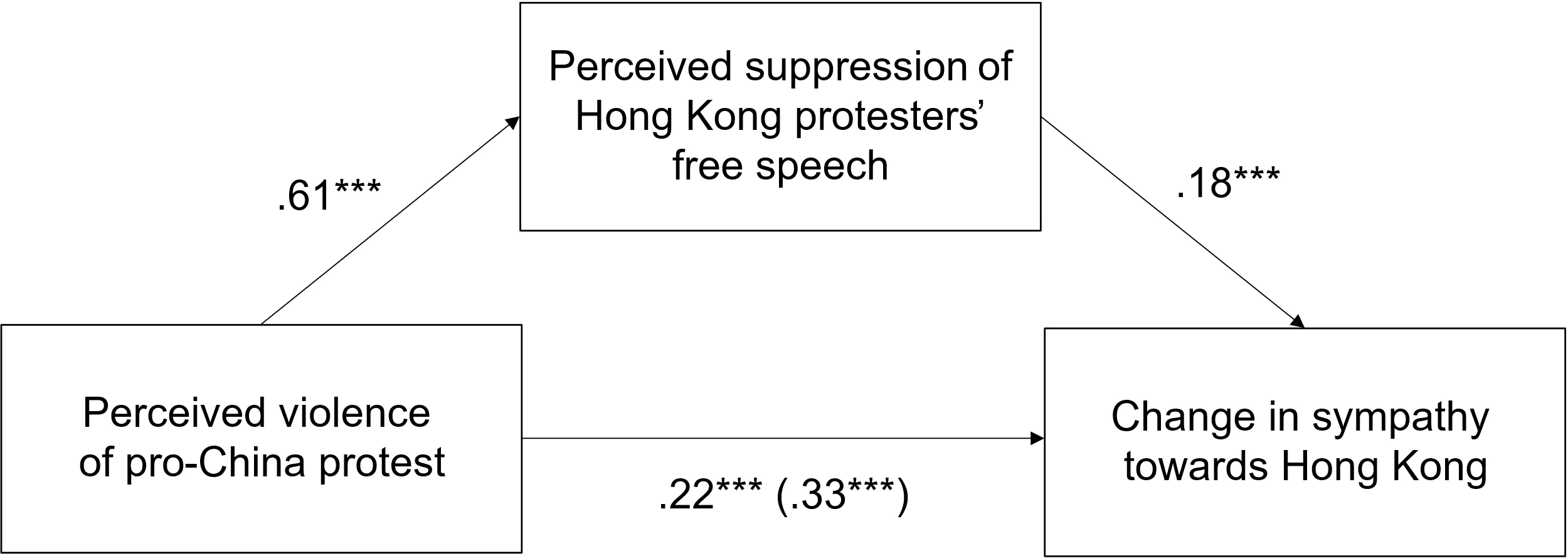
We tested whether perceived suppression of free speech mediated the relationship between perceived violence of the pro-China protest and changes in sympathy towards Hong Kong using PROCESS (Hayes, 2018; Model 4) with 10,000 bootstrapped samples. Political orientation was included as a covariate given the politicised nature of the protests. Perceived violence of the pro-China protest was positively associated with perceived suppression of free speech (b = 0.61, 95% CI [0.49, 0.73],p < .001), and perceived suppression of free speech (b = 0.18, 95% CI [0.08, 0.27],p < .001) was positively associated with changes in sympathy towards Hong Kong. The covariate political orientation was negatively associated with perceived suppression of free speech (b = -0.11, 95% CI [-0.21, -0.001], p = .047) and changes in sympathy towards Hong Kong (b = -0.16, 95% CI [-0.24, -0.07], p < .001). The indirect association between perceived violence of the pro-China protest and changes in sympathy towards Hong Kong via perceived suppression of free speech was significant, b = 0.11, boot SE = .04, boot 95% CI [0.05, 0.19]). The total association between perceived violence and changes in sympathy was significant (b = 0.33, 95% CI [0.23, 0.43],p < .001), as was the direct association (b = 0.22, 95% CI [0.11, 0.33],p < .001) after accounting for the mediator. Figure 1 summarises results of the mediation analysis. We note that the pattern of findings remained the same without controlling for political orientation (see Supplementary Material).

Figure 1

Mediation Model in Study 1

Following Imai et al. (2010), we conducted sensitivity analyses to assess how robust the indirect and direct associations are to potential unmeasured confounding. The sensitivity parameter ρ (rho) represents the correlation between the mediator and outcome error terms that an unmeasured confounder would induce. The indirect association would be nullified at ρ = 0.20 (a confounder explaining 4% of residual variance) and the direct association would require ρ = −0.40 (16% of residual variance) to be eliminated.

Discussion

Consistent with our hypothesis, perceived violence of the counter-protest was associated with greater concerns over free speech, which in turn was associated with increased sympathy for Hong Kong protesters. This was found among a sample of students in an Australian university that on average was more left leaning. While the findings accounted for political orientation as a covariate, it is worth noting that relatively greater right-wing orientation was associated with lower perceived suppression of free speech as well as reduced sympathy for Hong Kong protesters. As the study used cross-sectional correlational data, it is possible that those with more sympathetic attitudes toward the Hong Kong protesters interpreted more suppression of free speech and perceived higher levels of violence among the pro-China protest.

Study 2

Study 2 shifts to a different geopolitical setting by examining attitudes toward a pro-democracy movement in Thailand, a country ruled by constitutional monarchy. From 2020 to 2021, there were pro-reform protesters primarily led by young Thai students against the ruling government and the monarchy – institutions that have long been considered untouchable. The pro-reform protests demanded a series of democratic changes, including the resignation of the Prime Minister, drafting a new Thai constitution, and reform of the monarchy (BBC, 2020; Rasheed, 2020). In response, there have been counter-protests by groups who are pro-monarchy and pro-royalist (Phaicharoen & Watcharasakwet, 2020) defending the current government establishment and pledging to protect the monarchy against criticisms. While both sides have organised separate public gatherings in parallel and have been kept apart by police, there have been some instances of direct confrontation and physical clashes between pro-democracy protesters and pro-monarchy counter-protesters (BBC, 2020). In this context, we aimed to conceptually replicate Study 1 to examine whether and how public perceptions of the anti-reform counter-protesters were associated with attitudes toward the pro-reform protesters. Unlike Study 1 where the population sampled were third-party bystanders to the conflict, Thai residents sampled in Study 2 was directly implicated in the conflict and may have strong partisan loyalties. Thus, we account for political orientation as a covariate.

Method

Participants and Procedure

Participants were invited to complete an anonymous online survey about their opinions about the protests in Thailand. The survey could be completed in English or Thai. To recruit participants, the survey was posted on various social media sites (e.g., Facebook, Twitter). The data collection period was between 2nd and 21st October 2020. A total of 269 Thai participants completed the survey. There were 161 females, 70 males, 27 non-binary/third gender, five preferred to self-describe, and six did not report. Participants’ age ranged from 14 to 71 years (M = 32.98, SD = 12.97). In terms of highest level of education received, 24 completed high school, 148 received an undergraduate degree, 88 held a Master’s degree, six held a doctoral degree, and three did not report.

As in Study 1, participants were first given some background information about pro-social reform and anti-social reform protests in neutral language before they were asked to respond to a series of questions about their personal opinions on the protests. Specifically, the pro-reform protests were described as “demanding the resignation of the cabinet members and the dissolution of the parliament, as well as calling for the drafting of a new constitution” while the counter-protesters “pledge to protect the monarchy as well as preserve the trinity of nation, religion, and king”.

Measures

The same items used in Study 1 were adapted to the Thai context in Study 2: perceived violence of the pro-reform protest (α = .70), perceived violence of the anti-reform protest (α = .70), and perceived suppression of pro-reform protesters’ free speech (α = .93). Similar to Study 1, perceived changes in sympathy towards pro-reform protest and sympathy towards anti-reform protest were measured by asking participants the following: “Thinking about the anti-social reform protests mobilising against the pro-social reform protests, how does this make you feel towards the pro-social reform/anti-social reform protesters?” Responses were recorded on a scale from 1 (less sympathetic towards the pro-social reform/anti-social reform protesters) to 7 (More sympathetic towards the pro-social reform/anti-social reform protesters) with a midpoint at 4 (Did not change my attitudes). The scale anchors were originally from +3 to -3 and was recoded to a scale from 1 to 7 for ease of interpretation. As in Study 1, participants were also asked about their level of criticism of the pro-reform and anti-reform protests, but this question was not clearly understandable to participants due to a translation error, therefore the items were dropped from the measure. Finally, participants reported demographic information and political orientation on a scale from 1 (very left-wing) to 7 (very right-wing).

Results

Table 2 displays the means, standard deviations, and bivariate correlations. Participants reported increased sympathy towards the pro-social reform protests, with self-reported change in sympathy levels significantly exceeding the midpoint of the scale, t(264) = 22.82 p < .001, Cohen’s d = 1.40. In addition, participants reported decreased sympathy towards the anti-reform protests, with self-reported change in sympathy levels significantly lower than the midpoint of the scale, t(260) = -15.30, p < .001, Cohen’s d = -0.95. Paired samples t-tests showed that participants reported experiencing a greater change in sympathy towards the pro-reform protests compared to the anti-reform protests, t(257) = 22.26, p < .001, Cohen’s d = 1.39. Participants also reported perceiving the pro-reform protest as less violent than the anti-reform protest, t(268) = -16.16, p < .001, Cohen’s d = 0.99.

Table 2


Means, standard deviations, and bivariate correlations between variables in Study 2

 M (SD)123456
1. Perceived violence of pro-reform protest2.52 (1.37)     
2. Perceived violence of anti-reform protest4.70 (1.41)-.26***    
3. Perceived suppression of pro-reform protesters’ free speech5.09 (2.02)-.36***.47***   
4. Change in sympathy towards pro-reform protests6.12 (1.51)-.60***.34***.40***  
5. Change in sympathy towards anti-reform protests2.28 (1.82).47***-.32***-.34***-.38*** 
6. Political orientation2.33 (1.25).37***-.29***-.35***-.51***.23***
Note. *** p < .001. All items were measured on a scale from 1 to 7. For self-reported change in sympathy towards pro-reform/anti-reform protests, 1 indicated less sympathy and 7 indicated more sympathy. Higher scores on political orientation reflect higher right-wing orientation.

We tested whether perceived suppression of pro-reform protesters’ free speech mediated the link between perceived violence of the anti-reform protest and changes in sympathy towards the pro-reform protests using PROCESS (Hayes, 2018; Model 4) with 10,000 bootstrapped samples. To account for participants’ partisan loyalties in shaping attitudes toward the protests, we included political orientation as a covariate. Perceived violence of the anti-reform protest was positively associated with perceived suppression of free speech (b = 0.50, 95% CI [0.34, 0.66, p < .001), and perceived suppression of free speech (b = 0.12, 95% CI [0.03, 0.20], p = .006) was positively associated with changes in sympathy towards the pro-reform protests. The covariate political orientation was negatively associated with perceived suppression of free speech (b = -0.39, 95% CI [-0.57, -0.21], p < .001) and changes in sympathy towards the pro-reform protests (b = -0.47, 95% CI [-0.59, -0.34], p < .001). The indirect association between perceived violence of the anti-reform protest and changes in sympathy towards the pro-reform protests via perceived suppression of free speech was significant (b = 0.06, boot SE = 0.03, boot 95% CI [0.01, 0.13]). The total association between perceived violence and changes in sympathy was significant (b = 0.17, 95% CI [0.06, 0.28], p = .003), while the direct association was not significant after accounting for the mediator (b = 0.11, 95% CI [-0.01, 0.23], p = .062). See Figure 2 for the mediation model. We note that the pattern of findings remained the same without controlling for political orientation (see Supplementary Material). A sensitivity analysis following Imai et al. (2010) found that the indirect association would be nullified at ρ = 0.20 (a confounder explaining 4% of residual variance) and the direct association would be zero at ρ = −0.30 (9% of residual variance).

Figure 2

Mediation Model in Study 2

Discussion

Conceptually replicating the findings from Study 1, Study 2 found that greater perceived violence of a counter-protest was associated with greater concerns about the initial protesters’ free speech, which was in turn associated with greater sympathy for the initial social change protest. This was found in the context of anti-reform counter protests and pro-reform protests in Thailand. Similar to Study 1, the sample was on average left-leaning, though relatively greater right-wing orientation was associated with lower perceived suppression of free speech and reduced sympathy for the pro-reform protests. Given the correlational nature of the data, we once again cannot rule out the possibility that those who were sympathetic towards the pro-reform protesters perceived greater free speech suppression and greater violence from the anti-reform protests.

Study 3

Building on Study 1 and 2, Study 3 sought to experimentally test whether the use of a violent (versus non-violent) counter-protest strategy influences public sympathy towards the original protesters. This would provide greater internal validity than Study 1 and 2, in which perceived violence of the counter-protest was measured and its link to attitudes toward the original protest was tested correlationally. In Study 3, we tested whether absolute levels of sympathy towards the original protest would vary depending on the violent (versus non-violent) counter-protest conditions. In addition, in Study 1 and 2 the initial protest always advocated for social change (i.e., a system-challenging group), while the counter-protest group always defended the status quo (i.e., a system-supporting group). This raises the question of whether the effect of counter-protests on increasing sympathy towards the original protest would similarly occur in situations where the counter-protest group advocated for social change whereas the original protest defended the status quo. Study 3 therefore examined whether framing either group as the counter-protest influenced perceptions of the initial protest, especially whether the effects would persist when a social change movement was framed as organising the counter-protest.

Study 3 focused on protests around immigration in the U.S., which received increased attention under the 2017-2021 Trump administration due to increasingly restrictive immigration policies affecting vulnerable groups such as refugees and undocumented immigrants (Bey, 2018; Glenza, 2018). Anti-immigration groups have also increasingly mobilized to influence public discourse and have gained attention in the mainstream (Campani et al., 2022). In this context, the protest for social change was by immigrant rights groups advocating for the rights of incoming immigrants, and the protest defending the status quo was by White supremacist groups supporting restrictive immigration policies to ensure a White ethno-state. As mobilisation around immigration issues is heavily divisive between right-leaning and left-leaning people (Blee & Creasap, 2010; Fussell, 2014), we included political orientation as a covariate.

Method

Participants

An a priori power analysis using G*Power (Faul et al., 2007) revealed that at least 387 participants were required for 80% power to detect a medium-sized effect (d = .50). We oversampled participants to account for possible attrition. A total of 403 U.S. American participants were recruited on Prolific to complete an online survey. After excluding 22 participants for failing the manipulation check questions (see Measures section for details), 381 participants were retained for analyses. Participants’ age ranged between 18 to 64 years (M = 29.39 years, SD = 10.11). There were 180 males, 183 females, 15 non-binary/third gender, two were agender/questioning, and one did not report gender. In terms of racial background, 240 were White, 54 were Asian (East, South, or Southeast Asian), 25 were Black, 29 were Hispanic/Latinx, four were Native American/Alaskan Native, one were Native Hawaiian/Pacific Islander, and 26 were mixed race.

Procedure

The study was a 2 (counter protest group: White nationalists vs. immigrant rights) by 2 (strategy of the counter protest: violent vs. non-violent) between-groups factorial design. Participants read a summary of protest events and then answered questions about their opinions on those protests. Participants were randomly assigned to read one of four protest summaries, modelled after real protests that have occurred around U.S. immigration, with images from Google searches. The summaries were presented to participants as ostensibly real protests from 2019. In all four conditions, participants read about two protests: an initial protest and a counter-protest in response. The group framed as the original protest and the counter-protest varied by condition. When immigrant rights group were framed as the original protesters, the White nationalists were framed as the counter-protest, and vice versa. The immigrant rights protesters were described to participants as calling for less restrictive immigration laws and chanting slogans such as “build bridges, not walls”, while the White nationalist protesters were described as expressing anti-immigrant sentiments with slogans such as “deport illegals now”.

The counter-protest group was either described as using violent tactics or non-violent tactics. In the violent counter-protest condition, the summary indicated that the counter-protest group disrupted the original protesters by “yelling at them, tearing down several banners, and taking away the microphone from the organizers who were about to deliver a speech”. These actions may be viewed as disruptive rather than violent, however it fits within our broad operationalisation of violent tactics that could be perceived as harmful to others’ autonomy or dignity, even without physical injury or property destruction. In the non-violent condition, the summary indicated that both protests occurred in close proximity but counter-protesters “did not physically clash with or disrupt” the original protesters. The original protesters were always framed as using peaceful protest strategies (i.e., gathered in a peaceful public rally, chanted slogans, carried banners). At the end of the survey, participants reported demographic information and political orientation on a scale from 1 (Very liberal) to 9 (Very conservative). This study was pre-registered (see https://aspredicted.org/USJ_QWF) as an Honours thesis project that investigated sympathy as a key outcome, as well as additional variables (such as morality and emotional reactions) that are not investigated in this paper but were the focus of the student’s thesis.

Measures

As an attention check, participants were asked to identify the group that was counter protesting (White Nationalists / Immigrant rights activists / No counter-protest occurred), and whether the strategy of the counter-protest was disruptive (Yes / No / No counter-protest occurred). As a manipulation check for the counter-protest strategy, participants rated the extent to which they perceived the White nationalist protest (α = .88) and immigrant rights protest (α = .85) as using violent protest tactics on a scale from 1 (not violent / very peaceful / not disruptive at all) to 9 (very violent / not peaceful / very disruptive).

Similar to items used in Study 1 and 2, participants reported the extent to which they perceived suppression of the original protesters’ free speech (r = .92) in terms of the counter-protest “threatening the freedom of assembly of the immigrant rights / White nationalist protest” and “infringing upon the immigrant rights / White nationalist protesters’ free speech” on a scale from 1 (Not at all) to 9 (Very much).

In contrast to Study 1 and 2, where changes in sympathy levels were self-reported, here we measured absolute sympathy scores and changes in sympathy by systematically comparing levels of sympathy across conditions. Sympathy towards immigrant rights protest (α = .89) and towards White nationalist protest (α = .88) was measured using five statements adapted from Selvanathan et al. (2021) (e.g., “People need to listen to their arguments”, “I can sympathize with their cause”) on a scale from 1 (Strongly disagree) to 9 (Strongly agree).

Results

A series of two-way between group analysis of covariance (ANCOVA) was conducted to test the effect of condition on each outcome, controlling for participants’ political orientation. In the pre-registration, a two-way analysis of variance (ANOVA) was specified as the main analysis and as secondary analysis, it was noted that political orientation will be examined as a covariate. Political orientation (M = 3.53, SD = 2.10), with higher scores corresponding to greater conservatism, was found to be negatively correlated with sympathy towards the immigrant rights protest (r = -0.53, p < .001) and positively correlated with sympathy towards the White nationalist protest (r = 0.58, p < .001). This suggests that political orientation is a meaningful source of variance in participants’ responses, thus we opted to report findings with political orientation as a covariate to isolate the effects of condition on outcome measures.

Manipulation Checks

There was a significant interaction between counter-protest group and strategy on how violent the immigrant rights protest was perceived to be, F(1, 376) = 107.78, p < .001, ηp2 = .223. Participants in the violent immigrant rights counter-protest condition reported greater perceived violence of the immigrant rights protest (M = 5.62, SE = 0.14) compared to participants in the non-violent immigrant rights counter-protest condition (M = 2.13, SE = 0.14),F(1, 376) = 320.67, p < .001, ηp2 = .460. In addition, participants in the violent immigrant rights counter-protest condition perceived greater violence of the immigrant rights protest (M = 5.62, SE = 0.14) compared to participants in the violent White nationalist counter-protest condition (M = 2.42, SE = 0.14), F(1, 376) = 270.36, p < .001, ηp2 = .418. Thus, perceived violent strategy of the immigrant rights protesters was highest when this group was framed as the counter-protest using violent strategies, suggesting that the manipulation worked as intended.

There was a significant interaction between counter-protest group and strategy on how violent the White nationalist protest was perceived to be, F(1, 376) = 47.01, p < .001, ηp2 = .111. Participants in the violent White nationalist counter-protest condition reported greater perceived violence of the White nationalist protest (M = 7.55, SE = 0.18) compared to participants in the non-violent White nationalist counter-protest condition (M = 3.49, SE = 0.18),F(1, 376) = 259.87, p < .001, ηp2 = .409. In addition, participants in the violent White nationalist counter-protest condition perceived greater violence of the White nationalist protest (M = 7.55, SE = 0.18) compared to participants in the violent immigrant rights counter-protest condition (M = 5.06, SE = 0.18), F(1, 376) = 99.27, p < .001, ηp2 = .209. Thus, the perceived violent strategy of the White nationalist protesters was highest when this group was framed as the counter-protest using violent strategies, suggesting that the manipulation worked as intended.

Effects of Condition

The marginal means and standard errors by condition are reported in Table 3.

Table 3

Marginal means and standard errors by condition for Study 3


Counter-protest group


White nationalist protest


Immigrant rights protest


Counter-protest strategy


Violent

Non-violent


Violent

Non-violent

Perceived suppression of original protesters’ free speech

6.95a (0.23)

3.51b (0.23)


3.18b (0.23)

1.55c (0.23)

Sympathy towards immigrant rights protest

7.57a (0.15)

7.29a (0.15)


6.84b (0.15)

7.17ab (0.15)

Sympathy towards White nationalist protest

3.31ab (0.17)

3.46a (0.17)


2.94b (0.17)

3.48a (0.17)

Note. Standard errors reported in parentheses. Within a row, means without a common superscript differ (p < .05).

Perceived Suppression of Original Protesters’ Free Speech. There was a significant main effect of counter protest group on perceived suppression of the original protesters’ freedom of speech, F(1, 376) = 156.83, p < .001, ηp2 = .294. The White nationalist group was perceived to suppress the immigrant rights protesters’ freedom of speech (M = 5.23, SE = 0.16) more so than the immigrant rights protest was perceived to supress the White nationalist protester’s freedom of speech (M = 2.37, SE = 0.16). There was also a significant main effect of counter protest strategy, F(1, 376) = 123.43, p < .001, ηp2 = .247. A violent counter-protest tactic was perceived to suppress the original protesters’ freedom of speech (M = 5.07, SE = 0.16) more so than a non-violent tactic (M = 2.53, SE = 0.16). These main effects were qualified by a significant interaction between counter-protest group and counter-protest strategy, F(1, 376) = 15.87, p < .001, ηp2 = .041. The use of violence by a White nationalist counter-protest was viewed as a greater suppression of the original protesters’ freedom of speech (M = 6.95, SE = 0.23) than the use of violence by an immigrant rights counter-protest (M = 3.18, SE = 0.23), F(1, 376) = 137.29, p < .001, ηp2 = .267. The non-violent White nationalist counter-protest was also viewed as a greater suppression of the original protesters’ freedom of speech (M = 3.51, SE = 0.23) than the non-violent immigrant rights counter-protest (M = 1.55, SE = 0.23), but to a lesser degree, F(1, 376) = 36.10, p < .001, ηp2 = .088. Thus, the highest level of perceived suppression of the original protest’s freedom of speech was when the White nationalists were framed as the counter-protest group employing violent tactics. The findings remained the same when ANOVA was used (i.e., not controlling for political conservatism; see Supplementary Material).

Sympathy Towards the Immigrant Rights Protest. There was a main effect of counter-protest group on sympathy towards the immigrant rights protest, F(1, 376) = 7.97, p = .005, ηp2 = .021 such that participants reported greater sympathy towards the immigrant rights protest when White nationalists were the counter-protest group (M = 7.43, SE = 0.11) compared to when the immigrant rights protest was the counter-protest group (M = 7.00, SE = 0.11). There was no main effect of counter-protest strategy, F(1, 376) = .021, p = .884, ηp2 < .001. These main effects were qualified by a significant interaction between counter-protest group and counter-protest strategy, F(1, 376) = 4.10, p = .044, ηp2 = .011. A violent White nationalist counter-protest group increased sympathy towards the immigrant rights protest (M = 7.57, SE = 0.15), compared to when the immigrant rights group was the counter-protest group using a violent strategy (M = 6.84, SE = 0.15), F(1, 376) = 11.85, p = .001, ηp2 = .031. There was no significant difference in sympathy towards the immigrant rights protest when comparing the non-violent White nationalist counter-protest (M = 7.29, SE = 0.15) and the non-violent immigrant rights counter-protest (M = 7.17, SE = 0.15) conditions, F(1, 376) = 0.31, p = .575, ηp2 < .001. Taken together, sympathy for the immigrant rights protest emerged especially when the White nationalist group was framed as the violent counter-protest. The effects did not reach significance when ANOVA was used (i.e., not controlling for political conservatism; see Supplementary Material).

Sympathy Towards the White Nationalist Protest. There was no main effect of counter protest group on sympathy towards the White nationalist protest, F(1, 376) = 1.10, p = .294, ηp2 = .003. There was a significant main effect of counter-protest strategy, F(1, 376) = 4.25, p = .040, ηp2 = .011, such that there was lesser sympathy towards the White nationalist protest when counter-protest strategy was violent (M = 3.14, SE = 0.12) rather than non-violent (M = 3.46, SE = 0.12). However, there was no significant interaction between counter-protest group and counter-protest strategy, F(1, 376) = 1.34, p = .247, ηp2 = .004. There were no significant effects when ANOVA was used (i.e., not controlling for political conservatism; see Supplementary Material).

Mediation Analysis

To examine whether perceived suppression of immigrant rights protesters’ free speech mediated the effect of counter-protest strategy on sympathy towards the immigrant rights protest, we conducted a mediation analysis using Model 4 of PROCESS (Hayes, 2018) with 10,000 bootstrapped samples. This is a deviation from the pre-registration which did not specify a mediation analysis. Here, we used only participants in the White nationalist counter-protest condition who saw the immigrant rights protesters framed as the original protest group (n = 190), which mirrors Study 1 and 2 with a progressive initial protest. Manipulated strategy of the counter-protest was entered as the predictor (1 = violent, 0 = non-violent), perceived suppression of the original protesters’ free speech as the mediator, sympathy towards the immigrant rights protest as the DV, and political orientation as a covariate.

Counter-protest strategy was positively associated with perceived suppression of free speech (b = 3.60, 95% CI [2.95, 4.25], p < .001), and perceived suppression of free speech (b = 0.20, 95% CI [0.12, 0.29], p < .001) was positively associated with sympathy towards the immigrant rights protest. The covariate political orientation was negatively associated with perceived suppression of free speech (b = -0.42, 95% CI [-0.58, -0.26], p < .001) and sympathy towards the immigrant rights protest (b = -0.45, 95% CI [-0.55, -0.35], p < .001). The indirect effect of counter-protest strategy on sympathy via perceived suppression of free speech was significant (b = 0.73, boot SE = 0.16, boot 95% CI [0.45, 1.10]). The total effect of counter-protest strategy on sympathy was not significant (b = 0.31, 95% CI [-0.09, 0.72], p = .126), and the direct effect (b = -0.41, 95% CI [-0.90, 0.07], p = .095) was also not significant after accounting for the mediator. See Figure 3 for the mediation model. We note that the pattern of findings remained the same without controlling for political orientation except that the direct effect was significant (see Supplementary Material). A sensitivity analysis (Imai et al., 2010) indicated that the indirect effect would be nullified at ρ = 0.30 (confounding variable explaining 9% of residual variance), and the direct effect would be zero at ρ = 0.20 (4% of residual variance).

Figure 3

Mediation Model in Study 3

Discussion

Study 3 found that witnessing a White nationalist counter-protest disrupting an immigrant rights protest increased public sympathy towards the immigrant rights protest, compared to when the immigrant rights protest was framed as the counter-protest group disrupting a White nationalist protest. The use of violent (versus non-violent) tactics by the White nationalist counter-protest increased perceptions of free speech violations – that is, the violent White nationalist counter-protest was perceived as a greater suppression of immigrant rights protesters’ free speech compared to a peaceful White nationalist counter-protest. This in turn was linked to greater sympathy towards the immigrant rights protest. While the sample was on average left-leaning, relatively greater right-wing orientation was associated with lower perceived suppression of free speech and reduced sympathy for the protests. These findings are broadly consistent with Studies 1 and 2, which showed that perceived use of violent counter-protest strategies was associated with greater sympathy for the protest advocating social change, in part explained by perceived suppression of original protesters’ free speech.

Interestingly, Study 3 showed that when a White nationalist protest was disrupted by an immigrant rights counter-protest, there was no statistically significant shift in sympathy towards the White nationalist protest. This suggests that people do not apply the same standards when judging an immigrant rights protest disrupted by a White nationalist counter-protest versus a White nationalist protest disrupted by an immigrant rights counter-protest. While this is understandable given that White nationalists tend to be widely vilified, our findings are inconsistent with a previous study that found support for a White nationalist group increased after viewing a violent antiracist counter-protest against them (Simpson et al., 2018). It is possible that an antiracist group was seen as part of left-wing anti-fascist movements that tends to be viewed as radical, which may create a backlash effect that softens attitudes toward White nationalists by comparison (Simpson et al., 2018). In contrast, the immigrant rights movement used in our study is not typically associated with extremism, which could explain why attitudes toward White nationalists were largely unchanged.

Thus far, in Studies 1 to 3, we examined how the perceived violence of a counter-protest influenced concerns about protesters’ free speech, and how this in turn was associated with sympathy for social change protests. Building on this, Study 4A aims to test whether the mere presence of a counter-protest is sufficient to increase support for a social change protest. Study 4B will then examine whether, compared to a situation where no counter-protest occurs, a violent versus non-violent counter-protest would differentially shape public attitudes toward social change protests. Testing these hypotheses will provide additional insights into whether and how counter-protests shape public perceptions. Study 4A and 4B will focus on the context of climate protests where anti-mining protesters have mobilised to push for renewable energy and pro-mining protesters have mobilised in response.

Study 4A

Study 4A investigated whether the presence (versus absence) of a counter-protest can influence public sympathy towards a social change protest in an Australian coal mining context. The construction and use of coal mines is a heavily debated topic in Australia with significant environmental and economic consequences. Proposals for the construction of coal mines in Australia have historically incited the emergence of protests and counter-protests, as evidenced in the case of the Adani mine (Burt & McGee, 2019). The ‘Stop Adani’ movement emerged as a grassroots environmental effort with the goal of stopping the coal mine construction (Zając, 2018). In response, the ‘Start Adani’ counter-movement emerged to advocate for the construction of coal mines (Daley, 2019). We hypothesised that the presence of a pro-mining counter-protest would lead to greater public sympathy towards the environmental protest compared to when no counter-protest was present. As we do in previous studies, Study 4A and 4B will include political orientation as a covariate. Political ideology has been shown to influence support for the construction of new coal mines and climate action, with right-leaning voters more likely to support coal mines (Tranter & Foxwell-Norton, 2021) and left-leaning voters aligning with climate policies (Colvin & Jotzo, 2021).

Method

Participants

An a priori power analysis using G*Power revealed that at least 210 participants were required for 95% power to detect a medium-size effect between two groups (d = .50). A total of 210 Australian participants were recruited to complete online surveys via Prolific. Data were deleted from one participant who chose to withdraw from the study. Participants who failed the attention check (n = 53) were excluded from the sample (for more details, see Measures section). There were no cases of incomplete data. After exclusions, the final sample consisted of 156 participants: 61 in the control condition and 95 in the counter-protest condition. With this sample size, a sensitivity analysis using G*Power indicated that our study was able to detect an effect size of d = 0.60 or larger. Participants’ age ranged from 18 to 81 (M = 32.60; SD = 11.53). There were 70 females, 82 males, and four were gender non-binary. In terms of racial background, 110 were White/European, 33 Asian, three Middle Eastern, one Latin/Hispanic, one Pacific Islander and eight identified as other.

Procedure

The study used a between-groups experimental survey design. Participants first read a summary of a protest event. They were randomly assigned to one of two summaries, either a control or counter-protest condition. As in Study 3, the summaries were developed for the purposes of this study based on real protest events in Australia (e.g., Burt & McGee, 2019). They were presented to participants as ostensibly real. In the control condition, participants read about a protest against the construction of a new coal mine in regional Queensland (the anti-mining protest), including images taken from Google searches. The protestors called on the government to rescind their approval of the mine, and stated the detrimental environmental impacts that the mine would produce, if constructed. In the counter-protest condition, participants read about the same anti-mining protest, which was then disrupted by a counter-protest that supported the construction of the new coal mine. The pro-mining-protestors (counter-protest) were described as chanting slogans such as “start the mine” and “proud coal miner”, in direct opposition to the anti-mining protestors. They were described as getting into “heated arguments” with the anti-mining protestors, including telling the anti-mining protesters to “leave energy production to the experts”. After reading about the protest, participants answered questions about their opinions on the event. Finally, participants reported their demographic information and political orientation on a scale from 1 (Very liberal) to 9 (Very conservative). The study was pre-registered (see https://aspredicted.org/Q6G_TLJ) as an Honours thesis project and included exploratory variables such as environmental attitudes, prior protest, and mining industry experience, which are not investigated in this paper.

Measures

As an attention check, participants were asked: “Was there an opposing group of counter-protesters that clashed with the protestors?” with response options “yes”, “no” and “unsure”. Those who answered incorrectly or were unsure, based on their assigned condition, were excluded from analyses (n = 53). Specifically, seven participants in the control condition incorrectly answered “yes” and 36 reported “unsure”. In the counter-protest condition, four answered “no” and six were “unsure”. The high number of “unsure” responses in the control condition may reflect confusion caused by the question wording which raised ambiguity about the possibility that a counter-protest was present. The results remained unchanged when including the full sample in analyses (see Supplementary Material). The outcome variable, sympathy towards the anti-mining protest, was measured using the same five items used in Study 3 (α = .89).

Results

An ANCOVA was conducted to test the effect of condition on sympathy for the anti-mining protest, with political orientation as a covariate. Participants in the counter-protest condition (M = 7.17; SE = 0.13) did not significantly differ from those in the control condition (M = 7.19, SE = 0.16), F(2, 153) < 0.01, p = .945. Political orientation (M = 3.85; SD = 1.62), with higher scores referring to higher levels of conservatism, was associated with lower sympathy for the anti-mining protest (r = -0.57, p < .001). In the pre-registration, an ANOVA was specified as the main analysis; the findings remained the same when not controlling for political orientation (see Supplementary Material).

Discussion

Building on Studies 1-3, Study 4A suggests that the mere presence of a counter-protest does not promote support for a social change protest. To our knowledge, this is the first study to systematically assess whether counter-mobilisation alone is sufficient to sway public attitudes in favour of a social movement. As this is a single study in a specific context, replications are needed to assess whether and how the mere presence of counter-protests can shift attitudes. These findings nonetheless indicate that the presence of a counter-protest, in itself, may not be enough to influence attitudes; rather, the specific strategies employed by counter-protesters could play a more decisive role. To explore this possibility, Study 4B directly manipulates counter-protest strategy to investigate how different approaches to opposition shape public attitudes toward the original protest.

Study 4B

Building on Study 4A, Study 4B investigated whether the strategy of the counter-protest (violent vs. non-violent) can influence public attitudes toward a social change protest. While perceived use of violent counter-protest strategy was assessed as a predictor of support for a social change protest in Study 1-3, this was not tested experimentally. As in Study 4A, using the context of an environmental movement in Australia, we expected that a violent counter-protest (relative to the non-violent counter-protest) strategy would produce greater perceived suppression of the environmental protesters’ free speech, which in turn would lead to greater sympathy towards the environmental protest.

Method

Participants

An a priori power analysis using G*Power revealed that at least 252 participants were required for 95% power to detect a medium effect size (d = .25) for a difference between three groups. To account for exclusions, we oversampled by recruiting 300 Australian participants via Prolific. There were 32 participants who were excluded because they failed at least one attention check question (see Measures). The final sample consisted of 268 participants (control condition = 90, non-violent counterprotest condition = 97, violent counter-protest condition = 81). The age of participants ranged from 18 to 76 years (M = 33.92, SD = 12.20). In terms of racial background, 187 were White/European, 57 Asian, five Middle Eastern, four Latin/Hispanic, two Pacific Islander, two African, and 11 identified as other. As for political orientation (on a scale from 1-9), participants were slightly more left leaning (M = 3.65, SD = 1.78).

Procedure

This study used a 3-level between-groups design (i.e., control no counter-protest; non-violent counter protest; violent counter-protest). Participants were randomly assigned to read one of three media articles about ostensibly real protest events, and then answer questions about their perceptions of the protests. The articles were similar to Study 4A except that the strategy of the counter-protest was varied depending on condition. In all conditions, participants read about an environmental protest against the construction of a new coal mine in regional Queensland. In the non-violent counter-protest and violent counter-protest conditions, participants also read about a counter-protest that gathered to voice their opposition to the environmental protest and support the coal mine construction. In the non-violent counter-protest condition, the counter-protest was described as peaceful and non-confrontational, where it was explicitly stated that the protesters did not physically clash. By contrast, in the violent counter-protest condition, counter-protesters disrupted and physically clashed with the environmental protesters such as by “tearing down signs” and “shoving them to the ground”. The physical clashes described here represent a more explicit use of violent protest tactics compared to the violent counter-protest condition in Study 3. The study was pre-registered (see https://aspredicted.org/VKW_6FK) as an Honours thesis project and included exploratory variables similar to Study 4A including environmental attitudes, prior protest, and mining industry experience; these variables are not examined in this paper.

Measures

As an attention check, all participants were asked whether there was there a pro-mining protest (i.e., as a counter-protest) present at the event (Yes / No). Participants in the violent and non-violent counter-protest conditions were additionally asked as an attention check whether pro-mining counter-protest used violence to disrupt the environmental protesters (Yes / No). Using the same measures from Study 3, participants in the violent and non-violent counter-protest conditions reported their perceptions of the violent strategy of the pro-mining counter-protest (α = .93), as well as the perceived suppression of free speech (α = .94). All participants reported their sympathy towards the environmental protest (α = .87). Finally, participants reported their demographic information and political orientation on a scale from 1 (Very left-wing) to 9 (Very right-wing).

Results

A series of ANCOVAs was conducted to test the effect of condition on each outcome, controlling for participants’ political orientation. Although the pre-registration specifies ANOVAs as the main analysis, it was noted in secondary analysis that political orientation would be examined as a covariate. Political orientation (M = 3.65; SD = 1.78), with higher scores reflecting higher right-wing orientation, was negatively correlated with sympathy towards the environmental protest (r = -0.40, p < .001), indicating that it may systematically contribute to participants’ responses. Notably, the pattern of results remained the same when using ANOVAs (i.e., not controlling for political orientation), suggesting the results are robust across analytic approaches (see Supplementary Material).

Manipulation Check

An ANCOVA was conducted to examine the effect of counter-protest strategy (violent and non-violent counter-protest conditions) on perceived violent counter-protest strategy, controlling for political orientation. As expected, participants in the violent counter-protest condition (M = 7.15, SE = 0.13) perceived the counter-protest as significantly more violent than participants in the non-violent counter-protest condition (M = 2.23, SE = 0.12), F(1, 175) = 777.81, p < .001, ηp2 = .82. Thus, the manipulation of counter-protest strategy was deemed successful.

Effects of Condition

An ANCOVA was conducted to examine the effect of condition (control, non-violent counter-protest, violent counter-protest) on sympathy towards the environmental protest, controlling for political orientation. There was a significant effect of condition on sympathy, F(2, 264) = 3.48, p = .032, ηp2 = .03. Planned contrasts showed that sympathy towards the environmental protest was significantly higher in the control condition (M = 7.60, SE = 0.14) compared to the non-violent counter-protest condition (M = 7.10, SE = 0.13), p = .011. There was no significant difference in sympathy between the violent counter-protest condition (M = 7.46, SE = 0.15) and the control condition (M = 7.60, SE = 0.14), p = .457, or between the violent counter-protest condition (M = 7.46, SE = 0.15) and the non-violent counter-protest condition (M = 7.10, SE = 0.13, p = .083).

An ANCOVA was also conducted to test the effect of counter-protest strategy (violent and non-violent counter-protest conditions) on perceived suppression of environmental protesters’ free speech, controlling for political orientation. There was a significant effect of condition on perceived suppression of free speech, F(1, 175) = 292.43, p < .001, ηp2 = .626. The violent counter-protest was perceived as suppressing free speech (M = 6.92, SE = 0.19) more than the non-violent counter-protest (M = 2.63, SE = 0.17).

Mediation Analysis

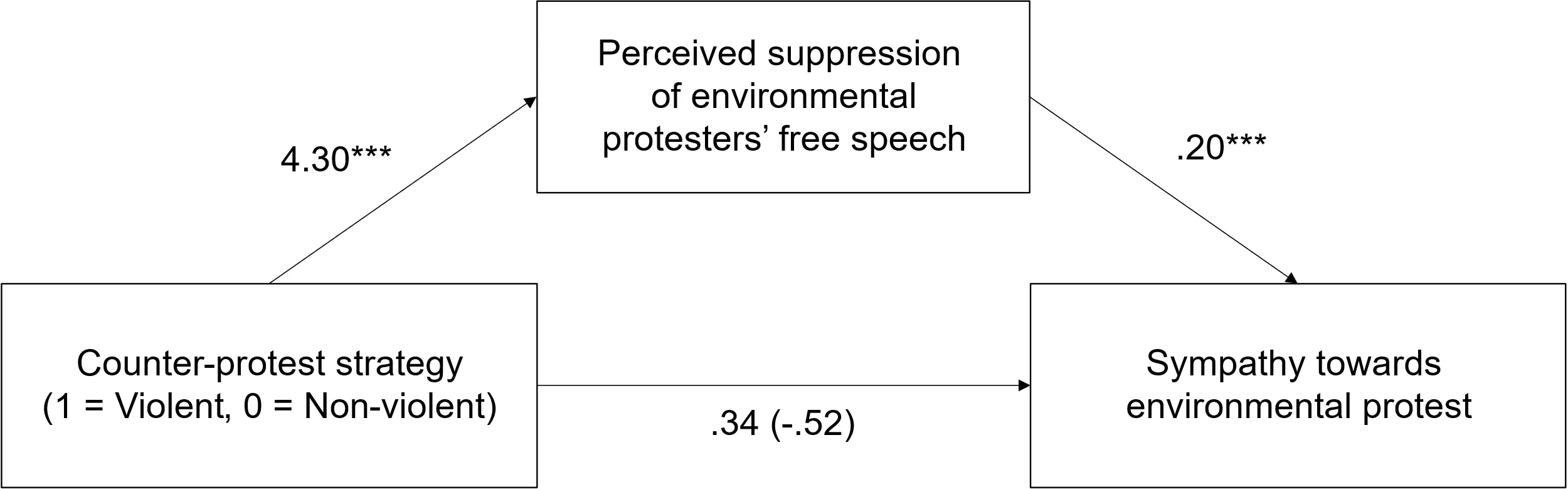
As pre-registered, a mediation analysis was conducted even though there was no significant difference between the violent and non-violent counter-protest conditions given that a significant total effect is not required to proceed with examining indirect effects (Rucker et al., 2011)[1]. We used PROCESS (Hayes, 2018; Model 4) to test the indirect effect of counter-protest strategy (0 = non-violent, 1 = violent) on sympathy towards the environmental protest via perceived suppression of free speech, controlling for political orientation. Counter-protest strategy was positively associated with perceived suppression of free speech (b = 4.30, 95% CI [3.80, 4.80], p < .001), and perceived suppression of free speech (b = 0.20, 95% CI [0.08, 0.32], p = .001) was positively associated with sympathy towards the environmental protest. The covariate political orientation was not significantly associated with perceived suppression of free speech (b = -0.09, 95% CI [-0.24, 0.06], p = .229), but was negatively associated with sympathy towards the environmental protest (b = -0.31, 95% CI [-0.43, -0.19], p < .001). The indirect effect of counter-protest strategy on sympathy via perceived suppression of free speech was significant (b = 0.86, boot SE = 0.27, boot 95% CI [0.34, 1.39]). The total effect of counter-protest strategy on sympathy was not significant (b = 0.34, 95% CI [-0.07, 0.76], p = .106), and the direct effect (b = -0.52, 95% CI [-1.18, 0.14], p = .121) was also not significant after accounting for the mediator. See Figure 4 for the mediation model. We note that the pattern of findings remained the same without controlling for political orientation (see Supplementary Material). A sensitivity analysis based on Imai et al. (2010) indicated that the indirect effect would be eliminated at ρ = 0.20 (a confounder explaining 4% of residual variance) and the direct effect would be zero at ρ = 0.10 (1% of residual variance).

Figure 4

Mediation Model in Study 4B

Discussion

In line with hypotheses, Study 4B showed that the violent pro-mining counter-protest (relative to the non-violent counter-protest) produced greater public concern for the suppression of the environmental protesters’ free speech. In turn, this was associated with greater sympathy towards the environmental protest. Similar to previous studies, the sample was on average left-leaning, and those with greater right-wing orientation reported lower sympathy for the environmental protests. Unexpectedly, viewing the environmental protest alone compared to viewing the protest being disrupted by a counter-protest did not change sympathy levels towards the environmental protest. This suggests that the effect of a violent counter-protest on public perceptions of a protest for social change may be more complicated than we previously envisioned. It is possible that exposure to any counter-protest, regardless of its level of violence, draws attention away from the original protest’s message and instead shifts focus to the conflict itself. This distraction may dilute the impact of the environmental protest, thereby dampening any potential increase in sympathy.

Although there was no direct effect of counter-protest violence on sympathy, the presence of an indirect effect via perceived suppression of free speech suggests a statistical suppression effect (Rucker et al., 2011), in which opposing mechanisms may be operating simultaneously. While concerns about free speech can promote public sympathy, other perceptions triggered by the violent counter-protest – such as assumptions about the environmental protest’s own use of violence – may reduce it. These competing processes could suppress the overall direct effect.

General Discussion

Counter-movements are a common response to social change movements. The present research offers one of the first systematic investigations into how counter-protests shape public attitudes toward the social change movements they oppose. We do so across a variety of contexts spanning pro-democracy movements in Hong Kong and Thailand, immigrant rights protests in the U.S., and environmental activism in Australia. Drawing on cross-sectional and experimental survey research designs, we found corroborating evidence linking the use of violent strategies by counter-protesters to greater public concern that such actions suppress the freedom of speech of social change protesters. These concerns, in turn, was associated with greater sympathy for the initial social change protest that they clash with. The effect of violent counter-protests on greater sympathy towards the initial protest was inconsistent across studies. Taken together, while counter-protests may seek to delegitimise a cause, they could paradoxically amplify concerns that the initial protests are being suppressed.

This work contributes novel insights into the psychology of social change. Notably, public concern for the suppression of free speech can occur in grassroots confrontations between protests and counter-protests. These findings echo and extend prior work on the paradoxical effects of state repression (e.g., Adam-Troian et al., 2020; Aytaç et al., 2018), by showing that similar effects can occur even when the repression may come from other civilians rather than authorities. While not all counter-protests intend to be repressive, in the specific instances where they use violent tactics to defend the status quo, our findings suggest that they can be perceived as suppression of social change protesters’ free speech. Perceived suppression of free speech may be part of a broader construct of illegitimacy perceptions (Jiménez-Moya et al., 2019; Lizzio-Wilson et al., 2022; Thomas & Louis, 2014). A disruptive counter-protest could potentially be viewed as evoking a sense of illegitimacy about the situation, thereby building support for a social change movement. Our findings are also in line with research on the negative effects of violent protest tactics on public perceptions (Lizzio-Wilson et al., 2022; Orazani & Leidner, 2019; Shuman et al., 2021; Thomas & Louis, 2014), and extends this work to the context of opposing social movements.

More broadly, the present research contributes to our understanding of how the public responds to interactions between protests and counter-protests, moving beyond much of the existing theorising on collective action that has focused on progressive social movements (for a review, see Shuman et al., 2024) in isolation from reactionary counter-movements that can arise in response to it. Our work complements and builds on emerging literatures on reactionary counter-movements (e.g., Guvensoy et al., 2025; Thomas & Osborne, 2022) by considering how the public responds when confronted with both sides of this dynamic simultaneously.

Constraints on Generality

We identified important boundary conditions for the effect of counter-protests on public attitudes. First, whether a protest defends or challenges the status quo appears to shape how counter-protest violence is interpreted. In Study 3, we experimentally manipulated which group was framed as the counter-protest: a system-challenging group (immigrant rights activists) or a system-stabilising group (White nationalists). Sympathy for the system-challenging group was highest when the system-supporting group was framed as the counter protest against them – not the reverse. This reflects a potential asymmetry in public perceptions of protests: when violent tactics are used by a reactionary counter-movement, it can reinforce the perception that they are attempting to suppress calls for progressive change. This finding can be further understood through the lens of the underdog literature – which shows that observers are especially likely to sympathize with groups perceived as disadvantaged (Bruneau et al., 2017; Vandello et al., 2007). A violent counter-protest disrupting a peaceful social change protest may emphasise the underdog status of the social change protest. As a result, their actions are perhaps viewed as more justifiable compared to those of the counter-protest group.

Second, the mere presence of a counter-protest appeared to be insufficient to motivate sympathy for a social change protest (Study 4A), suggesting that the tactics used by counter-protesters are crucial. It is specifically violent counter-protests that was indirectly associated with greater sympathy towards the original protest via greater perceived suppression of the original protesters’ free speech (Studies 1 – 3 and 4B). Our research highlights the strategic importance of protest tactics – not only for social change movements themselves, which has been the focus of previous research (for a review, see Orazani et al., 2021), but also for groups seeking to oppose them.

Third, the direct effect of counter-protest violence (vs. non-violence) on sympathy towards a protest for social change was not always consistent. Although violent versus non-violent counter-protest strategies did not directly affect public sympathy (Studies 3 and 4B), across studies, a violent counter-protest was linked to greater public sympathy towards a protest for social change indirectly through perceived suppression of their free speech (Studies 1 – 3 and 4B). This suggests that counter-protests may trigger a range of responses, with our research highlighting one potential pathway. It raises the possibility that counter-protests could reduce sympathy via other mechanisms, such as by activating feelings of threat and fear amongst some members of the public audience; such reactions could undermine the initial protest’s legitimacy and ultimately diminish support (e.g., Selvanathan & Lickel, 2019b). It is also possible that direct effects of violent counter-protests on sympathy towards the initial protest movement is limited, and instead, the stronger impact is on perceptions of free speech violations which could be more malleable rather than overall attitudes toward a movement.

Fourth, in all studies, the initial protest was perceived as more peaceful than the counter-protest or the initial protest was described as peaceful while the counter-protest was framed as disruptive or violent. This framing was a deliberate choice to focus on a particular type of counter-protest: those that clash with peaceful progressive protests. Our results therefore offer insights into how counter-protests are perceived when they disrupt peaceful progressive protests through intimidation or confrontational tactics. It is possible that the findings only emerge when there is an asymmetry between a peaceful protest and disruptive counter-protest, but it would not emerge, for example, if a peaceful counter-protest disrupted a violent protest.

Limitations and Future Research

Our research is limited in several ways. First, our studies were mostly conducted in Western liberal democracies where protest and freedom of expression is relatively more protected compared to less democratic countries (Vásquez et al., 2024). The correlational study in Thailand offers a valuable contrast, as it represents a setting with a history of military rule and ongoing restrictions on public assembly (Freedom House, 2025). However, beyond this case, we lack evidence that the results would generalise to less democratic environments where concerns about protester’s freedom of expression may be shaped by societal norms emphasising conformity and limited tolerance for dissent.

In addition, the link between perceived suppression of protesters’ free speech and sympathy towards a social change protest was correlational in all studies. There remains a concern about unmeasured confounders which can bias mediation estimates when the mediator is not experimentally manipulated (Imai et al., 2010). Our experimental studies were measurement-of-mediation designs that do not provide causal evidence of mediation (Pirlott & MacKinnon, 2016; Spencer et al., 2005). It is possible that those with sympathetic attitudes towards a protest movement viewed violent counter-protests as especially suppressive of the initial protesters’ freedom of speech. Future research using a manipulation-of-mediator design (Spencer et al., 2005), such as by manipulating levels of free speech suppression would provide a key test of the causal mechanism.

Furthermore, in all studies, our participants tended to be politically left-leaning on average; thus, the generalizability of our findings to more ideologically neutral or right-leaning individuals is limited. Although we statistically controlled for political orientation and showed that our effects were robust, our studies do not fully capture dynamics that could emerge in more politically heterogeneous samples. For instance, individuals with more politically conservative views may respond differently to counter-protests – possibly feeling affirmed or emboldened – leading to reduced support for the original protest movement. Indeed, research on Black Lives Matter protests in the U.S. showed that it mobilised public attitudes amongst political progressives but had little influence on conservatives (Reny & Newman, 2021), suggesting that effects of protests on the public may be contingent on political ideology. Future research is needed to examine a possible polarising effect of counter-protests.

To conclude, the present research provides a foundational step towards understanding how counter-protests shape public attitudes toward protests for social change. We highlight the complex and sometimes ironic ways in which counter-protests can inadvertently strengthen concerns for the initial protesters’ freedom of speech. Our findings underscore the potential strategic advantage of non-violent protest and the importance of understanding the opposition that social change protests face. As protests remain a vital expression of democratic participation, it is essential for researchers to consider counter-protests as active forces that may influence how protest messages are received and evaluated by the broader public.

Conflicts of Interest

The authors declare no competing interests.

Acknowledgements

This contribution was supported by research funds from the School of Psychology at The University of Queensland awarded to the first author and an Australian Research Council Laureate Fellowship (FL180100094) awarded to the third author.

Data Availability Statement

The data, analysis code, and study materials for this project is made available on the Open Science Framework: https://osf.io/tec45/

Supplementary Materials

The supplementary materials can be found here.

Author Contributions

All authors contributed to study design and write-up of this manuscript. The overarching project was conceptualised by H.S., M.H. and J.J. with individual studies developed with X.B., M.H., and R.T.M., who were students at the time of data collection. H.S., JJ., and M.H., developed the first full draft of the manuscript, with particular input from R.T.M. on Study 3, M.H. on Study 4A, and X.B. on Study 4B. The data was collected and analysed by H.S., X.B., M.H., and R.T.M.

Endnotes

[1] In cases where a significant indirect effect occurs with no significant total or direct effects, it is possible a potential suppressor variable may be exerting an opposing indirect effect to the mediator (Rucker et al., 2011). We conducted exploratory analyses testing suppression effects and these are reported in Supplementary Material.

Editor Curated

Frequently Asked Questions

  • What core question does this paper address, and why does it matter now?

    Selvanathan et al. (2026) ask whether counter-protests—especially when confrontational—undermine or enhance public support for the original protest. The question is timely amid rising polarization, where street encounters between opposing groups shape narratives about legitimacy and rights. Using five studies across Hong Kong, Thailand, U.S. immigration, and Australian coal politics, the team shows that when counter-protesters use aggressive tactics, observers often interpret this as suppressing free speech, which in turn increases sympathy for system-challenging movements. In other words, visible pushback can backfire for status-quo defenders. The findings matter for democratic discourse because they illuminate how the public reads conflicts over protest, who earns moral standing, and how perceptions of free speech shape support for social change.

  • How did the researchers test their hypotheses across different contexts?

    The study by Selvanathan et al. (2026) combines cross-sectional and experimental designs spanning multiple political contexts.

    1. Study 1: Australian campus clash between pro–Hong Kong and pro–China groups.
    2. Study 2: Thailand’s pro-reform movement vs. pro-monarchy counter-protests.
    3. Study 3: U.S. immigration protests (immigrant-rights vs. White nationalists) in a 2×2 experiment manipulating who counter-protested and whether tactics were violent vs. non-violent.
    4. Studies 4A/4B: Australian coal-mining protests assessing effects of counter-protest presence and tactic.

    Across studies, the team measured perceived counter-protest violence, perceived suppression of the original protesters’ free speech, and sympathy. Political orientation was included as a covariate to ensure effects were not merely ideological.

  • Does violence by counter-protesters often backfire on them?

    According to Selvanathan et al. (2026), aggressive counter-protest tactics often backfire by signaling suppression of free speech, which may increase sympathy for the original protest. In Study 3, a violent White nationalist counter-protest raised perceived free-speech suppression (b = 3.60, p < .001) and was indirectly associated with higher sympathy for immigrant-rights protesters (indirect b = 0.73, 95% CI [0.45, 1.10]). However, no consistent direct effect was observed on sympathy toward the protest movements.

  • What psychological mechanism explains the change in public sympathy?

    Selvanathan et al. (2026) identify perceived suppression of free speech as the key mediator. Observers infer that violent or disruptive counter-protests threaten others’ rights to assemble and speak, which confers moral standing on the targeted group and elevates sympathy. In Study 1 (Hong Kong context), perceived counter-protest violence predicted free-speech suppression (b = 0.61, p < .001), which then was associated with sympathy for Hong Kong protesters (b = 0.18, p < .001; indirect b = 0.11, 95% CI [0.05, 0.19]). Study 2 (Thailand) replicated this pathway (indirect b = 0.06, 95% CI [0.01, 0.13]). Study 3 experimentally confirmed the mechanism in the U.S. immigration context (indirect b = 0.73, 95% CI [0.45, 1.10]).

  • What are the practical implications for activists, organizers, and policymakers?

    Selvanathan et al. (2026) suggest three practical takeaways.

    1. For movements: Non-violent discipline and clear appeals to rights can win public sympathy, particularly if opponents escalate.
    2. For counter-movements: Aggressive disruption risks backfire by appearing to suppress free speech, especially against non-extremist, system-challenging groups.
    3. For policymakers and police: Protecting the freedom of assembly and minimizing coercive interventions can prevent perception-driven escalations and preserve trust.

    The authors also show political ideology shapes reactions, but effects persist after controlling for it. The bottom line: how confrontations are perceived—especially around free speech—can decisively tilt public support in polarized environments.

References

Adam-Troian, J., Çelebi, E., & Mahfud, Y. (2020). “Return of the repressed”: Exposure to police violence increases protest and self-sacrifice intentions for the Yellow Vests. Group Processes & Intergroup Relations23(8), 1171-1186. https://doi.org/10.1177/1368430220920707

Andrews, K. T. (2002). Movement-countermovement dynamics and the emergence of new institutions: The case of “white flight” schools in Mississippi. Social Forces, 80(3), 911–936. https://doi.org/10.1353/sof.2002.0001

Aytaç, S. E., Schiumerini, L., & Stokes, S. (2018). Why do people join backlash protests? Lessons from Turkey. Journal of Conflict Resolution, 62(6), 1205–1228. https://doi.org/10.1177/0022002716686828

BBC News. (2020, August 19). Thai protests: Thousands gather in Bangkok to demand reforms. BBC News. https://www.bbc.com/news/world-asia-53798826

BBC News. (2020, October 15). Thai protesters confront royals in Bangkok visit. BBC News. https://www.bbc.com/news/world-asia-54538508

Becker, J. C. (2020). Ideology and the promotion of social change. Current Opinion in Behavioral Sciences, 34, 6–11. https://doi.org/10.1016/j.cobeha.2019.10.005

Becker, J. C., & Tausch, N. (2015). A dynamic model of engagement in normative and non-normative collective action: Psychological antecedents, consequences, and barriers. European Review of Social Psychology, 26(1), 43–92. https://doi.org/10.1080/10463283.2015.1094265

Benford, R. D., & Hunt, S. A. (1992). Dramaturgy and social movements: The social construction and communication of power. Sociological inquiry62(1), 36-55. https://doi.org/10.1111/j.1475-682X.1992.tb00182.x

Bey, J. (2018, June 30). Thousands protest Trump immigration policies across U.S. CBS News. https://www.cbsnews.com/live-news/trump-ice-immigration-protests-today-2018-06-30-us-cities-live-updates/

Blee, K., & McDowell, A. (2012). Social movement audiences. Sociological Forum, 27(1), 1–20. https://doi.org/10.1111/j.1573-7861.2011.01299.x

Blee, K. M., & Creasap, K. A. (2010). Conservative and right-wing movements. Annual Review of Sociology36(1), 269-286. https://doi.org/10.1146/annurev.soc.012809.102602

Bruneau, E., Lane, D., & Saleem, M. (2017). Giving the underdog a leg up: a counternarrative of nonviolent resistance improves sustained third-party support of a disempowered group. Social Psychological and Personality Science8(7), 746-757.https://doi.org/10.1177/1948550616683019

Burstein, P. (2003). The impact of public opinion on public policy: A review and an agenda. Political Research Quarterly, 56(1), 29–40. https://doi.org/10.1177/106591290305600103

Burstein, P., & Linton, A. (2002). The impact of political parties, interest groups, and social movement organizations on public policy: Some recent evidence and theoretical concerns. Social Forces, 81(2), 380–408. https://doi.org/10.1353/sof.2003.0004

Burt, K., & McGee, R. (2019, April 28). Anti-Adani protesters felt threatened by locals in Queensland coal mining town of Clermont. ABC News. https://www.abc.net.au/news/2019-04-27/adani-carmichael-mine-greens-clermont-convoy-qld/11051390

Campani, G., Fabelo Concepción, S., Rodriguez Soler, A., & Sánchez Savín, C. (2022). The rise of Donald Trump right-wing populism in the United States: Middle American radicalism and anti-immigration discourse. Societies12(6), 154. https://doi.org/10.3390/soc12060154

Caren, N., Andrews, K. T., & Nelson, M. H. (2025). Black Lives Matter (BLM) protests and the 2020 Presidential election. Social Movement Studies, 24(3), 273–290. https://doi.org/10.1080/14742837.2023.2216652

Carey, S. C. (2006). The dynamic relationship between protest and repression. Political Research Quarterly, 59(1), 1–11. https://doi.org/10.1177/106591290605900101

Colvin, R. M., & Jotzo, F. (2021). Australian voters’ attitudes to climate action and their social-political determinants. Plos one16(3), e0248268. https://doi.org/10.1371/journal.pone.0248268

Daley, M. (2019, May 9). The Stop Adani convoy – what really happened in north Queensland. The Fifth State. https://thefifthestate.com.au/articles/the-stop-adani-convoy-what-really-happened-in-north-queensland/

Davenport, C. (2007). State repression and political order. Annual Review of Political Science, 10(1), 1–23. https://doi.org/10.1146/annurev.polisci.10.101405.143216

deMeritt, J. (2016). The strategic use of state repression and political violence. In W. R. Williams (Ed.), Oxford research encyclopedia of politics. https://doi.org/10.1093/acrefore/9780190228637.013.32

Economist Intelligence Unit. (2024). Democracy Index 2024: What’s wrong with representative democracy?

Faul, F., Erdfelder, E., Lang, A. G., & Buchner, A. (2007). G*Power 3: A flexible statisticalpower analysis program for the social, behavioral, and biomedical sciences. Behavior Research Methods, 39(2), 175-191. https://doi.org/10.3758/BF03193146

Feinberg, M., Willer, R., & Kovacheff, C. (2020). The activist’s dilemma: Extreme protest actions reduce popular support for social movements. Journal of Personality and Social Psychology, 119(5), 1086–1111. https://doi.org/10.1037/pspi0000230

Ferree, M. M. (2004). Soft repression: Ridicule, stigma, and silencing in gender-based movements. In D. J. Myers & D. M. Cress (Eds.), Authority in contention (Vol. 25, pp. 85-101). Emerald Group Publishing Limited. https://doi.org/10.1016/S0163-786X(04)25004-2

Fussell, E. (2014). Warmth of the welcome: Attitudes toward immigrants and immigration policy in the United States. Annual Review of Sociology, 40, 479–498. https://doi.org/10.1146/annurev-soc-071913-043325

Freedom House. (2025). Freedom in the world 2025: The uphill battle to safeguard rights. https://freedomhouse.org/sites/default/files/2025-03/FITW_World2025digitalN.pdf

Glenza, J. (2018, July 1). Protesters march against Trump immigration policies – as it happened. The Guardian. https://www.theguardian.com/world/live/2018/jun/30/trump-immigration-family-separation-protest-live-updates

Guvensoy, I., Bagci, S. C., & Yurt, D. (2025). Mobilizing against the disadvantaged: Unraveling the dynamics of anti-minority collective action. European Review of Social Psychology, 1-45. https://doi.org/10.1080/10463283.2025.2498283

Hayes, A. F. (2018). Introduction to mediation, moderation, and conditional process analysis: A regression-based approach. (2nd ed.). The Guilford Press.

Hager, A., Hensel, L., Hermle, J., & Roth, C. (2022). Group size and protest mobilization across movements and countermovements. American Political Science Review, 116(3), 1051–1066. https://doi.org/10.1017/S0003055421001131

Hess, D., & Martin, B. (2006). Repression, backfire, and the theory of transformative events. Mobilization: An International Quarterly, 11(2), 249–267. https://doi.org/10.17813/maiq.11.2.3204855020732v63

Hornsey, M. J., Blackwood, L., Louis, W., Fielding, K., Mavor, K., Morton, T., O’Brien, A., Paasonen, K., Smith, J., & White, K. M. (2006). Why do people engage in collective action? revisiting the role of perceived effectiveness. Journal of Applied Social Psychology, 36(7), 1701–1722. https://doi.org/10.1111/j.0021-9029.2006.00077.x

Howie, E. (2018). Protecting the human right to freedom of expression in international law. International Journal of Speech-Language Pathology, 20(1), 12–15. https://doi.org/10.1080/17549507.2018.1392612

Imai, K., Keele, L., & Yamamoto, T. (2010). Identification, inference and sensitivity analysis for causal mediation effects. Statistical Science, 25(1), 51–71. https://doi.org/10.1214/10-STS321

Jiménez-Moya, G., Miranda, D., Drury, J., Saavedra, P., & González, R. (2019). When nonactivists care: Group efficacy mediates the effect of social identification and perceived instability on the legitimacy of collective action. Group Processes & Intergroup Relations22(4), 563-577. https://doi.org/10.1177/1368430217751631

Khawaja, M. (1993). Repression and popular collective action: Evidence from the West Bank. Sociological Forum, 8(1), 47–71. https://doi.org/10.1007/BF01112330

Lee, T. (2002). Mobilizing public opinion: Black insurgency and racial attitudes in the civil rights era. University of Chicago Press.

Lizzio-Wilson, M., Thomas, E. F., Louis, W. R., Amiot, C.E., Bury, S.M., Molenberghs, P., Decety, J., & Crane, M. F. (2022). Do the means affect the ends? Radical tactics influence motivation and action tendencies via the perceived legitimacy and efficacy of those actions. European Journal of Social Psychology, 52, 695–717. https://doi.org/10.1002/ejsp.2847

Louis, W. R. (2009). Collective action—and then what? Journal of Social Issues, 65(4), 727–748. https://doi.org/10.1111/j.1540-4560.2009.01623.x

Meyer, D. S., & Staggenborg, S. (1996). Movements, countermovements, and the structure of political opportunity. American Journal of Sociology, 101(6), 1628–1660. https://doi.org/10.1086/230869

Milesi, P., & Alberici, A. I. (2018). Pluralistic morality and collective action: The role of moral foundations. Group Processes & Intergroup Relations, 21(2), 235–256. https://doi.org/10.1177/1368430216675707

Mottl, T. L. (1980). The analysis of countermovements. Social Problems, 27(5), 620–635. https://doi.org/10.2307/800200

Newman, B. J., Reny, T. T., & Merolla, J. L. (2024). Race, prejudice and support for racial justice countermovements: The case of “Blue Lives Matter”. Political Behavior, 46(4), 1491–1510. https://doi.org/10.1007/s11109-023-09881-y

Norris, P., & Inglehart, R. (2019). Cultural backlash: Trump, Brexit, and authoritarian populism. Cambridge University Press. https://doi.org/10.1017/9781108595841

Nylund, J. L., Thai, M., & Hornsey, M. J. (2025). The climate activist’s dilemma: Extreme protests reduce movement support but raise climate concern and intentions. Journal of Environmental Psychology, 106, 102682. https://doi.org/10.1016/j.jenvp.2025.102682

Opp, K., & Roehl, W. (1990). Repression, micromobilization, and political protest. Social Forces, 69(2), 521–547. https://doi.org/10.1093/sf/69.2.521

Orazani, N., Tabri, N., Wohl, M. J. A., & Leidner, B. (2021). Social movement strategy (nonviolent vs. violent) and the garnering of third‐party support: A meta‐analysis. European Journal of Social Psychology, 51(4–5), 645–658. https://doi.org/10.1002/ejsp.2722

Orazani, S. N., & Leidner, B. (2019). The power of nonviolence: Confirming and explaining the success of nonviolent (rather than violent) political movements. European Journal of Social Psychology, 49(4), 688–704. https://doi.org/10.1002/ejsp.2526

Osborne, D., Jost, J. T., Becker, J. C., Badaan, V., & Sibley, C. G. (2019). Protesting to challenge or defend the system? A system justification perspective on collective action. European Journal of Social Psychology, 49(2), 244–269. https://doi.org/10.1002/ejsp.2522

Phaicharoen, J., & Watcharasakwet, W. (2020, October 14). Thai protesters rally again, defying ban on demonstrations. BenarNews. https://www.benarnews.org/english/news/thai/new-rally-10142020180019.html

Pirlott, A. G., & MacKinnon, D. P. (2016). Design approaches to experimental mediation. Journal of Experimental Social Psychology, 66, 29–38. https://doi.org/10.1016/j.jesp.2015.09.012

Rasheed, Z. (2020, August 26). Why are Thai students protesting against King Vajiralongkorn? Al Jazeera. https://www.aljazeera.com/news/2020/8/26/why-are-thai-students-protesting-against-king-vajiralongkorn

Rasler, K. (1996). Concessions, repression, and political protest in the Iranian revolution. American Sociological Review, 132–152. https://www.jstor.org/stable/2096410

Reny, T. T., & Newman, B. J. (2021). The opinion-mobilizing effect of social protest against police violence: Evidence from the 2020 George Floyd protests. American Political Science Review115(4), 1499-1507. https://doi.org/10.1017/S0003055421000460

Rucker, D., Preacher, K. J., Tormala, Z. L., & Petty, R. E. (2011). Mediation analysis in social psychology: Current practices and new recommendations. Social and Personality Psychology Compass5(6), 359–371. https://doi.org/10.1111/j.1751-9004.2011.00355.x

Saavedra, P., & Drury, J. (2024). Understanding protest violence: From protesters’ to non-participants’ support for protest violence. In F. Bou Zeineddine & J. R. Vollhardt (Eds.), Resistance to repression and violence: Global psychological perspectives (pp. 95–114). Oxford University Press.

Selvanathan, H. P., & Jetten, J. (2020). From marches to movements: Building and sustaining a social movement following collective action. Current Opinion in Psychology, 35, 81–85. https://doi.org/10.1016/j.copsyc.2020.04.004

Selvanathan, H. P., & Lickel, B. (2019a). A field study around a racial justice protest on a college campus: The proximal impact of collective action on the social change attitudes of uninvolved bystanders. Journal of Social and Political Psychology, 7(1), 598–619. https://doi.org/10.5964/jspp.v7i1.1063

Selvanathan, H. P., & Lickel, B. (2019b). Empowerment and threat in response to mass protest shape public support for a social movement and social change: A panel study in the context of the Bersih movement in Malaysia. European Journal of Social Psychology, 49(2), 230–243. https://doi.org/10.1002/ejsp.2502

Selvanathan, H. P., Lickel, B., & Jetten, J. (2021). Collective psychological ownership and the rise of reactionary counter‐movements defending the status quo. British Journal of Social Psychology, 60(2), 587–609. https://doi.org/10.1111/bjso.12418

Shuman, E., Saguy, T., van Zomeren, M., & Halperin, E. (2021). Disrupting the system constructively: Testing the effectiveness of nonnormative nonviolent collective action. Journal of Personality and Social Psychology121(4), 819-841. https://doi.org/10.1037/pspi0000333

Shuman, E., Hasan-Aslih, S., Van Zomeren, M., Saguy, T., & Halperin, E. (2022). Protest movements involving limited violence can sometimes be effective: Evidence from the 2020 BlackLivesMatter protests. Proceedings of the National Academy of Sciences, 119(14), e2118990119. https://doi.org/10.1073/pnas.2118990119

Shuman, E., Goldenberg, A., Saguy, T., Halperin, E., & van Zomeren, M. (2024). When are social protests effective?. Trends in Cognitive Sciences28(3), 252-263. https://doi.org/10.1016/j.tics.2023.10.003

Simon, B., & Klandermans, B. (2001). Politicized collective identity. A social psychological analysis. The American Psychologist56(4), 319–331. https://doi.org/10.1037//0003-066X.56.4.319

Simpson, B., Willer, R., & Feinberg, M. (2018). Does violent protest backfire? Testing a theory of public reactions to activist violence. Socius: Sociological Research for a Dynamic World, 4, 2378023118803189. https://doi.org/10.1177/2378023118803189

Smith, M. (2019, July 24). UQ student protest turns violent as tensions flare over Hong Kong and Chinese minorities. ABC News. https://www.abc.net.au/news/2019-07-24/uq-student-protest-anger-over-hong-kong-chinese-minorities/11343130

Spencer, S. J., Zanna, M. P., & Fong, G. T. (2005). Establishing a causal chain: Why experiments are often more effective than mediational analyses in examining psychological processes. Journal of Personality and Social Psychology, 89(6), 845–851. https://doi.org/10.1037/0022-3514.89.6.845

Stone, A. L. (2016). The impact of anti-gay politics on the LGBTQ movement. Sociology Compass, 10(6), 459–467. https://doi.org/10.1111/soc4.12373

Subašić, E., Reynolds, K. J., & Turner, J. C. (2008). The political solidarity model of social change: dynamics of self-categorization in intergroup power relations. Personality and Social Psychology Review, 12(4), 330–352. https://doi.org/10.1177/1088868308323223

Tarrow, S. (2022). Power in Movement. Cambridge University Press.

Tarrow, S., & Tilly, C. (2009). Contentious Politics and Social Movements. In C. Boix & S. C. Stokes (Eds.), The Oxford Handbook of Comparative Politics (pp. 435-460). Oxford University Press. https://doi.org/10.1093/oxfordhb/9780199566020.003.0019

Thomas, E. F., & Louis, W. R. (2014). When will collective action be effective? Violent and non-violent protests differentially influence perceptions of legitimacy and efficacy among sympathizers. Personality and Social Psychology Bulletin, 40(2), 263–276. https://doi.org/10.1177/0146167213510525

Thomas, E. F., & Osborne, D. (2022). Protesting for stability or change? Definitional and conceptual issues in the study of reactionary, conservative, and progressive collective actions. European Journal of Social Psychology, 52(7), 985–993. https://doi.org/10.1002/ejsp.2912

Tindall, D. B., Howe, A. C., & Mauboulès, C. (2021). Tangled roots: Personal networks and the participation of individuals in an anti-environmentalism countermovement. Sociological Perspectives64(1), 5-36. https://doi.org/10.1177/0731121420908886

Tranter, B., & Foxwell-Norton, K. (2021). Only in Queensland? Coal mines and voting in the 2019 Australian federal election. Environmental Sociology7(1), 90-101. https://doi.org/10.1080/23251042.2020.1810376

Uysal, M. S., Saavedra, P., & Drury, J. (2024). Beyond normative and non‐normative: A systematic review on predictors of confrontational collective action. British Journal of Social Psychology, 63(3), 1385–1409. https://doi.org/10.1111/bjso.12735

Vásquez, I., Mitchell, M. D., Murphy, R., & Sutter Schneider, G. (2024). Human Freedom Index 2024: A global measurement of personal, civil, and economic freedom. Cato Institute & Fraser Institute. https://www.cato.org/sites/cato.org/files/2024-12/2024-human-freedom-index.pdf

Vandello, J. A., Goldschmied, N. P., & Richards, D. A. R. (2007). The appeal of the

underdog. Personality & Social Psychology Bulletin, 33(12), 1603–1616. https://doi.org/10.1177/0146167207307488

Wasow, O. (2020). Agenda seeding: How 1960s Black protests moved elites, public opinion and voting. American Political Science Review, 114(3), 638–659. https://doi.org/10.1017/S000305542000009X

Wright, S. C., Taylor, D. M., & Moghaddam, F. M. (1990). Responding to membership in a disadvantaged group: From acceptance to collective protest. Journal of Personality and Social Psychology, 58(6), 994 – 1003. https://doi.org/10.1037/0022-3514.58.6.994

Zhou, N. (2019, July 24). China and Hong Kong supporters clash at University of Queensland. The Guardian. https://www.theguardian.com/australia-news/2019/jul/24/china-hong-kong-students-clash-university-queensland

Zając, M. (2018, February 23). Stop Adani: How a grassroots environmental movement is ticking SDG boxes in Australia. Impakter. https://impakter.com/stop-adani-grassroots-environmental-movement-ticking-sdg-boxes-australia/

Previous Post
Stigma-based solidarity betrayal

Stigma-based solidarity betrayal: Implications for resistance to the rise of ethno-nationalism in the U.S.